
This article's table of contents introduction:
- Table of Contents
- Introduction: The Evolution of Industrial Ventilation
- What Are Low Noise, Speed, and Powerful Centrifugal Fans?
- Key Technical Parameters: Noise, Speed, and Power
- Design Features That Reduce Noise Without Sacrificing Power
- Applications of High-Performance Industrial Exhaust Fans
- Common Myths vs. Facts About Centrifugal Fans
- Frequently Asked Questions (FAQ)
- Conclusion: Choosing the Right Fan for Your Facility
** The Ultimate Guide to Low Noise, Speed, and Powerful Centrifugal Fans for Industrial Exhaust Systems
Table of Contents
- Introduction: The Evolution of Industrial Ventilation
- What Are Low Noise, Speed, and Powerful Centrifugal Fans?
- Key Technical Parameters: Noise, Speed, and Power
- Design Features That Reduce Noise Without Sacrificing Power
- Applications of High-Performance Industrial Exhaust Fans
- Common Myths vs. Facts About Centrifugal Fans
- Frequently Asked Questions (FAQ)
- Conclusion: Choosing the Right Fan for Your Facility
Introduction: The Evolution of Industrial Ventilation
Industrial environments demand reliable, high-performance ventilation systems that can handle extreme heat, dust, fumes, and corrosive gases. Among the most critical components are low noise, speed, powerful centrifugal fans used for industrial exhaust applications. Traditional exhaust fans often struggled with a trade-off: high airflow meant high noise levels, and compact designs sacrificed efficiency. Today, however, advancements in aerodynamics, motor technology, and sound-dampening materials have made it possible to achieve both high static pressure and low decibel levels.
Whether you are managing a chemical plant, a food processing facility, or a warehouse, selecting the right centrifugal fan is crucial for worker safety, equipment longevity, and compliance with occupational noise standards. This guide explores how modern industrial exhaust fans balance speed and power while minimizing acoustic impact.
What Are Low Noise, Speed, and Powerful Centrifugal Fans?
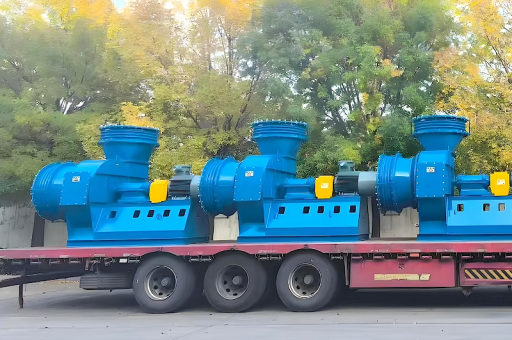
A centrifugal fan (also called a radial fan or blower) moves air by rotating an impeller inside a spiral casing. Unlike axial fans, centrifugal fans generate higher pressure, making them ideal for ducted exhaust systems that need to overcome resistance from filters, bends, and long runs.
- Low Noise refers to sound levels typically below 75 dB(A) at full load, achieved through precision-balanced impellers, optimized blade angles, and acoustic insulation.
- Speed relates to the rotational velocity of the impeller, measured in RPM. High-speed models deliver more airflow per unit size.
- Powerful indicates the fan's ability to generate high static pressure (often above 2000 Pa) while maintaining energy efficiency.
These three attributes are not mutually exclusive. For example, a backward-curved centrifugal fan with a premium motor can move 30,000 m³/h of air at 2800 RPM while producing only 72 dB of noise.
Key Technical Parameters: Noise, Speed, and Power
Noise Level (dB(A))
- Measured at 1 meter distance in free field conditions.
- For industrial settings, OSHA recommends exposure limits of 85 dB(A) over 8 hours. Low-noise fans (70–78 dB) help facilities stay compliant.
- Sources of noise: aerodynamic turbulence, mechanical vibration, and motor hum.
Rotational Speed (RPM)
- Directly influences airflow (Q) and static pressure (P). Doubling RPM roughly quadruples pressure (affinity laws).
- Modern fans use EC motors (electronically commutated) for variable speed control without efficiency loss.
Power Consumption (kW)
- A powerful fan does not mean wasteful. High-efficiency motors (IE4 or IE5 class) can reduce energy costs by 30% compared to older models.
- Example: A 7.5 kW backward-curved fan can replace a 11 kW forward-curved fan for the same duty.
Key Formula:
Airflow (m³/h) × Static Pressure (Pa) ÷ (Fan Efficiency × 3600) = Power Input (kW)
Design Features That Reduce Noise Without Sacrificing Power
Modern low noise speed powerful centrifugal fans incorporate several engineering refinements:
| Feature | Benefit |
|---|---|
| Backward-curved blades | Higher efficiency, lower turbulence noise |
| Acoustic foams and liners | Absorb mid-to-high frequency sounds |
| Vibration isolators | Reduce structure-borne noise |
| Aerodynamic inlet cones | Smooth air entry, reduce vortex noise |
| EC motors | Quieter operation, wider speed range |
Case in point: A facility using a forward-curved fan at 85 dB switched to a backward-curved fan with the same airflow and pressure, reducing noise to 74 dB while cutting power consumption by 18%.
Applications of High-Performance Industrial Exhaust Fans
These fans are indispensable in industries where both air quality and acoustic comfort matter:
- Chemical Processing: Exhaust corrosive vapors at high static pressure. Low-noise models reduce ambient noise in control rooms.
- Pharmaceutical Cleanrooms: Need precise airflow + low vibration to avoid contamination.
- Data Centers: Cooling servers while meeting strict noise ordinances (often < 70 dB at 1m).
- Food Processing: Removing steam, heat, and odors without disrupting production noise limits.
- Printing & Packaging: Extracting solvent fumes with spark-resistant construction.
Real-world example: A printing factory installed two low noise centrifugal exhaust fans rated at 25,000 m³/h and 2000 Pa. The noise dropped from 88 dB to 76 dB, and annual energy savings exceeded $4,200.
Common Myths vs. Facts About Centrifugal Fans
Myth 1: "Centrifugal fans are always louder than axial fans." Fact: At the same static pressure, centrifugal fans are often quieter because they run at lower blade tip speeds.
Myth 2: "Powerful fans must be bulky and noisy." Fact: With advanced blade profiling and EC motors, compact fans deliver high pressure at 70–75 dB.
Myth 3: "Low noise means lower performance." Fact: Many low-noise fans achieve the same or better efficiency due to improved aerodynamics.
Myth 4: "All industrial exhaust fans are the same." Fact: Fan design, motor class, and acoustic treatment vary hugely. A poorly selected fan can cost 3x more in energy and noise fines.
Frequently Asked Questions (FAQ)
Q1: What is the maximum noise level allowed in industrial environments using exhaust fans? A: OSHA recommends an 8-hour exposure limit of 85 dB(A). Many facilities target 75–78 dB for new installations. Local regulations may be stricter.
Q2: Can I reduce noise from an existing fan without replacing it? A: Yes. Install acoustic duct silencers, vibration isolators, or a variable frequency drive (VFD) to slow the fan when full speed is not needed.
Q3: What is the difference between forward-curved and backward-curved centrifugal fans for noise? A: Backward-curved blades generate less aerodynamic noise (5–10 dB lower) and offer higher efficiency. Forward-curved fans are cheaper but noisier and less efficient at high pressure.
Q4: How do I calculate the power needed for a low-noise industrial exhaust fan? A: Use: Power (kW) = (Airflow m³/s × Static Pressure Pa) ÷ (1000 × Fan Efficiency). For example: 8 m³/s × 1500 Pa ÷ (1000 × 0.75) = 16 kW. Then choose a fan with at least 18 kW motor capacity.
Q5: Are low-noise centrifugal fans more expensive? A: Initial cost may be 15–25% higher, but total cost of ownership (TCO) is lower due to energy savings and reduced noise mitigation expenses.
Conclusion: Choosing the Right Fan for Your Facility
Selecting the right low noise, speed, and powerful centrifugal fan for industrial exhaust applications is a decision that affects safety, productivity, and operational costs. Focus on three priorities:
- Match the fan curve to your system resistance – Oversized fans waste energy and increase noise.
- Choose backward-curved or airfoil designs for best acoustic performance.
- Invest in EC motors and VFDs – They allow speed optimization for variable loads.
Modern industrial exhaust fans no longer force you to choose between power and quiet operation. By understanding the interplay of blade design, motor technology, and acoustic engineering, you can create a ventilation system that protects both your workers and your bottom line.
If you need expert guidance on sizing, quotation, or retrofitting, contact a specialist who can analyze your ductwork, required static pressure, and noise budget. The right fan will last 15–20 years – make the choice count.





