
This article's table of contents introduction:
- Mechanical Design: The "Cooling" Strategies
- Material Selection (Critical)
- Specific Fan Types (Configurations)
- Key Features to Specify in Your Purchase Order
- Real-World Applications
- Critical Warning: Avoid Cheap Imports
This is a common requirement in industrial applications. Since your temperature limit is less than 600°C (1112°F), you are operating in the High-Temperature Range (between 250°C and 600°C) but below the Ultra-High/Extreme Range (which requires special alloys like Inconel and starts above 700°C).
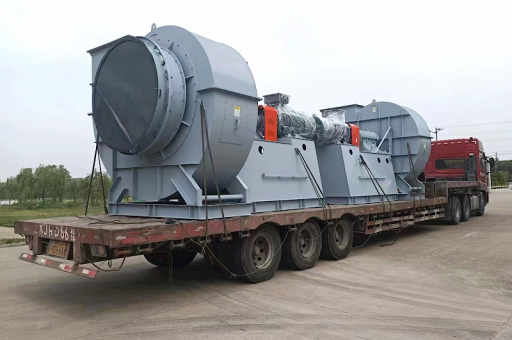
For this specific temperature range, you need Heavy-Duty Centrifugal Fans that utilize thermal barrier strategies and heavy-gauge materials.
Here is a detailed breakdown of the specific fan types, materials, and features you need.
Mechanical Design: The "Cooling" Strategies
Unlike standard fans which rely on ambient air to cool the bearing shaft, fans operating near 600°C require specific mechanical designs to protect the bearings and motor.
a) Shaft Cooling (Mandatory):
- Shaft Cooling Disc: A large, finned disc is mounted on the fan shaft between the housing and the bearing pedestal. This disc radiates heat away and blocks radiant heat from traveling along the shaft to the bearings.
- Cooling Fan (on the shaft): A small axial fan is mounted on the shaft behind the cooling disc. This blows ambient air directly onto the bearing housing.
b) Bearing Pedestal / Shaft Separator:
- The fan impeller should be mounted on a shaft extension that runs through a separator plate.
- Ventilated Pedestal: Air must be allowed to circulate between the impeller side and the bearing side.
c) Insulation Box / Lagging:
- The fan housing (volute) must be heavily insulated (e.g., rockwool or ceramic fiber mat) to:
- Protect personnel.
- Reduce heat transmission to the motor and structural supports.
- Lower the temperature rise of the air around the bearings.
Material Selection (Critical)
At 600°C, standard carbon steel will weaken significantly and scale (oxidize) rapidly.
| Component | Recommended Material | Why |
|---|---|---|
| Impeller (Wheel) | Stainless Steel 310S (UNS S31008) | Ideal. High creep strength, excellent oxidation resistance up to 1050°C. |
| Corten Steel (ASTM A606 / A588) | Acceptable for lower end of range (400-550°C); forms a protective oxide layer. | |
| Inconel 600 or 601 | Overkill, but provides maximum life. Use if fluctuations above 600°C are expected. | |
| Shaft | Alloy Steel (e.g., 4140) or Stainless Steel 416 | Requires high strength at temperature. Must be designed for thermal expansion. |
| Housing (Volute) | Mild Steel (with heavy insulation) or Stainless Steel 310S | The housing does not experience the same centrifugal stress as the wheel, so heavy-gauge mild steel works if insulated. 310S ensures longevity. |
| Fasteners | High-temperature alloy (e.g., A286, Inconel 718) | Standard bolts will gall and fail. |
Specific Fan Types (Configurations)
For 600°C, you generally have two main design philosophies:
Type A: Direct Drive with Extended Shaft (Preferred for reliability)
- The impeller is mounted on a long shaft, far away from the motor.
- A bearing pedestal (with high-temp grease or oil mist) supports the shaft close to the impeller.
- The motor is coupled to the shaft via a flexible coupling.
- Pros: Motor stays cool, easy to maintain, no belt slippage.
- Cons: Requires a strong base frame and shaft alignment.
Type B: Belt Drive with Cooling (For variable speed)
- The motor is mounted on a slide base away from the fan.
- The bearing pedestal is on the fan side.
- Pros: Easy to adjust fan speed via pulley changes.
- Cons: Belts degrade faster in ambient heat; requires a well-ventilated belt guard.
Type C: Plug Fans in a Plenum (For Ovens & Kilns)
- The impeller is mounted directly inside the hot ductwork or oven chamber.
- The motor and bearings are mounted on an air-cooled backplate outside the hot zone.
- Pros: Excellent for circulating hot air inside a chamber.
- Cons: Very specific to the ducting system.
Key Features to Specify in Your Purchase Order
When ordering for less than 600°C, you must request:
- "Heat Slinger" (Cooling Disc) on the shaft.
- Separator Plate between impeller and bearings.
- High-temperature grease (e.g., synthetic polyurea) for bearings.
- Shaft seal (labyrinth or carbon ring) to prevent hot gas leakage to bearings.
- Vibration monitors (accelerometers) on the bearing housing.
- Expansion joints on the ductwork to accommodate thermal growth of the fan housing.
Real-World Applications
These fans are commonly used for:
- Cement Kiln exhaust (secondary air).
- Biomass Boilers and Waste-to-Energy plants (flue gas recirculation).
- Industrial Ovens (powder coating, painting, drying).
- Glass Manufacturing (furnace draft).
- Steel Forging (fume extraction).
Critical Warning: Avoid Cheap Imports
Many standard "high-temp" fans are rated for 200-300°C. A fan truly rated for 600°C must have:
- A weld-in hub (not a pressed-on hub).
- A thick impeller backplate to prevent distortion.
- Explicit temperature derating curves for the materials used.
If you cannot confirm these, the impeller may warp or the blades may crack (stress rupture) at 600°C.
Would you like me to help you calculate the specific power (kW) or static pressure needed for your specific airflow (CFM/m³/h)?





