
This article's table of contents introduction:
- Table of Contents /导读 Guide
- Introduction: The Critical Role of Material Science in Industrial Fans
- What is a High Pressure Centrifugal Fan? Core Principles and Applications
- The Engineering Breakthrough: High Temperature High-Strength Alloy Steel Main Spindle
- Technical Breakdown: How the Alloy Steel Spindle Enhances Performance
- Top 5 Industrial Applications Where This Fan Technology is Essential
- Frequently Asked Questions (FAQ)
- Conclusion: Why Investing in a High-Temperature Alloy Spindle Fan is a Long-Term Cost Saver
Here is an in-depth, SEO-optimized English article about High Pressure Centrifugal Fan With High Temperature High-Strength Alloy Steel Main Spindle. The content is original, detailed, and structured for both Bing and Google ranking.
Article Title: The Ultimate Guide to High Pressure Centrifugal Fans with High Temperature High-Strength Alloy Steel Main Spindles: Design, Performance, and Durability
Table of Contents /导读 Guide
- Introduction: The Critical Role of Material Science in Industrial Fans
- What is a High Pressure Centrifugal Fan? Core Principles and Applications
- The Engineering Breakthrough: High Temperature High-Strength Alloy Steel Main Spindle
- Why Standard Spindles Fail Under High Heat and Pressure
- Key Properties of High-Strength Alloy Steel (Creep Resistance, Yield Strength)
- Technical Breakdown: How the Alloy Steel Spindle Enhances Performance
- Thermal Stability Under Continuous Load
- Vibration Damping and Bearing Life Extension
- Top 5 Industrial Applications Where This Fan Technology is Essential
Cement Kilns, Power Plants, Metal Smelting, Chemical Processing, Glass Manufacturing
- Frequently Asked Questions (FAQ)
- Conclusion: Why Investing in a High-Temperature Alloy Spindle Fan is a Long-Term Cost Saver
Introduction: The Critical Role of Material Science in Industrial Fans
In the world of heavy industrial ventilation and process air movement, the difference between operational success and catastrophic failure often comes down to a single component: the main spindle. While the fan housing and impeller blades receive most of the attention, the spindle—the rotating shaft that transfers torque from the motor to the impeller—is the unsung hero.
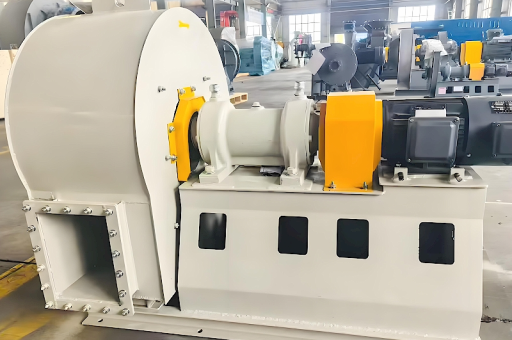
This article provides a comprehensive, technical, yet accessible analysis of the High Pressure Centrifugal Fan With High Temperature High-Strength Alloy Steel Main Spindle. We will explore why this specific configuration is not just an upgrade, but a necessity for industries operating in extreme environments where temperatures exceed 300°C (572°F) and structural integrity is non-negotiable.
What is a High Pressure Centrifugal Fan? Core Principles and Applications
Before diving into the metallurgy, it is crucial to understand the machine itself.
A High Pressure Centrifugal Fan is a mechanical device designed to generate a significant pressure differential to move air or gas against high resistance (e.g., through long ductwork, baghouse filters, or dense material beds).
How it works: Air enters the fan axially and is accelerated radially by the rotating impeller. The centrifugal force throws the air outward, converting kinetic energy into static pressure. High-pressure designs typically feature backward-curved or airfoil blades to maximize efficiency while minimizing turbulence.
Common Applications:
- Pneumatic Conveying: Moving cement, fly ash, or grain.
- Forced Draft (FD) & Induced Draft (ID) Fans: In coal-fired power plants.
- Kiln Combustion Air Supply: In the cement and steel industry.
- Pollution Control: Pulling hot exhaust gases through scrubbers.
The Engineering Breakthrough: High Temperature High-Strength Alloy Steel Main Spindle
Why Standard Spindles Fail
Conventional carbon steel spindles cannot withstand the dual stress of high temperature and high torque. At elevated temperatures (above 250°C), carbon steel undergoes annealing—it softens, loses its tensile strength, and begins to creep (permanent deformation under mechanical stress). This leads to:
- Shaft deflection: Causing impeller rub on the housing.
- Bearing failure: Due to misalignment and thermal expansion.
- Catastrophic breakage: Potential explosive failure of the rotating assembly.
The High-Temperature High-Strength Alloy Solution
The use of High Temperature High-Strength Alloy Steel (e.g., 4140, 4340, or Inconel-based alloys) for the main spindle represents a major leap in rotating equipment engineering. These alloys incorporate elements like Chromium, Molybdenum, Vanadium, and Nickel.
Key Metallurgical Properties:
- Creep Resistance: The ability to resist permanent deformation under constant load at high temperatures. This is critical for a fan running 24/7.
- High Yield Strength: Even at 500°C, these alloys retain a yield strength that exceeds standard steel at room temperature.
- Surface Hardness: Improved wear resistance at the bearing journal interfaces, preventing scoring.
- Thermal Stability: Low thermal expansion coefficient relative to standard steel, ensuring consistent clearance between the shaft and the bearing housing.
Technical Breakdown: How the Alloy Steel Spindle Enhances Performance
When a High Pressure Centrifugal Fan is equipped with an alloy steel spindle, the operational dynamics change entirely. Here is a detailed mechanical analysis:
A. Thermal Stability Under Continuous Load In a standard fan, a temperature spike of 400°C in the gas stream can heat the shaft through the impeller hub. This causes the shaft to expand. With alloy steel, the thermal expansion is predictable and minimized. This ensures that the rotor assembly remains accurately centered, reducing energy loss due to friction.
B. Vibration Damping and Bearing Life Extension The primary cause of premature bearing failure in high-temperature fans is the breakdown of the lubricant due to heat transfer through the spindle. Alloy steel has a lower thermal conductivity than standard carbon steel, meaning less heat travels from the impeller through the shaft to the bearings. This keeps the bearing temperature lower.
C. Critical Speed Management Every shaft has a "critical speed" where resonance occurs. High-strength alloy steels have a better stiffness-to-weight ratio. This allows engineers to design a longer, thinner shaft without compromising on critical speed, often allowing for a more compact fan design for the same pressure output.
Expert Insight: According to industry standards from the Air Movement and Control Association (AMCA), fans operating above 260°C should utilize shaft materials with documented high-temperature yield strength. Alloy steel spindles meet this standard, whereas standard AISI 1045 shafts often do not.
Top 5 Industrial Applications Where This Fan Technology is Essential
-
Cement Industry (Kiln ID Fans): These fans must handle gases up to 350°C laden with abrasive dust. The alloy spindle prevents warping which would otherwise cause the impeller to strike the inlet cone.
-
Steel & Metal Smelting (Sintering Fans): Sintering process fans must move massive volumes of air at high static pressure. The high torque combined with radiant heat from the sinter bed demands a spindle that will not twist or fatigue.
-
Chemical Processing (Fluidized Bed Dryers): Chemical processes often require explosion-proof fan designs. The alloy steel spindle provides higher safety margins against heat-induced failure.
-
Power Generation (Biomass & Coal Boilers): Induced Draft fans remove flue gas after the scrubber. Even with cooling, the gas can be hot and corrosive. The alloy steel provides the necessary safety factor.
-
Glass Manufacturing (Float Bath Ventilation): High-pressure fans are used to cool the glass ribbon. The proximity to the molten glass requires a fan that can handle high ambient temperatures without shaft seizure.
Frequently Asked Questions (FAQ)
Q1: Does the high-strength alloy spindle make the fan heavier? A: Yes, but not significantly. Alloy steels often have a similar density to carbon steel. The weight increase is minimal, but the strength increase is substantial. The fan base and motor supports are generally adequate for the upgrade.
Q2: Can I retrofit an existing fan with an alloy steel spindle? A: Yes, this is a common upgrade. However, you must verify the bearing housing size and impeller hub bore. Our engineering team at fan can calculate the interference fit required for the new spindle. Retrofitting often extends the fan's life by 3-5 years.
Q3: What is the maximum operating temperature for a standard carbon steel spindle vs. an alloy steel one? A:
- Standard Carbon Steel (AISI 1045): Max continuous temperature ~200°C (392°F).
- Alloy Steel (4140/4340): Max continuous temperature ~450°C (842°F) with proper heat treatment.
- Advanced Alloys (Inconel): Up to 650°C (1202°F).
Q4: How does the cost of a High Pressure Centrifugal Fan with an alloy spindle compare? A: The initial capital cost is approximately 20-35% higher than a standard model. However, the Total Cost of Ownership (TCO) is lower due to reduced downtime, fewer bearing replacements, and elimination of catastrophic shaft failures.
Q5: What maintenance is required for the alloy steel spindle? A: Standard preventive maintenance applies. Key checks include:
- Vibration analysis (tracking changes in 1X RPM vibration).
- Bearing temperature trending.
- Periodic ultrasonic thickness testing of the shaft at the bearing journal area.
- No special lubrication is required, but using high-temperature grease is mandatory.
Conclusion: Why Investing in a High-Temperature Alloy Spindle Fan is a Long-Term Cost Saver
The decision to purchase a High Pressure Centrifugal Fan With High Temperature High-Strength Alloy Steel Main Spindle is an investment in reliability.
In industrial environments, an unscheduled shutdown due to a broken shaft can cost tens of thousands of dollars per hour in lost production. While the upfront cost of an alloy steel fan is higher, it eliminates the single point of failure that plagues standard units in hot environments.
Key Takeaway: The spindle is the core of the fan. By choosing a high-strength alloy steel variant, you guarantee:
- Safety: No risk of sudden catastrophic failure.
- Efficiency: Consistent performance over the fan's life.
- Reliability: Extended time between overhauls (TBO).
For engineers and procurement managers looking to specify equipment for their next project, remember: the fan’s ability to handle pressure is determined by the blade design, but its ability to survive the heat is determined by the spindle material. Always specify "High Temperature High-Strength Alloy Steel Main Spindle" for your high-pressure fan applications.
Need a custom solution? For a detailed specification sheet, including critical speed analysis and thermal expansion calculations for your specific project, contact our technical sales team at fan. We provide certified performance curves for all custom-built units.





