
This article's table of contents introduction:
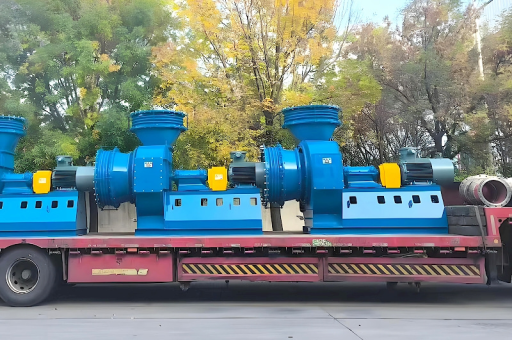
- Deconstructing Your Request
- What a "Flat Performance Curve" Actually Means (And Why It's Hard)
- Typical Design Solutions for This Specification
- Key Customization Parameters (What the Manufacturer Needs)
- Example of a Suitable Commercial Product Line
- Potential Problems and Mitigation
- Final Recommendation
This is a highly specific equipment request that sits at the intersection of industrial ventilation, aerodynamic design, and custom manufacturing.
To provide a useful response, I will break down what this request actually means technically, the engineering challenges involved, and how a manufacturer would typically address it.
Deconstructing Your Request
- High Pressure: Typically > 2,000 Pa (200 mmWG) and often up to 5,000-10,000 Pa (500-1000 mmWG). This rules out standard HVAC fans.
- Forced Ventilation: Implies the fan is pushing air into a system (e.g., a duct, furnace, or pressurized room) against resistance, rather than just extracting.
- Customized: The housing, impeller diameter, inlet/outlet orientation, motor mount, and coatings will be made to your specific site dimensions or process conditions (e.g., high temperature, corrosive gas, explosive environment).
- Centrifugal Fan: Air enters axially and exits radially.
- Flat Performance Curve: This is the most critical and challenging specification.
What a "Flat Performance Curve" Actually Means (And Why It's Hard)
A "flat curve" (technically known as a steep pressure characteristic or non-overloading curve) means:
- As the flow rate (CFM/m³/h) changes (e.g., due to a clogged filter or blocked duct), the pressure (Static Pressure) changes very little.
- The Benefit: The fan does not "overload" the motor. If the system resistance drops unexpectedly, a fan with a steep curve will draw significantly more current and potentially burn out the motor. A flat curve fan will see a moderate flow increase but the power draw stays relatively stable.
- The Challenge: Most high-pressure centrifugal fans (like Radial or Paddle Wheel designs) have a steep curve (high pressure sensitivity). Backward Curved or Airfoil blades usually have a flat power curve, but often struggle to generate true "High Pressure" (above 10 kPa).
The Solution: The manufacturer must design an impeller that is a Backward Inclined (BI) or Backward Curved (BC) design, but with specialized blade geometry (thicker airfoils or modified angles) to generate the required high pressure while maintaining the non-overloading power characteristic.
Typical Design Solutions for This Specification
To achieve a customized high-pressure fan with a flat curve, a manufacturer will likely choose one of the following impeller types:
| Impeller Type | Shape | Pressure Capability | Curve Shape | Best For |
|---|---|---|---|---|
| Backward Inclined (BI) | Flat blades tilted away from rotation | Medium-High (up to ~5 kPa) | Flat (Non-overloading) | Clean air, dust-free, high efficiency. |
| Backward Curved (BC) | Curved blades away from rotation | High (5-15 kPa) | Very Flat | High efficiency, medium pressure. |
| Airfoil (AF) | Hollow, wing-shaped blades | Medium-High | Extremely Flat | Highest efficiency, clean air only. |
| Radial (R) / Paddle Wheel | Straight blades | Very High (>20 kPa) | Steep (Overloading) | High pressure, dirty air, material handling. |
Conclusion: For your request (High Pressure + Flat Curve), a customized Backward Curved (BC) or High-Pressure Airfoil design is the most likely candidate. A standard Radial fan will not give you a flat curve.
Key Customization Parameters (What the Manufacturer Needs)
To build this, you must specify the Operating Point exactly. A "flat curve" is defined by a range.
You must provide:
- Airflow (Q): e.g., 10,000 m³/h (5,800 CFM)
- Static Pressure (SP): e.g., 3,500 Pa (14 inWG)
- Gas Type: Air, or specific gas (e.g., methane, corrosive H2S, high-temp exhaust). (Critical for material selection and explosion-proof rating).
- Temperature: Ambient, or up to 200°C / 400°C / 600°C.
- Dust Load: Is the air clean (<1 mg/m³), moderate (1-10 mg/m³), or heavy ( > 10 mg/m³)?
- System Curve: Do you need the curve to be flat from 0-100% flow, or just at your specific operating point?
Typical Customization Options:
- Housing: Scroll width, inlet cone size, discharge angle (Top Horizontal, Down Blast, etc.).
- Materials: Carbon Steel (painted), Stainless Steel 304/316, Corten, Inconel (for high heat).
- Coating: Epoxy, Zinc-rich, or Rubber lining for corrosion.
- Drive: Direct Drive (motor on shaft) for speed control, or Belt Drive for speed flexibility.
- ATEX / IECEx: Explosion-proof construction for hazardous areas (e.g., Zone 1 or Zone 2 gas groups).
Example of a Suitable Commercial Product Line
If you were to contact a manufacturer (e.g., Greenheck, Howden, New York Blower, Cincinnati Fan, or a specialized Chinese OEM like Zibo Longquan or Shanghai Vortex), you would ask for modifications to a specific series.
- Request: "I need a custom BC (Backward Curved) fan, typically from a series like 'BCF' or 'BSI-BC', but with the following modifications: [List pressure and flow]. I require a flat performance curve with a non-overloading power characteristic up to the wide-open volume."
Potential Problems and Mitigation
- Surge Margin: A very flat curve can be difficult to control. At low flow (near shut-off), the fan might enter "surge" (unstable flow reversal). The manufacturer should provide a system curve analysis to ensure your system resistance never dips into the surge zone.
- Impeller Weight: High-pressure BC fans require strong, heavy impellers. This demands high-quality dynamic balancing (ISO 1940 G2.5 or G1.0).
- Horsepower: A flat curve means the motor is safe, but you still need to correctly size the motor for the peak power demand, even if that occurs at a different flow point.
Final Recommendation
Do not buy a standard "High Pressure" fan off the shelf. They almost always have a steep curve.
- Define your "System Resistance Curve" – this is the pressure drop at different flow rates for your actual duct/filter setup.
- Contact a manufacturer specializing in Centrifugal Fans with Backward Curved Blades and specify that you need a "Class II" or "Class III" construction (heavy-duty).
- Ask for a performance curve showing the Power (kW) curve. Ensure the power curve is descending as flow increases (the definition of a flat/non-overloading curve).
If you can provide the specific Flow (m³/h or CFM) and Pressure (Pa or inWG) you need, I can help you calculate the likely impeller diameter (mm) and motor power (kW) required for a typical custom BC fan.





