
This article's table of contents introduction:
- Core Design & Configuration
- Key Operational Parameters
- Applications
- Critical Considerations for Sizing & Selection
- Typical Large Flow Models
- Sizing Example
- Maintenance & Troubleshooting
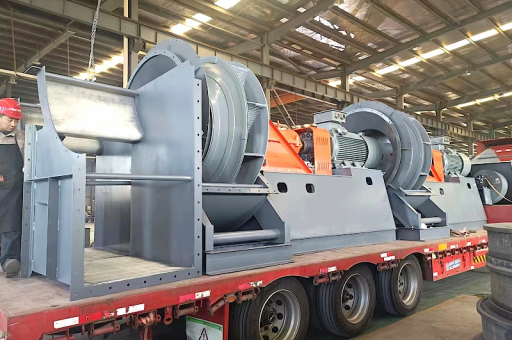
Here is a comprehensive overview of Large Flow Centrifugal Fans designed for operation with clean air and material transportation.
This type of fan bridges the gap between standard HVAC fans (clean air only) and heavy-duty industrial fans (high dust loading). It is engineered for high volume, moderate pressure, and the ability to handle entrained particulate without clogging or excessive wear.
Core Design & Configuration
The key differentiator is the impeller design. For clean air and material transport, the impeller must be robust enough to withstand particle impact while still being aerodynamically efficient.
-
Impeller Type:
- Backward Inclined (BI) / Backward Curved (BC): Ideal for large flow, high efficiency, and clean air. Not suitable for material transport as the curved blades trap material.
- Radial (Paddle Wheel / RIM): The standard for material transport. Straight radial blades (often reinforced). Advantages: Non-clogging, handle large particles, robust. Disadvantages: Lower efficiency, higher noise.
- Radial Tip (RT): A compromise. Flatter blades than BC but curved at the tip. Offers better efficiency than pure radial while still handling moderate particulate loads (e.g., wood chips, light dust).
- Airfoil (AF): Highest efficiency for clean air. Never used for material transport.
-
Housing:
- Scroll / Volute: Standard centrifugal design to convert velocity to pressure.
- Lined Housing: For abrasive materials (sand, cement), the housing and impeller backplate can be lined with replaceable wear plates (hardox, ceramic tile, or rubber lining).
-
Construction:
- Steel: Common for clean air (e.g., CQ steel or Galvanized).
- Hardox / AR Steel: For abrasive material transport.
- Stainless Steel: For corrosive fumes or food-grade material transport (e.g., grain, plastic pellets).
- Aluminum: Lightweight, spark-resistant for volatile environments.
Key Operational Parameters
| Parameter | Clean Air Operation | Material Transportation |
|---|---|---|
| Flow Rate (CFM/m³/hr) | Very high (e.g., 50,000+ CFM) | High, but lower than clean air due to loading |
| Static Pressure (in. wg / Pa) | Low to Medium (5" - 15" wg) | Higher (10" - 30"+ wg) to overcome airlock friction |
| Loading (Ratio) | 0% | 1:1 to 20:1 (air-to-material ratio by weight) |
| Efficiency | 70-85% (Optimal) | 50-70% (Lower due to impeller resistance) |
| Speed (RPM) | Moderate (e.g., 800-1800 RPM for large fans) | Higher to maintain velocity & avoid settling |
Applications
These fans are critical in many industries:
Clean Air (Large Volume):
- Dust Collection Systems: Primary baghouse or cartridge filter exhaust.
- HVAC: Large commercial/industrial building ventilation (e.g., stadiums, factories).
- Process Air: Drying ovens, cooling towers, paint spray booth exhaust.
- Mining: Main mine ventilation (air circulation, no material).
Material Transportation (Pneumatic Conveying):
- Dilute Phase Conveying: Moving lightweight, non-abrasive materials like:
- Agriculture: Grains (corn, wheat, soybeans), pellets, seeds.
- Plastics: Pellets, regrind, powder (using SS or polished impellers).
- Wood: Sawdust, wood chips, shavings, MDF dust.
- Paper: Trim, scraps, shredded paper.
- Recycling: Shredded plastic, cardboard, aluminum cans (via cyclone eductors).
Critical Considerations for Sizing & Selection
-
Material Properties:
- Abrasive? (Sand, cement) → Radial wheel + Hardox lining + replaceable wear strips.
- Hygroscopic? (Sugar, salt) → SS with drain plugs, avoid dead spots.
- Combustible/Dust Explosion? (Grain, coal, metal powders) → SS/Aluminum, spark-resistant construction, explosion-proof motor, shaft grounding, ATEX certification.
-
System Velocity:
- Transport Velocity: Must exceed the "saltation velocity" (speed at which particles drop out of the airstream). For heavy materials, this can be 5,000 - 6,500 FPM.
- Fan Inlet: Fan inlet must be sized to avoid vortex or starvation.
-
Fan Location:
- Pressure Fan (Blower): Fan is before the material pick-up point. Good for light materials. Handles clean air until the pick-up.
- Vacuum Fan (Exhauster): Fan is after the separator (cyclone/filter). Material passes through the fan. This is the most common for heavy material transport. The fan must be designed for high wear.
- Pull-Through: Fan is after the filter (cleanest air, longest fan life).
-
Airlock:
- CRITICAL: A rotary airlock (star feeder) or drop-thru valve is required at the inlet of a material-handling fan (or at the cyclone outlet) to prevent massive air loss and maintain system pressure.
Typical Large Flow Models
Popular industrial manufacturers for this service include:
- New York Blower (NYB): General purpose HD radial fans. (Series 20, 30, 60).
- Chicago Blower: High-pressure, large-volume material handling fans.
- Howden / TLT-Babcock: Heavy industrial (mining, cement, steel).
- Greenheck: BIDW (Backward Inclined Double Width) for clean air; SPI, SPM for material handling.
- Cincinnati Fan: Top 29 (utility) / HP (material handling).
Sizing Example
Scenario: Pneumatic conveying of wood chips (100 lbs/cu.ft bulk density) at 20 tons/hour.
- Flow required: ~10,000 CFM (to maintain 5,000 FPM in 16" duct).
- Static Pressure: 20" wg (high due to friction from dense phase conveying).
- Fan Wheel: 48" diameter, Radial (paddle wheel) design.
- Power: 100-150 HP (due to high pressure, lower efficiency).
- Drive: V-belt or direct drive (VFD for volume control).
- Construction: Heavy gauge steel (0.1875" - 0.25" wheel), possible AR plate.
Maintenance & Troubleshooting
| Issue | Clean Air Fan | Material Transport Fan |
|---|---|---|
| Wear | Low (mainly bearings) | High (blade tips, housing at cut-off, backplate) |
| Balance | Stable | Degrades due to uneven wear/material buildup |
| Buildup | Low | High (sticky materials create imbalance) |
| Noise | Lower (BC/AF blades) | Higher (Radial blades, turbulent flow) |
Conclusion: A Large Flow Centrifugal Fan for clean air and material transport is typically a Radial (paddle wheel) or Radial Tip fan with an oversized shaft, heavy bearings, and a heavy-duty housing. For pure clean air applications, a Backward Inclined design is far more efficient. The selection comes down to balancing efficiency (clean air) vs. robustness (material transport). For any material handling, always add wear protection and oversize by 10-15% to account for wear and performance degradation over time.





