
This article's table of contents introduction:
- Breakdown of the Key Terms
- Key Design Characteristics & Components
- Typical Applications
- Comparison with Other Fan Types
- Summary
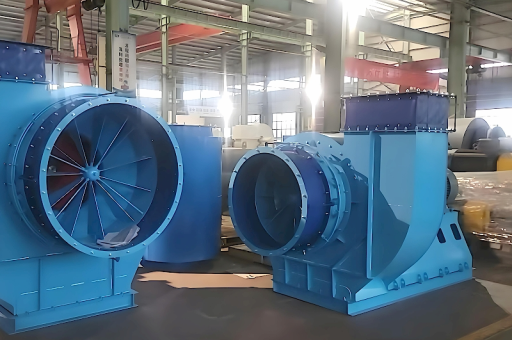
This is a very specific and high-performance product specification. Here is a detailed breakdown of what "Large Flow, Low Noise, High Efficiency Belt Drive Centrifugal Fan" means, the key design considerations, and typical applications.
Breakdown of the Key Terms
-
Belt Drive Centrifugal Fan:
- How it works: The fan wheel (impeller) is not connected directly to the motor shaft. Instead, a belt and pulley system transmits power from the motor to the fan.
- Advantages:
- Speed Control: You can change the fan's speed (RPM) by changing the pulley size ratio. This allows for precise adjustment of airflow (Flow) and pressure.
- Motor Protection: The belt can slip slightly, acting as a fuse to protect the motor from sudden jams or overloads. It also dampens vibration transmission from the motor.
- Motor Placement: The motor can be mounted in a more convenient location (e.g., outside the airstream for cooling or in a less obstructive spot).
- Disadvantages: Less efficient than direct drive due to belt friction. Requires more maintenance (belt tensioning, replacement). Takes up more space.
-
Centrifugal Fan (Radial Fan):
- Airflow Path: Air enters the impeller axially (parallel to the shaft) and is expelled radially (perpendicular to the shaft) by centrifugal force.
- Characteristics: Generates higher pressure than axial fans. The air flow is more directional (typically out of a scroll housing).
-
Large Flow:
- Definition: Refers to the volume of air moved per unit of time (e.g., CFM - Cubic Feet per Minute, or m³/h - Cubic Meters per Hour).
- Design for Large Flow: The fan is physically large, with a wide impeller and a large inlet area. The scroll housing is also designed with a large cross-section to minimize air velocity and pressure loss.
-
Low Noise:
- Source of Noise: In centrifugal fans, noise primarily comes from turbulence (vortex shedding), mechanical vibration (imbalance, bearing noise), and airflow over the blades and housing.
- Design for Low Noise:
- Blade Design: Uses backward-curved (backward-inclined) or airfoil blades. These are inherently quieter than forward-curved or radial blades because airflow is smoother and separation is reduced.
- Housing Design: The scroll housing is designed with a smooth, continuous profile to minimize pressure pulsations.
- Vibration Isolation: The fan is mounted on vibration dampeners (springs or rubber isolators).
- Belt Drive: The belt itself acts as a vibration damper between the motor and the impeller, reducing noise from motor vibration.
- Bearing Quality: Uses high-quality, low-noise bearings (e.g., precision ball bearings).
- Speed: Lower rotational speed (RPM) is directly correlated with lower noise. Large flow is achieved through impeller diameter and width, not necessarily high RPM.
-
High Efficiency:
- Definition: The ratio of useful air power output to the mechanical power input (motor power).
- Design for High Efficiency:
- Blade Profile: Airfoil blades are the most efficient, followed by backward-curved blades. They have lower aerodynamic drag and convert more input power into airflow.
- Precision Engineering: Tight tolerances between the impeller inlet and the housing inlet (inlet cone) to minimize recirculation losses.
- Belt Drive Efficiency: While a belt drive is less efficient than a direct drive, modern synchronous belts (toothed belts) are more efficient than older V-belts. Proper belt tension is critical.
- Motor Efficiency: Uses a high-efficiency motor (e.g., IE3, IE4, NEMA Premium).
- System Design: The fan is designed to operate at its Best Efficiency Point (BEP) for the given application.
Key Design Characteristics & Components
| Component | Design Feature for Target Performance |
|---|---|
| Impeller | - Type: Backward-curved (BC) or Airfoil (AF) blades. - Material: High-strength steel, aluminum, or composite (for lighter weight and reduced inertia). - Construction: Welded, riveted, or one-piece construction for precise balance. |
| Housing | - Scroll: Optimized geometry for smooth air acceleration and minimal turbulence. - Material: Heavy-gauge steel for stiffness and damping. - Inlet Cone: Precisely machined to match the impeller inlet for minimal recirculation. |
| Drive System | - Pulleys: Adjustable (variable pitch) or fixed pitch. - Belt: Synchronous (timing) belt for higher efficiency and lower noise, or V-belt for standard applications. - Tensioning: Automatic belt tensioner or manual adjustment for consistent performance. |
| Bearings | - Type: High-quality, self-aligning ball bearings or spherical roller bearings. - Lubrication: Sealed for life or regreasable for long service intervals. |
| Motor | - Type: NEMA or IEC standard, high-efficiency (IE3/IE4). - Mounting: Base mounted or C-face to the fan base. |
| Base/Frame | - Construction: Rigid, heavy-duty steel base with vibration isolation mounts. |
| Inlet/Outlet | - Inlet: Typically a bell-mouth to reduce air entry losses. - Outlet: Flanged for easy duct connection. |
Typical Applications
These fans are ideal for HVAC, industrial, and commercial applications where high volume, quiet operation, and energy efficiency are critical.
- Commercial HVAC: Large office buildings, hospitals, schools, convention centers (air handling units, exhaust systems).
- Industrial Ventilation: Factories, warehouses, cleanrooms, paint booths, fume extraction.
- Process Air: Drying systems, pneumatic conveying, material handling.
- Data Centers: Cooling large server rooms (requires very high reliability and efficiency).
- Mining & Tunnels: Ventilation in tunnels and underground mines.
- Agriculture: Ventilation for large poultry houses, pig barns, greenhouses (requires high volume at low pressure).
Comparison with Other Fan Types
| Feature | Large Flow, Low Noise, High Efficiency Belt Drive Centrifugal | Direct Drive Centrifugal | Forward Curved Centrifugal (Squirrel Cage) | Axial Fan |
|---|---|---|---|---|
| Flow | High | Medium-High | High | Very High |
| Pressure | Medium-High | Medium | Low-Medium | Low |
| Efficiency | Highest | High (no belt loss) | Lower | Moderate |
| Noise | Lowest | Low | Lower | Higher (can be very high) |
| Speed Control | Excellent (via pulley change) | Limited (motor speed control) | Limited | Limited (VFD on motor) |
| Cost | Higher initial + maintenance | Higher initial + lower maintenance | Lower | Lowest |
| Maintenance | Higher (belt, tensioning) | Lower (bearings only) | Low | Low |
Summary
A Large Flow, Low Noise, High Efficiency Belt Drive Centrifugal Fan is a high-end, performance-optimized system designed for demanding applications. The key to its performance is the use of a backward-curved or airfoil impeller, a precisely designed scroll housing, high-quality bearings and motor, and a belt drive system that allows for perfect speed tuning. It is the go-to choice when you need to move a lot of air quietly and efficiently, even against moderate resistance, and you have the budget for the initial cost and ongoing maintenance.





