
This article's table of contents introduction:
- Key Specifications Summary (Typical for this model)
- Why is this fan specific to Aluminum?
- Common Issues / Maintenance:
- Are you looking for:
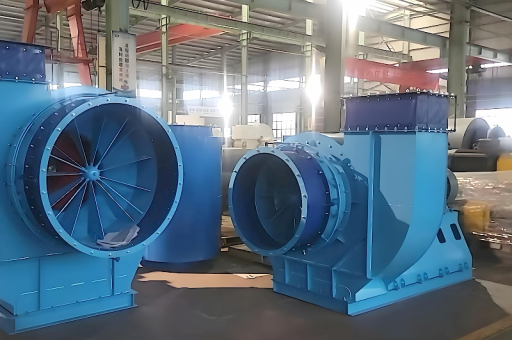
It appears you are referencing specifications for a specific industrial fan model, likely used in aluminum smelting or other high-heat metallurgical processes. Here is the breakdown of the specifications you listed, along with their typical meaning and application.
Model: 5-55-12.5C (or 5-55-12.5C)
- 5-55: This is the fan series/type. It typically refers to a high-temperature, centrifugal fan designed for heavy industrial use with backward-inclined blades (efficiency-oriented).
- 5: This is the impeller diameter in decimeters. 12.5 decimeters = 1250 mm (approx. 49 inches).
- C: This indicates the drive arrangement. "C" type usually means the impeller is overhung and driven by a belt drive (pulleys and belts) from an external motor, rather than direct drive. This allows for speed adjustments.
Motor: 110 kW (approx. 147 HP)
- This is the motor power. For a fan this size, this is a high-power, heavy-duty motor (likely 6-pole or 8-pole, 3-phase, 380V/660V or similar industrial voltage).
Performance: 68,000 Air Volume
- This is the airflow capacity, almost certainly measured in m³/h (cubic meters per hour).
- 68,000 m³/h is a very large volume, typical for:
- Electrolytic cell fume extraction in aluminum smelters (capturing fluoride gases and heat).
- Flue gas desulfurization (FGD) or dust collection systems.
- Large-scale furnace ventilation.
Special Feature: "Electrolytic Aluminum High Temperature" This is the critical application. In aluminum production (Hall-Héroult process):
- Gas: The fan handles hot, corrosive gas containing HF (hydrogen fluoride), SO₂, CO₂, and alumina dust.
- Temperature: The casing and impeller must be built to withstand 200°C to 350°C (or higher) continuously.
- Material: The impeller is typically made of high-strength, corrosion-resistant alloy steel (e.g., 16Mn or stainless steel for critical parts). The shaft is usually 40Cr (Chromium alloy) or similar.
- Key Design Feature: The fan must have a water-cooled bearing housing (cooling fan or water jacket on the shaft) to prevent heat transfer from the hot shaft to the bearings.
Key Specifications Summary (Typical for this model)
| Parameter | Value | Notes |
|---|---|---|
| Model | 5-55-12.5C | High-temp centrifugal |
| Power | 110 kW | Motor rating |
| Air Volume | 68,000 m³/h | At operating point |
| Pressure | Not listed | Likely 2000–3500 Pa range (medium pressure) |
| Speed | Not listed | Typically 730–960 RPM (belt-driven) |
| Temperature | >250°C | Requires heat-resistant bearings & seals |
| Material | Steel / Alloy | Corrosion-resistant for fluoride gas |
Why is this fan specific to Aluminum?
- High Temperature: The exhaust from the electrolytic pots (750-960°C) is cooled to ~150-300°C before the fan, but it is still much hotter than standard fans.
- Corrosion: The HF gas attacks standard carbon steel. The fan must be coated (e.g., with epoxy/phenolic) or made from stainless steel.
- Spark Resistance: The impeller is often made of aluminum alloy or non-ferrous material to prevent sparks if it rubs against the casing (important for combustible gas mixtures).
Common Issues / Maintenance:
- Bearing failure due to heat soaking if the cooling system fails.
- Impeller erosion from alumina dust (requires hardfacing or ceramic lining).
- Unbalance from dust buildup (requires regular cleaning of the impeller blades).
Are you looking for:
- A replacement fan with these specs?
- Technical data (fan curve, pressure, speed)?
- Installation/operation guidance (e.g., how to start this up safely)?
- A quote or a drawing?
Please let me know what specific action or information you need regarding this "5-55-12.5C" fan, and I can provide more targeted help.





