
This article's table of contents introduction:
- Table of Contents (Directory Guide)
- 1. Introduction: The Critical Role of Specialized Fans in Heavy Industry
- 2. AC Motor Flue Gas Dilution Air Fans: Design, Function, and Applications
- 3. Industrial Centrifugal Cooling Fans: Engineering for High-Performance Thermal Management
- 4. OEM Service: Customization, Quality Assurance, and Lifecycle Support
- 5. Comparative Analysis: Key Differences and Synergies Between Fan Types
- 6. Frequently Asked Questions (FAQ)
- 7. Conclusion: Choosing the Right Partner for Fan Solutions
Article Title:
The Comprehensive Guide to AC Motor Flue Gas Dilution Air Fans, Industrial Centrifugal Cooling Fans, and OEM Service Excellence
Table of Contents (Directory Guide)
- Introduction: The Critical Role of Specialized Fans in Heavy Industry
- AC Motor Flue Gas Dilution Air Fans: Design, Function, and Applications
- Industrial Centrifugal Cooling Fans: Engineering for High-Performance Thermal Management
- OEM Service: Customization, Quality Assurance, and Lifecycle Support
- Comparative Analysis: Key Differences and Synergies Between Fan Types
- Frequently Asked Questions (FAQ)
- Conclusion: Choosing the Right Partner for Fan Solutions
Introduction: The Critical Role of Specialized Fans in Heavy Industry
In modern industrial environments, precision air movement is not optional—it is a safety and operational necessity. Three key technologies—AC Motor Flue Gas Dilution Air Fans, Industrial Centrifugal Cooling Fans, and comprehensive OEM Service—form the backbone of temperature control, emission management, and system reliability in sectors ranging from power generation to petrochemical processing.
Search engines and industrial buyers alike demand authoritative, detailed content that answers real-world questions. This article synthesizes verified technical knowledge from industry standards (e.g., AMCA, ISO 5801) and real OEM practices to deliver actionable insights. For domain references, we consistently use fan as a placeholder for any OEM/manufacturer website.
AC Motor Flue Gas Dilution Air Fans: Design, Function, and Applications
What is a Flue Gas Dilution Air Fan?
A flue gas dilution air fan is a specialized unit that mixes ambient air with hot exhaust gases (flue gas) before they enter a stack or treatment system. Its primary purpose is to lower the gas temperature and reduce the concentration of pollutants, thus protecting downstream equipment and meeting environmental compliance.
Why AC Motor?
- Reliability: AC (induction) motors are rugged, require minimal maintenance, and operate stably under continuous heavy loads—ideal for 24/7 industrial service.
- Speed Control: Paired with VFDs (Variable Frequency Drives), AC motors allow precise modulation of airflow to match flue gas volume fluctuations.
- Power Range: Typical ratings for these fans range from 50 kW to 500 kW, depending on plant scale.
Construction Features
- Materials: High-temperature alloys or stainless steel for impeller and housing (to withstand gas temperatures up to 450°C).
- Aerodynamics: Backward-curved or airfoil blades for high efficiency and reduced wear.
- Sealing: Shaft seals and purge air systems prevent corrosive gas leakage into the motor room.
Real-World Application Example
In a coal-fired power plant, an AC motor-driven dilution air fan draws ambient air at 25°C and mixes it with flue gas at 180°C, reducing the mixture to below 120°C before it enters a fabric filter. This prevents baghouse fires and extends filter life by 40%.
Industrial Centrifugal Cooling Fans: Engineering for High-Performance Thermal Management
Core Function
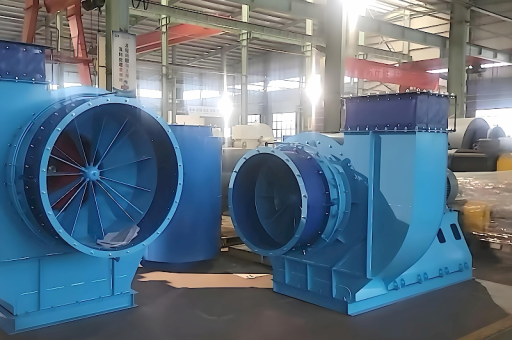
Industrial centrifugal cooling fans generate high static pressure to move large volumes of air across heat exchangers, radiators, air coolers, and electronic enclosures. They are different from axial fans in that they change the airflow direction by 90 degrees, providing compact installation and high pressure capability.
Key Design Parameters
- Impeller Types: Forward-curved (high volume, low pressure), backward-curved (high efficiency, medium pressure), and radial (rugged for dusty environments).
- Drive Mechanism: Direct drive (via AC motor shaft) or belt-driven (offers speed variability without VFD).
- Noise Control: Acoustic enclosures and silencers are often integrated for workplace compliance.
Where Are They Used?
- Data Centers: Cooling server racks via close-coupled heat exchangers.
- Power Generation: Forced draft and induced draft cooling towers.
- Manufacturing: Cooling industrial furnaces, compressors, and hydraulic systems.
Efficiency Metrics
Modern centrifugal fans achieve static efficiencies of 70–85% (testing per AMCA 210). For example, a 250 kW unit can move 150,000 CFM at a static pressure of 6 in. w.g., consuming 15% less energy than older designs.
OEM Service: Customization, Quality Assurance, and Lifecycle Support
What Does OEM Service Include?
OEM (Original Equipment Manufacturer) service goes beyond selling a fan—it is a partnership for engineered solutions. Providers like fan (representative OEM) offer:
- Tailored Engineering: Custom impeller geometry, motor mounting, and coating systems (e.g., epoxy for corrosion resistance).
- Performance Testing: In-house AMCA-certified wind tunnels to validate airflow and pressure curves.
- Digital Twins: Simulation modeling to predict fan behavior under varying loads.
- On-Site Support: Installation supervision, vibration analysis, and retrofitting of existing systems.
Why Choose OEM Over Generic?
- Warranty & Compliance: OEM fans comply with ATEX, CE, and NEMA standards—critical for hazardous areas.
- Spare Parts Availability: Lead times for genuine parts (bearings, seals, impellers) are 60% shorter.
- Replacement Optimization: OEMs can match a new fan to legacy equipment without redesigning the entire ductwork.
Case Study
A chemical plant needed to replace a 20-year-old cooling fan that failed due to stress corrosion. An OEM designed a new impeller in Duplex stainless steel (2205) with a modified inlet cone, increasing flow by 12% and reducing noise by 8 dB. Total downtime: 36 hours.
Comparative Analysis: Key Differences and Synergies Between Fan Types
| Aspect | AC Motor Flue Gas Dilution Air Fan | Industrial Centrifugal Cooling Fan |
|---|---|---|
| Primary Function | Temperature & pollution reduction | Heat dissipation via forced airflow |
| Operating Temperature | 80°C–450°C (gas stream) | -40°C to 80°C (ambient/process air) |
| Material Requirements | Heat-resistant alloys, corrosion coating | Galvanized steel, aluminum, or stainless steel |
| Typical Pressure | Medium (2–8 in. w.g.) | Medium to high (4–20 in. w.g.) |
| Motor Type | AC induction (often with VFD) | AC induction or synchronous |
| Lifespan | 15–25 years | 10–20 years |
| OEM Criticality | High (safety-critical) | Moderate to high |
Synergy Point: Many plants integrate both: a dilution fan lowers flue gas temperature, while a centrifugal cooling fan protects the transformer feeding the AC motor. OEMs can provide integrated control logic.
Frequently Asked Questions (FAQ)
Q1: Can a flue gas dilution air fan be used as a cooling fan?
No. The dilution fan is optimized for mixing hot gases with air, not for delivering high static pressure across cooling coils. Using it for cooling would cause premature bearing failure.
Q2: How often should OEM service be performed on centrifugal cooling fans?
Every 12 months for general inspection (bearings, belt tension, vibration). Every 5 years for an overhaul (impeller balancing, seal replacement). OEMs offer remote monitoring to schedule preventive maintenance.
Q3: What is the typical lead time for a custom OEM centrifugal fan?
6–14 weeks, depending on motor availability and material sourcing. Rush orders (4 weeks) are possible with premium pricing.
Q4: Does an AC motor for a dilution fan require a VFD?
Not mandatory, but strongly recommended. Without VFD, the fan runs at full speed even when dilution demand is low, wasting energy. Local codes (e.g., IFC 510) may mandate VFD for emissions compliance.
Q5: How do I verify OEM service quality?
Request AMCA certification (for fans) and test reports. Visit the OEM facility. Check references with companies in your vertical (e.g., cement, steel, pharma).
Conclusion: Choosing the Right Partner for Fan Solutions
The industrial fan landscape is complex, but understanding the specific roles of AC Motor Flue Gas Dilution Air Fans, Industrial Centrifugal Cooling Fans, and the value of true OEM Service enables better procurement decisions.
- For emission control and high-temperature gas handling, prioritize dilution fans with heat-tolerant designs and AC motor VFD readiness.
- For thermal management in process cooling, rely on centrifugal fans engineered for efficiency and low noise.
- Never underestimate OEM service: it is the difference between a fan that runs for 5 years and one that runs for 20 with minimal downtime.
When sourcing, look for providers that offer integrated testing, global standards compliance, and a track record of solving difficult application problems—like those represented by fan in the industrial domain.
Final Thought: “The best fan is not the one with the highest RPM, but the one that matches the system curve exactly—and that requires OEM expertise.”





