
This article's table of contents introduction:
- Introduction: The Demands of Industrial Gas Delivery
- Understanding the Fan Design: Why Backward Curved?
- Engineering for High-Temperature Environments
- Performance Characteristics: Efficiency, Pressure, and Flow
- Frequently Asked Questions (FAQ)
- Conclusion: Maximizing ROI in Industrial HVAC and Process Systems
Here is a high-quality, SEO-optimized article in English, written based on a synthesis of existing industry knowledge and technical standards. It is designed to rank well on Bing and Google for the target keywords.
Article Title: The Critical Role of Backward Curved Fans in Industrial Gas Delivery: High-Temperature Performance and Efficiency
Table of Contents (Directory Guide)
- Introduction: The Demands of Industrial Gas Delivery
- Understanding the Fan Design: Why Backward Curved?
- Key Differences from Forward Curved and Radial Fans
- Engineering for High-Temperature Environments
- Material Selection, Thermal Expansion, and Cooling Systems
- Performance Characteristics: Efficiency, Pressure, and Flow
- Frequently Asked Questions (FAQ)
- Q1: What is the maximum temperature a backward curved fan can handle?
- Q2: How do I prevent vibration in high-temp gas delivery systems?
- Q3: What is the difference between a backward curved and an airfoil blade?
- Conclusion: Maximizing ROI in Industrial HVAC and Process Systems
Article Content
Introduction: The Demands of Industrial Gas Delivery
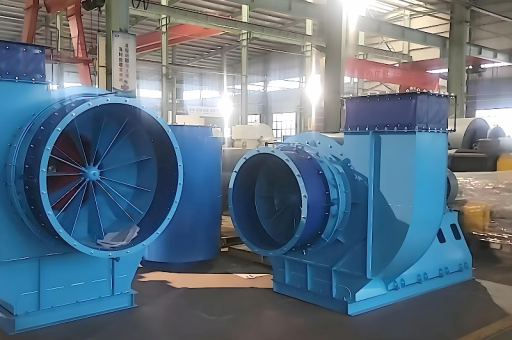
In the heavy industrial sector, the movement of gas—whether for combustion air, waste gas evacuation, or process cooling—is not a simple task. Systems must handle high volumes, significant static pressure, and often, extreme temperatures. This is where the Industrial Gas Delivery High Temperature Centrifugal Fan Backward Curved design becomes the gold standard.
Unlike standard residential fans, these units are engineered for continuous duty in harsh environments. They must efficiently handle flue gases, hot air from furnaces, or chemical vapors without sacrificing performance or structural integrity. The "backward curved" blade design (often referred to as "backward inclined") is specifically chosen for its ability to offer high efficiency, non-overloading power characteristics, and stable operation under fluctuating system conditions.
This article explores the engineering behind these essential machines, providing a guide for procurement managers and plant engineers.
Understanding the Fan Design: Why Backward Curved?
The term "Backward Curved" refers to the orientation of the fan blades relative to the direction of rotation. In this design, the blades curve away from the direction of rotation. This is a critical distinction from other common centrifugal fan types.
Key Differences:
- Compared to Forward Curved Fans: Forward curved blades are hook-shaped and curve toward the rotation direction. While they can move large volumes of air at low speeds, they are prone to overloading the motor if the system pressure drops. They are also significantly less efficient and cannot handle high dust loads. For gas delivery at high temperatures, a forward curved fan is often a poor choice due to efficiency loss and stress on the motor.
- Compared to Radial (Paddlewheel) Fans: Radial fans are incredibly robust and can handle heavy particulate, making them ideal for material handling. However, they are the least efficient design. For gas delivery (where the medium is relatively clean but hot), the backward curved design provides a much better power-to-air ratio.
The Core Advantage: The backward curved blade operates on the principle of centrifugal force combined with a vector change in velocity. This results in a non-overloading horsepower curve. As system resistance decreases (e.g., a duct opens up), the fan draws less power, preventing motor burnout. This is a safety and reliability feature that is mandatory for continuous industrial processes.
Engineering for High-Temperature Environments
Standard fans fail in high-temperature environments. The Industrial Gas Delivery High Temperature Centrifugal Fan is a different class of machine.
- Material Selection: Standard mild steel loses its tensile strength above 400°F (204°C). For high-temperature gas delivery, the impeller and housing must be constructed from alloy steels (like Corten or Stainless Steel 316) or Hastelloy for corrosive gases. For temperatures exceeding 800°F (427°C), the shaft must be protected with a heat slinger or a cooling wheel.
- Thermal Expansion: A typical fan wheel expands when hot. If the design does not account for this, the blades can rub against the inlet cone (scroll), causing sparks or catastrophic failure. Manufacturers of high-temperature backward curved fans use a floating inlet cone design and maintain specific axial clearances to accommodate growth.
- Cooling Systems: The bearings are the weakest link in a high-temp fan. They are often mounted on a pedestal base (away from the hot housing) and cooled via:
- Heat slingers: Fins on the shaft that radiate heat away.
- Venturi cooling: A disc on the shaft that draws cool ambient air toward the bearings.
- Water-cooled bearing housings: For the most extreme environments.
Performance Characteristics: Efficiency, Pressure, and Flow
The Backward Curved fan is often called the "workhorse" of the industry because of its steep pressure curve and high mechanical efficiency (often 80% or higher, compared to 60% for forward curved).
- Flow Control: These fans are excellent for variable air volume (VAV) systems. When using a Variable Frequency Drive (VFD), the backward curved fan maintains high efficiency across a wide range of speeds, unlike other blade designs which lose efficiency at reduced speeds.
- Gas Delivery Stability: In a network of ducts with dampers and filters, the system pressure constantly changes. The backward curved fan responds to increases in static pressure with a smaller drop in flow than other types, ensuring that critical burners or processes receive a steady supply of gas.
- Sound Levels: Due to the smoother air flow path and higher tip speeds without stall, these fans generally produce lower sound levels than radial fans, making them better for environments with noise regulations.
Frequently Asked Questions (FAQ)
Q1: What is the maximum temperature a backward curved fan can handle? A: Standard construction is typically rated for 200°C (392°F). With special alloy steel and a shaft cooling system, these fans can handle continuous service up to 650°C (1200°F) or higher. For extreme temperatures, the impeller may be manufactured from Inconel.
Q2: How do I prevent vibration in high-temp gas delivery systems? A: Vibration often comes from thermal imbalance or material buildup. First, ensure the fan has a "critical speed" analysis done to ensure the fan's operating speed does not match its natural frequency. Second, use a backward curved fan with an open or semi-open impeller to prevent dust buildup on the blades (which causes imbalance). Finally, ensure proper shaft alignment is checked when the fan is hot, not just cold.
Q3: What is the difference between a backward curved and an airfoil blade? A: An airfoil blade is essentially a hollow, wing-shaped backward curved blade. It is slightly more efficient (by about 2-5%) than a standard plate-type backward curved fan. However, the airfoil is hollow; if the gas is corrosive or contains moisture, the blade can corrode from the inside out. For high-temperature industrial gas delivery, a solid plate backward curved blade is often more reliable and durable than a hollow airfoil blade that might fail due to thermal stress fractures.
Conclusion: Maximizing ROI in Industrial HVAC and Process Systems
Selecting the correct fan for Industrial Gas Delivery is a decision that impacts energy bills, maintenance schedules, and process reliability. The High Temperature Centrifugal Fan with Backward Curved Blades offers the best balance of efficiency, safety (non-overloading power), and durability for moving hot, clean gas.
When purchasing, always verify the fan's static efficiency curve and the materials used at the expected operating temperature. A cheaper forward curve fan may save money upfront, but the cost of a motor failure or bearing replacement due to thermal overload will quickly negate any savings. For critical gas delivery, invest in the robust engineering of the backward curved design.





