
This article's table of contents introduction:
- Key Features of This Specification
- Typical Applications
- Critical Selection Parameters (How to Buy)
- Example Product Designation
- Manufacturers to Look For
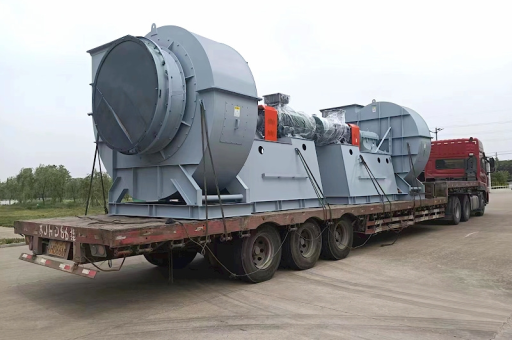
Based on your keywords, you are looking for a Centrifugal Fan specifically designed for High-Temperature applications, constructed from Metallurgy-grade Carbon Steel, and featuring a Single Inlet design.
This is a specific class of industrial fan built for moving hot gases, often found in steel mills, foundries, power plants, and glass manufacturing. Here is a breakdown of what that specification means and what you should look for.
Key Features of This Specification
-
Single Inlet:
- Air enters from one side of the impeller (wheel).
- Typically uses an overhung rotor design (wheel mounted on the end of the shaft, supported by bearings on one side only).
- Best for ducted systems where space is limited on one side.
-
Carbon Steel Construction (Metallurgy Grade):
- This usually refers to ASTM A36, A285 Gr. C, or A515 Gr. 70 for the housing and wheel.
- Why Carbon Steel? It offers high strength, durability, and better thermal stress resistance than standard mild steel at elevated temperatures. It is significantly cheaper than stainless steel (e.g., 304/316 SS).
- Limitation: Carbon steel will oxidize (scale) and lose strength rapidly above 450°C (842°F). For very high temperatures (e.g., >500°C), it must be replaced with Alloy Steel (e.g., Chrome-Moly) or Stainless Steel.
-
Centrifugal Fan:
- High Pressure: Centrifugal fans generate higher static pressure than axial fans, which is necessary to push hot air through ductwork, scrubbers, and heat exchangers.
- Wheel Design: The blade type is critical for high-temperature applications:
- Radial / Paddle Wheel: Most common for high-temp. Simple, robust, self-cleaning, and least susceptible to thermal expansion distortion.
- Backward Inclined / Airfoil: More efficient but more prone to thermal stress issues.
- Forward Curved: Rarely used for high temp due to deep blades and expansion problems.
-
High Temperature:
- The fan must be designed to handle thermal expansion.
- Key Components:
- Shaft: Must be stainless steel (e.g., AISI 410 or 304 SS) to prevent "heat creep" from transferring heat down the shaft to the bearings.
- Bearings: Must be mounted externally (out of the airstream) and often have a water cooling jacket or a heat slinger.
- Housing: Must have an expansion joint or sliding bolt holes to allow the housing to grow without warping.
- Shaft Seal: High-temp packing or labyrinth seal to prevent hot gas leakage.
Typical Applications
- Boilers: Induced Draft (ID) fans moving flue gas.
- Furnaces: Recirculating hot air in heat-treating furnaces.
- Kilns: Cement, lime, and ceramic kiln exhaust.
- Dryers: Spray dryers, rotary dryers, and flash dryers handling hot process air.
- Pollution Control: Baghouse fans for hot gas filtration.
Critical Selection Parameters (How to Buy)
When sourcing a fan with these specifications, you must provide:
-
Actual Temperature: (e.g., 200°C, 400°C, or 600°C)
- Note: Most fans rated for "High Temperature" but built from standard Carbon Steel are limited to 200°C - 400°C (400°F - 750°F). Beyond that, you need alloy steels.
- Density Correction: Hot air is less dense. You must specify the actual volume (ACFM/AM³/h) and the mass flow, not just standard conditions.
-
Gas Composition: Is the gas clean, or does it contain dust, corrosive compounds (SOx, NOx), or moisture? Carbon steel is not corrosion-resistant.
-
Duty Cycle: Is it continuous operation or intermittent? Continuous high-temp requires stronger cooling systems for bearings.
-
Spark Resistance: If handling explosive gases (e.g., CO), you may need a non-sparking design (e.g., aluminum or brass tip, monel shaft).
Example Product Designation
A typical fan might be called a "High-Temp Radial Tip Paddle Wheel" fan.
- Wheel: Carbon Steel (A36)
- Shaft: 410 Stainless Steel
- Bearings: Pillow block with grease fittings and heat slinger
- Coupling: Flexible
- Max Temp: 200°C (continuous) / 350°C (intermittent)
Manufacturers to Look For
- New York Blower (NYB)
- Howden
- TLT-Turbo (Siemens)
- Cincinnati Fan
- Robinson Fans
- Greenheck (for industrial duty)
- AirPro Fan & Blower Co.
Recommendation: If your temperature is below 200°C (400°F), a standard Carbon Steel fan with external bearings will work. If your temperature is above 200°C, specifically ask for a "Radial Paddle Wheel" design with a stainless steel shaft and water-cooled bearings. If it exceeds 450°C (840°F), you cannot use standard Carbon Steel for the wheel or housing—you must upgrade to Alloy Steel (e.g., Hastelloy, Inconel, or Chrome-Moly).





