
This article's table of contents introduction:
- Understanding the Terminology
- Specific Design Features for an "Antifraying" Foundry Fan
- Common Foundry Applications for This Fan
- Potential Limitations & Alternatives
- How to Specify This Fan (Example Request)
- Important Note on "Antifraying" vs. "Abrasion Resistance"
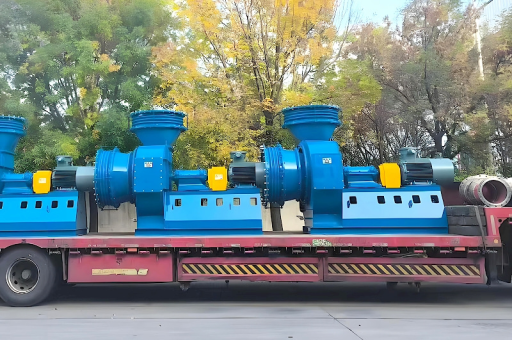
It appears you are looking for information on Large Capacity Forward-Curved (Forward Heavy Duty) Centrifugal Fans specifically designed for Foundry applications, with a focus on Antifraying features.
Here is a breakdown of what this specification means and the key features you should look for in such a fan.
Understanding the Terminology
- Large Capacity: These fans handle high volumes of air (CFM/m³/h), often required for entire building ventilation, large dust collection systems, or melting furnace air supply.
- Forward Heavy Duty (Forward-Curved):
- Forward-Curved Blades: The blades curve in the direction of rotation. They are typically quieter than backward-curved blades and are excellent for moving large volumes of air against relatively low to medium static pressure.
- Heavy Duty: Built with thicker gauge steel, heavier bearing supports, and reinforced shafts to withstand the harsh, continuous operation of a foundry.
- Foundry: The application is in a dirty, high-temperature, abrasive environment (sand, metal dust, scale, smoke, hot gases).
- Antifraying: This is the most critical feature. In a foundry, dust and fibers accumulate on fan blades. "Antifraying" means the fan is designed to resist the build-up of material that can cause:
- Imbalance: Leading to vibration and bearing failure.
- Erosion: Sand particles eroding the blade surface.
- Fraying/Unraveling: If handling fibrous materials (like from core making or filters), the material can wrap around the shaft or catch on rough edges, causing imbalance.
Specific Design Features for an "Antifraying" Foundry Fan
To meet the "Antifraying" requirement, a standard forward-curved fan will be modified with these features:
| Feature | Purpose in Foundry Environment |
|---|---|
| Reinforced, Welded Construction | Blades are continuously welded to the backplate and shroud (not just spot-welded). This prevents debris from getting stuck in gaps. |
| Smooth, Non-porous Surface | The fan wheel is ground smooth to prevent dust and sand from adhering. Often painted with a high-solids epoxy or rubber lining for abrasion resistance. |
| Heavy-Duty, Wide-Base Blades | Blades are thicker to resist erosion from sand particles. A wider base reduces the angle where fibers can catch. |
| Open or Semi-Open Inlet (Inlet Cone) | Allows large, sticky particles to pass through without plugging the throat of the fan. |
| Split Housing | Allows easy access for cleaning the inside of the housing and the wheel without removing the ductwork. |
| Shaft Seal / Purge System | Prevents dust from traveling along the shaft into the bearings. A purge uses compressed air to keep the bearing area clean. |
| Tapered Shaft & Locking Assembly | Simplifies removal of the wheel for maintenance, as corrosion and dust can seize standard keyed shafts. |
Common Foundry Applications for This Fan
- Cupola / Electric Arc Furnace Ventilation: Moving hot, particle-laden air away from the melting area.
- Sand Handling / Reclamation Systems: Exhaust from vibrating screens, elevators, and belt conveyors.
- Dust Collection Primary Fan: The main fan pulling air through baghouses or cartridge collectors.
- General Shop Ventilation: Removing smoke, fumes, and heat from large foundry floors.
Potential Limitations & Alternatives
- Efficiency: Forward-curved fans are less efficient than backward-curved (airfoil) or backward-inclined fans. In a foundry running 24/7, this higher energy cost is often justified by lower maintenance.
- Pressure Limit: They are not ideal for high-pressure applications (e.g., pneumatic conveying). For high pressure, a Radial Blade (Radial Tip) or Backward-Inclined fan is better.
How to Specify This Fan (Example Request)
If you are writing a purchase order or specification, include these points:
Fan Type: Heavy Duty, Forward-Curved Centrifugal Fan Application: Foundry Dust Collection / Ventilation Capacity: [e.g., 50,000 CFM] Static Pressure: [e.g., 12" w.g.] Construction Requirements:
- Antifraying Design: Full continuous weld on blade to backplate and shroud. Grind smooth all internal surfaces.
- Wheel: Heavy gauge steel with reinforced blade construction. Must be dynamically balanced per ISO 1940 G6.3 or better.
- Housing: Split housing with access door. Lined with replaceable abrasion-resistant material (e.g., 1/4" AR plate or rubber lining) on the cutoff/scroll.
- Shaft: Oversized shaft with inboard/outboard bearing arrangement. Shaft seal with purge port for compressed air.
- Drive: Belt drive with sheaves sized to allow for 10% future capacity increase. Taper-lock bushings on sheaves.
- Accessories: Inlet box, inlet vanes (if modulating airflow), vibration monitoring ports.
Important Note on "Antifraying" vs. "Abrasion Resistance"
- Antifraying: Usually refers to preventing fibrous material (stringy core sand binders, fiberglass insulation) from catching and wrapping.
- Abrasion Resistance: Refers to preventing solid particle (sand, scale) wear.
A true foundry fan must address both. A standard forward-curved fan is not good for abrasion. Therefore, this fan likely has a thickened scroll and blade design or a sacrificial liner.
Bottom Line: You need a TEFZ (Totally Enclosed Fan-Cooled) motor, a heavy-duty V-belt drive, and a custom-built wheel where the forward-curved blades are welded into solid segments (like an "SIROCCO" wheel but in heavy steel) rather than the lighter sheet-metal construction used in HVAC.
Would you like me to elaborate on any specific component, such as the bearing selection or the inlet cone design for this application?





