
This article's table of contents introduction:
- Core Component Breakdown
- Why "Energy Saving" and "High Volume"? The Backward Blade Advantage
- Typical Specifications for a Q235 Cement Fan
- Applications in a Cement Plant
- Advantages of this Specific Combination
- Potential Limitations / Considerations
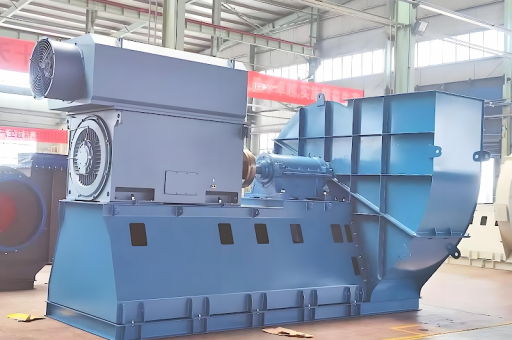
Based on the keywords you provided, here is a detailed breakdown of what a Q235 Single Inlet Cement Fan with High Volume Backward Energy Saving is, its key features, and typical applications.
This describes a specific type of industrial centrifugal fan, commonly used in the cement and heavy industrial sectors.
Core Component Breakdown
- Q235 (Material): This is the most common grade of carbon structural steel in China (similar to ASTM A36). It means the fan housing, impeller, and inlet cone are made from standard sheet steel. It offers good weldability, strength, and cost-effectiveness. For cement fans handling clean or mildly dusty air, Q235 is standard. For highly abrasive dust, a harder steel (e.g., Q345 or wear-resistant lining) would be specified.
- Single Inlet: Air enters the fan from only one side. This is the standard configuration for most industrial fans, as opposed to a "double inlet" fan which draws air from both sides (usually for very high volume, lower pressure applications).
- Cement Fan: This indicates the intended application. Cement fans must handle high volumes of air, often at high temperatures, and frequently contain abrasive cement dust. They are designed for ruggedness and long service life.
- High Volume: This points to the fan's performance characteristic. It is designed to move a large quantity of air (measured in CFM or m³/h). The "backward" blade design is key to this.
- Backward (Blades): This refers to the impeller blade design. Backward-curved or backward-inclined blades are curved away from the direction of rotation.
- Energy Saving: This is the primary benefit of the backward-curved blade design.
Why "Energy Saving" and "High Volume"? The Backward Blade Advantage
The "backward" design is the key performance driver:
| Feature | Backward-Curved/Inclined Blade | Forward-Curved Blade (Old Design) |
|---|---|---|
| Efficiency | High (up to 85%) | Low (typically 60-70%) |
| Power Draw | Non-overloading power curve | Overloading power curve |
| Noise | Lower (aerodynamically cleaner) | Higher |
| Application | High volume, moderate-high pressure, clean to slightly dirty air | Low pressure, high volume (e.g., HVAC, dust collection) |
| Cost | Higher initial cost, lower operating cost | Lower initial cost, higher operating cost |
Key Benefit: Non-Overloading Power Curve This is the most critical "energy-saving" feature. With a backward-curved fan, as the system resistance (e.g., a clogged filter) decreases (meaning air flows more freely), the motor's power draw decreases. It cannot overload the motor. With a forward-curved fan, the opposite happens – a decrease in resistance causes a massive increase in power draw, which can burn out the motor. Backward fans are much safer and more efficient in variable systems.
Typical Specifications for a Q235 Cement Fan
- Material: Housing & Impeller: Q235 Carbon Steel.
- Impeller Type: Backward-inclined or backward-curved.
- Inlet: Single inlet.
- Outlet: Typically radial or tangential.
- Drive: Direct drive or belt drive (most common for speed control).
- Temperature Range: Standard up to 80°C (180°F). Can be upgraded to 200-400°C with high-temperature bearing and seal modifications.
- Performance Range:
- Volume: 10,000 to 500,000+ m³/h (6,000 to 300,000+ CFM)
- Pressure: 500 to 3,000+ Pa (2 to 12+ inches w.g.)
- Balance: Dynamic balancing to ISO 1940 G6.3 or G2.5.
Applications in a Cement Plant
A "Q235 Single Inlet Backward Fan" is a versatile workhorse. It is commonly used for:
- Kiln System:
- Primary Air Fan: Supplying air to the kiln burner (clean air).
- Coal Mill Fan: Conveying pulverized coal.
- Kiln Induced Draft (ID) Fan: Pulling exhaust gases through the kiln (though this often requires high-temperature alloys or special coatings).
- Grinding Systems:
- Raw Mill Fan: Drawing air through the raw mill and separator.
- Cement Mill Fan: Pneumatically conveying finished cement.
- Separator Fan: Recirculating air in a dynamic separator.
- Material Handling:
- Airslide Fans: Providing low-pressure air for fluidized conveyor systems.
- Dust Collector Fans: Exhaust fans for baghouses and electrostatic precipitators (ESPs).
- Cooling:
- Clinker Cooler Fans: Supplying air to cool hot clinker (often high-pressure, but can be backward in some designs).
Advantages of this Specific Combination
- Low Operating Cost: The 85% efficiency translates directly into lower electricity bills, which is a major cost driver in a cement plant.
- Motor Protection: The non-overloading power curve eliminates the risk of motor burnout if a duct becomes accidentally open or a filter is bypassed.
- Quieter Operation: The aerodynamic design is inherently less noisy than forward-curved or radial blade fans.
- Durability: Q235 steel is strong and robust, capable of withstanding the rigors and vibrations of a cement plant.
- Simple Maintenance: Single inlet design allows for easy access to the impeller for cleaning or repair.
Potential Limitations / Considerations
- Initial Cost: Backward-curved fans are more expensive to manufacture than forward-curved fans.
- Abrasion: Standard Q235 is not ideal for highly abrasive dust. If the air contains raw meal or clinker dust, the blades will wear rapidly. You would require wear-resistant lining (e.g., ceramic tile or hardfacing) on the impeller and housing.
- Temperature: Standard Q235 loses structural strength above 350-400°C (660-750°F). For hot gas applications, you would need a high-temperature version with a specially designed shaft cooling system, heat slinger, and potentially different materials (e.g., 16Mn or Corten).
In Summary: The "Q235 Single Inlet Cement Fan High Volume Backward Energy Saving" is a highly efficient, robust, and safe industrial fan perfectly suited for moving large volumes of air in a cement plant while minimizing energy consumption. It is a significant upgrade over older, less efficient fan designs. However, you must carefully specify the temperature and dust loading of your specific application to ensure you get the correct material (standard Q235 vs. a hardened or high-temperature variant).





