
This article's table of contents introduction:
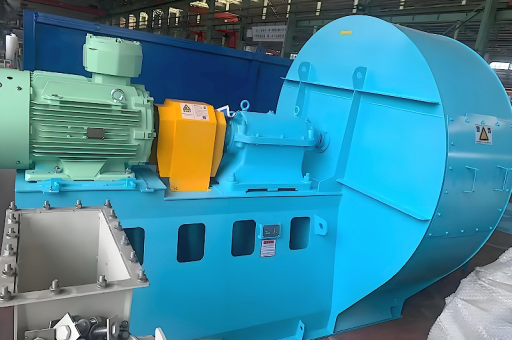
- The Specific Fan Type: Heavy-Duty Centrifugal Fan (Radial or Backward Inclined)
- Why Carbon Steel? (Material Specification)
- "High Volume" (Typical Power Plant Specs)
- How to Specify This Fan (Technical Procurement)
- Summary: The Exact Fan You Need
It appears you are looking for a specific type of industrial fan used in power plants, characterized by Carbon Steel construction, High Wear Resistance, and High Volume capacity.
Based on these three keywords, you are almost certainly referring to an Induced Draft (ID) Fan or a Primary Air (PA) / Forced Draft (FD) Fan handling coal dust, fly ash, or abrasive flue gas.
Here is the technical breakdown of what that specification means and the specific fan type you should target:
The Specific Fan Type: Heavy-Duty Centrifugal Fan (Radial or Backward Inclined)
- Why: Axial fans cannot handle the high abrasion required. For high volume + high wear, you need a centrifugal fan with specific blade geometries.
- Best Design for Your Specs:
- Radial Blade (or Radial Tip): Highest wear resistance. Ideal for "dirty" air with heavy particulate (fly ash, coal dust).
- Backward Inclined (Airfoil or Flat): Higher efficiency for "cleaner" high-volume air (PA/FD fans), but requires thicker carbon steel or liners for wear resistance.
Why Carbon Steel? (Material Specification)
- Standard: ASTM A36 (structural) or AR400 / AR500 (Abrasion Resistant) for the wear zones (blades, liners).
- Key Feature: Carbon steel is chosen over stainless steel because it is weldable, cheap, and allows for hard-facing.
- Wear Solution: The fan housing and blades are lined with replaceable Carbon Steel wear plates (often 6mm to 12mm thick). These are sacrificial parts designed to be bolted on and swapped out during maintenance.
"High Volume" (Typical Power Plant Specs)
- Flow Rate: 100,000 to 1,000,000+ CFM (Cubic Feet per Minute) or ~200 to 2000 m³/s.
- Application: Moving massive amounts of flue gas from the boiler to the chimney (ID fan) or pushing combustion air into the boiler (FD fan).
How to Specify This Fan (Technical Procurement)
If you are trying to buy this fan, do not just ask for "Carbon Steel High Wear." You must specify these parameters:
| Parameter | Specification for Your Fan |
|---|---|
| Type | Heavy Duty Centrifugal (Radial or Backward Inclined) |
| Material | Housing: ASTM A36 Carbon Steel (10-12mm thick) Blades: AR500 Carbon Steel (Hardox or equivalent) Liner: Bolted AR400 wear plates on the cut-off and scroll. |
| Volume (Flow) | [Insert CFM or m³/s] |
| Pressure (SP) | [Insert Static Pressure in inches w.g. or Pa] |
| Temperature | Up to 400°C (For high-temp, use Corten steel or special alloy, not standard carbon steel). |
| Wear Protection | - Hardfacing: Weld overlay on blade leading edges. - Inlet Cone: Replaceable carbon steel liner. - Outlet: Lined in the direction of flow. |
| Drive | Belt drive (common for variable speed) or Direct drive (for fixed high volume). |
| Speed | High RPM (typically 750 to 1500 RPM) for high volume. |
Summary: The Exact Fan You Need
You are looking for a Heavy-Duty, Carbon Steel, Abrasion-Resistant Centrifugal Induced Draft Fan (or Primary Air Fan) .
Crucial Warning: Carbon steel has a temperature limit. If the gas temperature exceeds 400°C (750°F), carbon steel loses its strength and will yield (creep). For higher temperatures, you must use Alloy Steel or Stainless Steel (e.g., 316H) for the impeller.
If you are dealing with abrasive flue gas at normal temperatures (<200°C), the standard solution is:
- Blades: Carbon Steel (AR500).
- Housing: Carbon Steel (A36) with replaceable liners.
- Rotation: Usually Backward Inclined (for efficiency) with thick leading edges or Radial (for extreme abrasion).
Note: If you need a specific catalog number, manufacturer (like Howden, TLT-Babcock, or FLSmidth), or design drawings, please provide the exact flow rate, pressure, and temperature required.





