
This article's table of contents introduction:
- Table of Contents
- Introduction to 7.5kW Centrifugal Fans
- How a 7.5kW Centrifugal Fan Works
- Key Technical Specifications
- Common Applications Across Industries
- Advantages Over Other Fan Types
- Installation and Maintenance Best Practices
- Frequently Asked Questions (FAQ)
- Conclusion
** The Ultimate Guide to 7.5kW Centrifugal Fans: Performance, Applications, and Technical Insights
Table of Contents
- Introduction to 7.5kW Centrifugal Fans
- How a 7.5kW Centrifugal Fan Works
- Key Technical Specifications
- Common Applications Across Industries
- Advantages Over Other Fan Types
- Installation and Maintenance Best Practices
- Frequently Asked Questions (FAQ)
- Conclusion
Introduction to 7.5kW Centrifugal Fans
Centrifugal fans are indispensable in modern industrial and commercial ventilation systems. Among them, the 5kW centrifugal fan stands out as a powerful yet efficient solution for moving large volumes of air against moderate to high static pressure. Whether you are managing a dust collection system, an HVAC duct network, or an industrial drying process, understanding the nuances of this specific power class is essential for optimizing performance and energy consumption.
A 7.5kW (approximately 10 horsepower) centrifugal fan typically delivers an airflow range between 8,000 and 25,000 m³/h, depending on the impeller design, speed, and system resistance. This makes it a versatile choice for mid-range applications where smaller fans fall short and larger units would be unnecessarily expensive or bulky.
Key Insight: Unlike axial fans, centrifugal fans generate pressure by accelerating air radially outward. The 7.5kW power rating provides enough torque to handle dirty air, long duct runs, and restricted inlets without stalling.
How a 7.5kW Centrifugal Fan Works
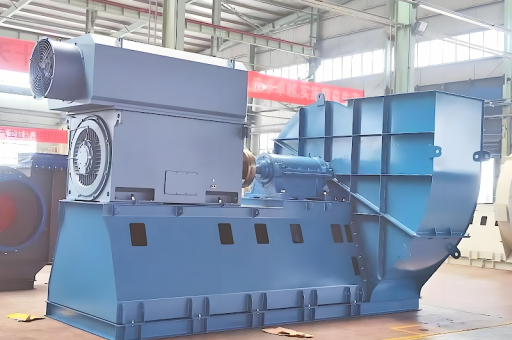
The operating principle of a centrifugal fan is based on converting rotational kinetic energy into increased air pressure. A motor spins an impeller enclosed in a scroll housing. Air enters axially at the impeller hub and is flung outward by curved blades, gaining velocity and pressure before being discharged through the outlet.
Core components:
- Impeller: Available in backward-curved, forward-curved, or radial designs. Backward-curved impellers are most common for 7.5kW units because they offer higher efficiency and non-overloading power characteristics.
- Motor: Typically a three-phase induction motor (e.g., 380V, 50Hz or 460V, 60Hz) directly coupled or belt-driven. Belt drives allow speed adjustment for fine-tuning performance.
- Housing: Constructed from steel, stainless steel, or coated materials to resist corrosion or abrasion.
- Inlet/Outlet: Conical inlet for smooth airflow entry; rectangular or circular outlet for duct connection.
Technical Note: The fan performance curve for a 7.5kW centrifugal fan shows how flow rate decreases as static pressure increases. Selecting the operating point close to the peak efficiency zone (usually around 70–80% of maximum flow) maximizes energy savings.
Key Technical Specifications
To choose the right 7.5kW centrifugal fan, you need to evaluate these critical parameters:
| Parameter | Typical Range for 7.5kW Fans |
|---|---|
| Power Consumption | 5 kW @ rated load |
| Voltage / Frequency | 380–480V, 3-phase, 50/60Hz |
| Maximum Airflow | 8,000 – 25,000 m³/h |
| Maximum Static Pressure | 1,500 – 4,000 Pa |
| Impeller Diameter | 400 – 800 mm |
| Speed (Direct Drive) | 1,450 – 2,900 rpm |
| Noise Level | 75 – 85 dB(A) at 1m |
| Operating Temperature | -20°C to +80°C (standard) |
Efficiency: High-quality 7.5kW centrifugal fans achieve 70–82% total efficiency when properly matched to the system.
Important: Always cross-check the fan curve provided by the manufacturer. A fan running far to the right of its peak efficiency point will draw more current than its rated 7.5kW, risking motor overload. Conversely, operating too far left may cause surge or vibration.
Common Applications Across Industries
The 7.5kW centrifugal fan is a workhorse in many sectors:
- HVAC Systems: Used in commercial buildings for exhaust, supply air, or smoke management. Its ability to overcome duct friction makes it ideal for multi-story ventilation.
- Dust Collection: In woodworking shops or metal fabrication facilities, these fans move dust-laden air through cyclone separators and baghouse filters. The robust construction resists wear from abrasive particles.
- Agricultural Ventilation: For poultry barns or mushroom growing rooms, the 7.5kW fan provides high-volume airflow to control humidity and temperature.
- Industrial Drying Ovens: Conveyorized dryers in printing or food processing rely on centrifugal fans to circulate hot air uniformly.
- Fume Extraction: Chemical labs or welding stations use these fans to capture toxic fumes and maintain negative pressure.
Case Example: A 7.5kW backward-curved centrifugal fan installed in a timber processing plant reduced motor current draw by 18% compared to an older forward-curved unit, while maintaining the same duct static pressure of 2,200 Pa.
Advantages Over Other Fan Types
Why choose a 7.5kW centrifugal fan over an axial fan or a smaller radial fan?
- Higher Static Pressure Capability: Axial fans struggle beyond 500 Pa, while a 7.5kW centrifugal can handle up to 4,000 Pa or more.
- Non-Overloading Power Curve: Backward-curved impellers ensure that motor power peaks at a specific flow, preventing burnout even if the duct is blocked.
- Dirt Tolerance: The impeller design minimizes dust buildup, maintaining balance and reducing maintenance frequency.
- Energy Efficiency: Modern 7.5kW fans with IE3 motors can save hundreds of dollars annually in electricity costs compared to older, lower-efficiency models.
Trade-off: Centrifugal fans are larger and noisier than axial fans of similar airflow. However, the performance benefits often outweigh these drawbacks in demanding applications.
Installation and Maintenance Best Practices
To maximize the lifespan of your 7.5kW centrifugal fan, follow these guidelines:
Installation:
- Ensure a straight duct section of at least 3–5 duct diameters before the fan inlet to avoid turbulence.
- Use flexible connections between fan and ductwork to isolate vibration.
- Mount the fan on a rigid base or vibration isolators. A 7.5kW fan can generate significant forces; improper mounting leads to noise and bearing wear.
- Verify electrical connections match the motor nameplate (star or delta configuration).
Maintenance:
- Weekly: Check for unusual noise or vibration. Clean inlet screen or filter.
- Monthly: Inspect belt tension (if belt-driven) and alignment. Worn belts can reduce airflow by 15–20%.
- Quarterly: Lubricate bearings according to manufacturer specifications. Most 7.5kW fan bearings require regreasing every 2,000 operating hours.
- Annually: Clean impeller blades with a non-abrasive brush. Check for imbalance caused by dust accumulation or corrosion.
Warning: Operating a 7.5kW fan with a blocked inlet or outlet can cause the motor to draw overcurrent. Always install overload protection (e.g., thermal relay set to 1.1× rated current).
Frequently Asked Questions (FAQ)
Q1: What is the typical airflow of a 7.5kW centrifugal fan? A: It depends on the impeller design and system pressure. A backward-curved impeller fan might produce 12,000 m³/h at 2,500 Pa static pressure, while a forward-curved design could reach 20,000 m³/h but at lower pressure (e.g., 1,200 Pa). Always consult the fan curve.
Q2: Can a 7.5kW centrifugal fan be used for high-temperature applications? A: Yes, but modifications are needed. Standard fans handle up to 80°C. For temperatures up to 200°C, specify a heat-slinging fan with a shaft cooling disc and high-temperature bearings. For above 200°C, consider a direct-drive fan with an external motor.
Q3: How do I calculate the power consumption of a 7.5kW fan? A: Real power (kW) = √3 × Voltage × Current × Power Factor / 1000. For example, at 400V, 13A, and PF 0.85, consumption = 1.732 × 400 × 13 × 0.85 / 1000 = 7.66 kW. Note that a fan drawing more than its rated power indicates operation too far right on the curve.
Q4: Is a 7.5kW centrifugal fan suitable for outdoor installation? A: Yes, if the housing is weatherproof (IP54 or higher) and the motor is enclosed. Specify a painted steel or stainless steel housing with a rain hood. For coastal areas, opt for 316 stainless steel.
Q5: What is the difference between belt-driven and direct-drive 7.5kW fans? A: Direct-drive is simpler (no belt maintenance), but speed is fixed to motor speed. Belt-drive allows changing speed by swapping pulleys, enabling fine-tuning of airflow and pressure. Belt-drive also isolates the motor from heat or vibration in the fan.
Conclusion
A 5kW centrifugal fan is a robust, energy-efficient solution for a wide range of industrial and commercial air movement tasks. From dust collection to HVAC, its ability to generate high static pressure while maintaining reasonable efficiency makes it a preferred choice for engineers and facility managers. When selecting a fan, always match the performance curve to your system’s resistance, invest in proper installation, and adhere to a preventive maintenance schedule.
By understanding the technical specifications, applications, and common pitfalls outlined in this guide, you can ensure that your 7.5kW centrifugal fan delivers reliable performance for years to come.
Note: For specific product recommendations or detailed selection assistance, consult a reputable fan manufacturer or an industrial ventilation specialist.





