
This article's table of contents introduction:
- Key Performance Specs (Typical Range)
- Common Impeller Types for 160 kW
- Critical Engineering Considerations
- Typical Applications
- Common Questions to Ask (Troubleshooting)
- Safety Warning
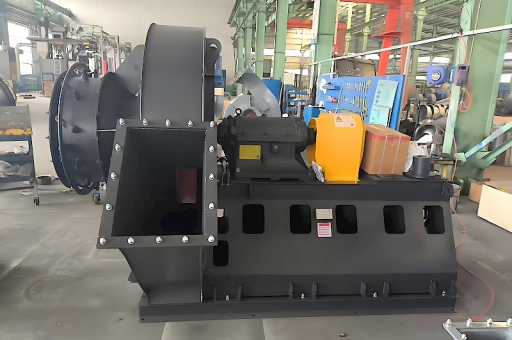
This is a substantial piece of industrial equipment. A 160 kW (approximately 215 HP) centrifugal fan is typically found in heavy industrial applications such as mines, large power plants, cement factories, or large-scale HVAC for stadiums/tunnels.
Here is a technical breakdown of what this specification entails, key considerations, and typical applications.
Key Performance Specs (Typical Range)
For a fan of this power, the operating point (Flow vs. Pressure) is highly specific, but a general range looks like this:
- Power: 160 kW (215 HP)
- Voltage: Typically 400V (50Hz), 480V (60Hz), or 3.3kV/6.6kV (MV) for efficiency.
- Flow Rate (Air Volume): Roughly 50,000 to 250,000 m³/h (29,000 to 147,000 CFM) depending on pressure.
- Pressure (Static): Usually 3,000 to 8,000 Pa (12 to 32 inches w.g.) for medium pressure, or higher for high-pressure applications (e.g., pneumatic conveying).
- Impeller Diameter: Likely 1,200 mm to 2,000 mm (47" to 79").
- Motor Speed: Usually Direct Drive via a 4-pole motor (~1,500 RPM @ 50Hz) or Belt Drive for speed flexibility.
Common Impeller Types for 160 kW
The choice depends on what you are moving (clean air vs. dust):
| Impeller Type | Characteristics | Best For | Efficiency |
|---|---|---|---|
| Backward Curved (BC) | Non-overloading power curve. Quiet, high efficiency. | Clean air, HVAC, general ventilation. | High (85%) |
| Backward Inclined (BI) | Similar to BC, but slightly more robust. | Medium dust loads, industrial exhaust. | High (82%) |
| Radial (Paddle Wheel) | Strong, simple. Handles sticky or heavy dust. | Cement, wood chips, pneumatic conveying. | Low (65-70%) |
| Airfoil (AF) | Highest efficiency. Hollow blades. | Critical continuous operation (power plants). | Very High (88%+) |
| Forward Curved (FC) | High volume, low pressure. Smaller housing. | Low-pressure HVAC (rare at 160kW). | Moderate (75%) |
Critical Engineering Considerations
If you are specifying, installing, or troubleshooting this fan, pay attention to these:
A. Motor Starting
- Direct On Line (DOL): Requires a very high starting current (600-800A). The grid must be very stiff. Not recommended for 160kW unless the system is isolated.
- Star-Delta: Reduces starting current to ~33%. Common for 160kW.
- Soft Starter: Smooth acceleration. Highly recommended to reduce mechanical shock to the fan shaft and bearings.
- VFD (Variable Frequency Drive): The best method. Allows you to ramp up slowly, control flow precisely, and save significant energy (often 30-50%) if the fan runs at partial load.
B. Bearings
- At 160kW, bearing life is critical.
- Heavy-duty spherical roller bearings are standard.
- Lubrication: Must have a central grease line or oil bath (for very high speeds). Regreasing schedule must be strict (e.g., every 500 hours).
C. Structural Support & Vibration
- The fan scroll must be on a heavy steel baseplate (I-beams, channels).
- Vibration switches or transducers are mandatory for this size to prevent catastrophic failure.
- Isolation dampers (spring or rubber) under the baseplate are essential to stop vibration transmitting to the building.
D. Ductwork
- Inlet and outlet ducts must be fully supported. The fan flanges cannot bear the weight of heavy ducting.
- A flexible connector (canvas or rubber) on the inlet and outlet is needed to isolate the fan from duct expansion/vibration.
Typical Applications
- Cement Plants: Baghouse dust collectors (high pressure, dirty air).
- Mines: Main ventilation fans (high volume, continuous duty).
- Power Plants: Induced Draft (ID) fans (pulling hot flue gas through scrubbers) or Forced Draft (FD) fans.
- Steel Mills: Furnace exhaust or ventilation.
- Tunnels: Jet fan ventilation systems or fresh air supply.
Common Questions to Ask (Troubleshooting)
- "Is it running too hot?" (Check for belt slippage, dirty impeller, or running outside its design curve).
- "Is it vibrating?" (Check for impeller imbalance from build-up, bearing wear, or loose foundation bolts).
- "How much kW is it actually drawing?" (Measure with a clamp meter. If it's drawing 200kW on a 160kW motor, the damper is too far open or the system resistance is lower than design).
- "Do I need a VFD?" (If the fan runs at a fixed speed but you throttle it with a damper more than 20% of the time, a VFD will pay for itself in energy savings within 1-3 years).
Safety Warning
- Lock-out/Tag-out (LOTO): Never work on a 160kW fan without ensuring the power source is locked out. The impeller can act like a flywheel and spin for minutes after power-off due to inertia.
- Horsepower Lock: Do not overspeed the fan. A 160kW motor is powerful enough to destroy the impeller if it spins too fast.
Bottom line: A 160kW centrifugal fan is a high-stakes machine. It requires a robust power supply, proper foundations, and a strict maintenance schedule (vibration analysis, bearing temperature monitoring, regreasing). If you are looking to buy one, specify the air volume (m³/h) , static pressure (Pa) , air temperature, and dust load.





