
This article's table of contents introduction:
- Typical Applications
- Key Technical Specifications (Typical)
- Critical Engineering Considerations
- What is your goal?
This is a request for information or specifications, but it's not a complete question. To give you the best answer, I'll break down what a 132 kW centrifugal fan typically entails, its applications, common specifications, and the critical engineering considerations.
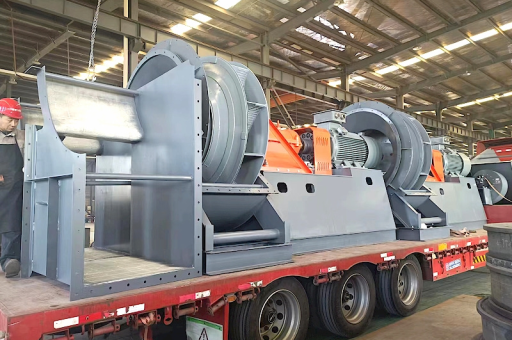
A 132 kW (≈ 177 HP) fan is a very large industrial machine. It is not a standard building ventilation fan; it is used in heavy industrial processes.
Typical Applications
A fan of this power is required to move very large volumes of air against significant resistance (pressure). Common uses include:
- Mine Ventilation: Main mine fans for underground hard rock or coal mining.
- Cement Plants: Induced Draft (ID) fans for kilns, or Raw Mill fans.
- Power Generation: Induced Draft (ID) or Forced Draft (FD) fans for boiler air supply.
- Steel Mills: Sinter cooler fans, fume extraction for electric arc furnaces.
- Wastewater Treatment: Large aeration blowers for biological treatment (though these are often multi-stage centrifugal or positive displacement).
- HVAC for Large Structures: Tunnel ventilation for subways or road tunnels (or smoke extract fans).
Key Technical Specifications (Typical)
To properly specify or analyze a 132 kW fan, engineers need the following parameters. Here are plausible ranges for a fan of this power:
- Motor Power: 132 kW (177 HP)
- Voltage: Typically 380-480V (60Hz) or 400-690V (50Hz) for a motor of this size. Often uses a 6-pole or 4-pole motor.
- Speed: 1000–1800 RPM (depending on pole count and application). High-pressure fans may be faster.
- Flow Rate (Air Volume): Could be 50,000 to 150,000 m³/h (29,000 to 88,000 CFM) , depending on the pressure required.
- Pressure (Static/Fan): Typically 2,000 to 8,000 Pa (8 to 32 inches w.g.) . Very high-pressure applications might be higher.
- Efficiency: High-quality centrifugal fans achieve 80–85% peak efficiency.
- Sound Power Level: In excess of 110 dB(A) - requires significant acoustic treatment.
- Impeller Type:
- Backward Curved/Cambered: Most common for high efficiency and stable operation.
- Radial (Paddle Wheel): Used for heavy dust loading (e.g., cement).
- Airfoil: Highest efficiency for clean air.
Critical Engineering Considerations
Choosing and installing a 132 kW fan is a major investment. Key issues are:
-
Motor Starting: A 132 kW motor draws a very high starting current (6-8x full load current). Direct-on-line (DOL) starting may cause a massive voltage drop on the grid.
- Solutions: Star-Delta starter, Soft Starter, or Variable Frequency Drive (VFD). A VFD is highly recommended for energy control and soft starting.
-
Power Factor: A large motor has a poor power factor (0.8–0.85 lagging). Utility companies may penalize this. Power factor correction capacitors are often required.
-
Foundation & Vibration: The fan and motor must be mounted on a massive, rigid concrete inertia base to prevent vibration transmitting into the building structure.
-
Ductwork & Isolation: Flexible connections (fabric or stainless steel bellows) are essential between the fan and the ductwork to prevent vibration transfer.
-
Controls: A (VFD) is a very common control method. Inlet Guide Vanes or Dampers are older, less efficient methods.
-
Heat Dissipation: The fan's power is converted into heat, pressure, and velocity. The heat must be removed by the airstream or by cooling. The motor itself (if in the airstream) requires cooling.
-
Fan Laws: Performance is governed by the Fan Laws:
- Flow (Q) ∝ Speed (N)
- Pressure (P) ∝ N²
- Power (kW) ∝ N³
- Critical: Doubling the fan speed requires eight times the power (2³ = 8). A 132 kW fan running at full speed at peak load is huge.
What is your goal?
To provide specific, actionable help, I need a clearer question. Please choose one:
- "I need to buy one." → I'll ask about flow (m³/h) and pressure (Pa) to verify 132 kW is correct.
- "I have one and it's broken." → I'll ask for symptoms (e.g., "trips the breaker", "vibrates excessively", "low flow").
- "I need to design a system for it." → I'll ask about ductwork, application, and controls.
- "What does 'kW' mean in this context?" → I'll explain the relationship between air power and shaft power.
- "It's for my university project." → I'll explain the Fan Laws and typical design calculations.
Please tell me more about your specific situation.





