
This article's table of contents introduction:
- Typical Specifications (What "250 kW" implies)
- Most Common Applications
- Critical Considerations for Installation & Operation
- Troubleshooting Common Issues
- Energy Efficiency (The "Money" Issue)
- Summary: What do you need to know?
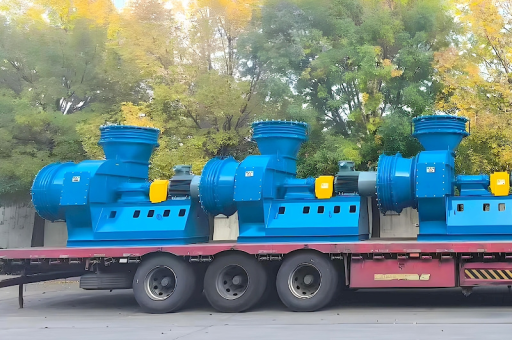
To provide you with a useful response about a 250 kW centrifugal fan, I need to clarify the context. 250 kW (approximately 335 HP) is a very large industrial fan. These are typically used in heavy industries like mining, cement, steel mills, power plants, or large-scale HVAC systems.
Below is a breakdown of the key specifications, applications, and challenges associated with a fan of this size.
Typical Specifications (What "250 kW" implies)
- Power: 250 kW (Motor output power, usually AC induction motor)
- Airflow: Extremely high. Depending on the pressure, this could move 100,000 to 600,000+ CFM (Cubic Feet per Minute) or 170,000 to 1,000,000+ m³/h.
- Pressure: Typically Medium to High Static Pressure (e.g., 2,500 Pa to 8,000 Pa / 10” to 32” w.g.).
- Impeller Diameter: Large, often 5 to 3 meters (5 to 10 feet) in diameter.
- Speed: Usually operates at 600 to 1,200 RPM (driven via V-belt or directly coupled with a gearbox/inverter). 1,500 RPM would be very high for a fan this size.
- Vibration: Requires heavy-duty bearings (split pillow block, spherical roller) and a rigid base frame.
- Motors: Almost always a 3-phase induction motor (LV 400V/690V or MV 3.3kV/6.6kV/11kV). A 250 kW motor on 400V draws around 430 Amps (full load).
Most Common Applications
A fan this size is not for a small workshop. It is found in:
- Cement Plants: ID (Induced Draft) fans for preheater towers or raw mill exhaust.
- Steel Mills: Baghouse dust collection fans or combustion air fans.
- Power Plants: Primary air fans, forced draft (FD) fans, or induced draft (ID) fans for boilers.
- Mines: Main ventilation fans (often running 24/7).
- Large Tunnels: Ventilation for subway or road tunnels (reversible type).
- Chipboard/MDF Production: Drying line fans for wood particles.
Critical Considerations for Installation & Operation
If you are dealing with a 250 kW fan, the following are critical:
A. Starting Method (Crucial)
- Direct-on-Line (DOL): Impossible for 250 kW on a weak grid. The inrush current would be 3,000A+ and cause a massive voltage dip.
- Star-Delta (Y-Δ): Possible, but torque is reduced. Not ideal for high-inertia fans.
- Soft Starter: Common. Reduces mechanical shock. Typically 480A-rated for 250 kW.
- Variable Frequency Drive (VFD): The best option. Allows for very low inrush current (1.2x FLA), variable speed for process control, and massive energy savings (Fan Affinity Laws: Power ∝ Speed³).
B. Drive Train
- V-Belt Drive: Allows for speed changes, absorbs some shock, but has losses and requires maintenance (tension, alignment).
- Direct Drive (via Coupling): High efficiency, less maintenance. Needs a VFD or gearbox.
C. Ductwork & Dampers
- The ductwork must be sized correctly. A static pressure loss of just 500 Pa on a 250 kW fan represents significant energy waste.
- Inlet box dampers (variable inlet vanes) are often used for flow control if no VFD is present. Outlet dampers are very inefficient.
D. Safety Systems
- Vibration Monitoring: Mandatory (accelerometers on bearing housings).
- Bearing Temperature: RTDs or thermocouples feeding into the control system.
- Casing Drainage: For fans handling moist air to prevent water accumulation and imbalance.
Troubleshooting Common Issues
| Symptom | Likely Cause | Solution |
|---|---|---|
| Fan vibrates | Impeller imbalance (dust build-up, erosion, corrosion) OR bearing failure | Clean impeller. Check for wear. Replace bearings. |
| Motor overloads | Inlet/outlet damper closed when starting (ID fan) OR system resistance too low | Open dampers slowly. Check ductwork. |
| Low airflow | Slip in belt drive, dirty filter, impeller worn down, damper stuck | Inspect belts, clean/replace filter, check clearances. |
| Noise / Whistle | Air leakage through duct joints or partial stall at the impeller | Seal ducts. Check operating point on fan curve. |
| Bearing overheat | Incorrect lubrication (too much/too little) OR misalignment | Purge old grease. Re-align motor and fan. |
Energy Efficiency (The "Money" Issue)
A 250 kW fan running 24/7 for a year at $0.10/kWh costs $219,000 per year in electricity.
- Using a VFD to reduce speed by just 10% (from 100% to 90%) reduces power consumption by 27% (from 250 kW to 183 kW). That saves $58,000 per year.
- Using an efficient impeller design (e.g., backward-curved airfoil blades instead of radial blades) can save 10-15%.
Summary: What do you need to know?
To give you a specific answer, tell me:
- What is the application? (e.g., "Cement plant ID fan")
- What is the problem? (e.g., "Motor is tripping on overload" or "Looking for specifications for a bid")
- What is the current drive system? (e.g., "Belt drive, 4-pole motor, soft starter")
- What is the operating speed? (e.g., "Currently running at 850 RPM")
For immediate action: If you are installing a 250 kW fan, ensure you have a minimum of a soft starter or a VFD and mandatory vibration protection. This is a high-energy, high-inertia machine that can cause significant damage if not handled correctly.





