
This article's table of contents introduction:
- The Material: 16Mn Steel (Q345 / S355JR)
- The Design: Backward Curved (BC / BI)
- The Application: Industrial Drying
- Typical Specifications for a "16Mn Backward Curved Drying Fan"
- Important Considerations for Selection
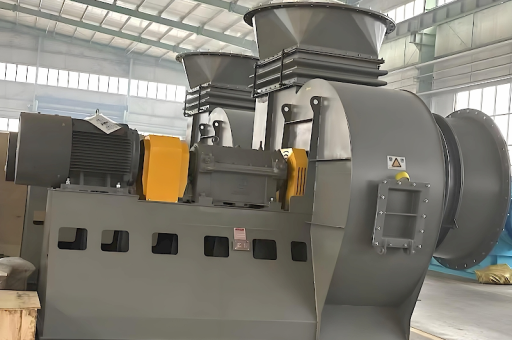
It appears you are looking for specifications or application information regarding industrial centrifugal fans that are:
- Material: Made of 16Mn steel (a high-strength low-alloy structural steel).
- Design: Backward Curved (Backward Inclined) impeller design.
- Application: Drying systems (pneumatic conveying, fluid bed dryers, spray dryers, etc.).
Here is a detailed breakdown of what these fans are, their characteristics, and why this combination is used for industrial drying.
The Material: 16Mn Steel (Q345 / S355JR)
- What is it? 16Mn is a Chinese standard designation (now largely replaced by Q345 or Q355 in GB/T standards). It is similar to European S355JR or American A572 Grade 50.
- Why use it for fans?
- Higher Strength: It has a yield strength of ~345 MPa, significantly higher than standard Q235 (A36) steel (~235 MPa). This allows for:
- Thinner walls: Reduced weight and lower rotational inertia.
- Higher tip speeds: Allows the fan to generate higher pressures without the impeller failing (bursting).
- Resistance to fatigue: Better for constant high-speed operation.
- Wear Resistance: 16Mn is tougher and more resistant to abrasion than mild steel, making it suitable for air streams carrying particulate matter (dust, grains, powders).
- Weldability: It is readily weldable, allowing for strong impeller and housing fabrication.
- Higher Strength: It has a yield strength of ~345 MPa, significantly higher than standard Q235 (A36) steel (~235 MPa). This allows for:
The Design: Backward Curved (BC / BI)
- Blade Shape: The blades curve away from the direction of rotation.
- Key Characteristics:
- High Efficiency: Typically 80-85% peak static efficiency. They are the most efficient design for centrifugal fans (non-airfoil).
- Non-Overloading Power Curve: This is critical. The motor power draw peaks at a specific point (usually around 60-70% of wide-open flow) and then drops off as flow increases.
- Benefit: If a duct clogs or the system resistance drops suddenly, the motor is unlikely to overload and trip. This makes BC fans safe for variable systems.
- High Pressure Medium Flow: They generate high static pressures (suitable for overcoming resistance in dryers) while delivering a stable, uniform airflow.
- Self-Limiting: They cannot run wildly and burn out a motor like a Forward Curved (FC / Sirocco) fan can if the system resistance changes.
The Application: Industrial Drying
Industrial drying often involves:
- High Temperature: Air temperatures can range from 80°C to 400°C+ (for direct-fire dryers).
- Abrasive Particles: Product being dried (sand, sawdust, minerals, grains, chemicals) is carried in the air stream.
- High Static Pressure: Needed to push air through bed dryers, rotary dryers, or long duct runs.
- Continuous Duty: Fans run 24/7 for weeks or months.
Why this combination works for Drying:
| Requirement for Drying | How the 16Mn Backward Curved Fan Solves It |
|---|---|
| Strength under heat | 16Mn retains better structural integrity at elevated temperatures than mild steel, reducing creep and deformation. (For extreme heat >350°C, you would need alloy steels like Q345R or stainless). |
| Abrasion resistance | 16Mn is harder than standard carbon steel. Combining this with a hardox liner or ceramic tile coating in the fan's wear zone extends life significantly. |
| Non-overloading | If the product clogs the duct momentarily, the BC fan's motor won't burn up, saving maintenance costs. |
| Efficiency (Energy Cost) | Industrial dryers consume massive amounts of energy. A high-efficiency BC fan reduces electricity consumption (kW) by 10-20% vs. an FC fan for the same duty. |
| Stable Pressure | BC fans have a steep pressure curve, meaning they maintain a relatively constant pressure even if flow varies slightly, which is vital for fluidized bed dryers. |
Typical Specifications for a "16Mn Backward Curved Drying Fan"
When ordering or specifying this fan, you would provide these parameters:
- Fan Type: 9-19 Series or 9-26 Series (Common Chinese standards for high-pressure BC fans) or an industrial custom design (e.g., "No. 10D").
- Impeller Material: 16Mn.
- Housing Material: Q235 (common) or 16Mn (for high temp/pressure).
- Shaft Material: 45# steel (carbon steel) or 40Cr (alloy steel) for high-speed applications.
- Duty: Industrial Drying (e.g., Sand Dryer / Sawdust Dryer / Pharmaceutical Fluid Bed).
- Flow Rate (Q): e.g., 20,000 m³/h.
- Total Pressure (P): e.g., 5500 Pa.
- Temperature: e.g., 150°C.
- Motor: e.g., 45 kW, 1450 RPM (or VFD controlled).
Important Considerations for Selection
- Wear Protection: For abrasive materials (sand, cement, minerals), the fan must have wear plates (liners) on the housing cut-off and the impeller blades (often welded on the backside of the blade). Standard 16Mn alone may not last long in heavy abrasive drying.
- Temperature de-rating: At high temperatures, the yield strength of 16Mn decreases. A structural engineer must calculate the impeller's safety factor at the operating temperature, not at room temperature. At 200°C, 16Mn retains about 85-90% of its room temperature strength.
- Balance: Backward curved fans must be dynamically balanced (Grade G6.3 or G2.5) to avoid vibration at high speeds. 16Mn's good weldability helps here for adding balancing weights.
- Spark Protection: If drying flammable materials (e.g., wood dust, grains), the fan may require aluminum impellers (non-sparking) or carbon steel with PTFE seals and grounding. 16Mn will spark if it hits the housing.
Summary: Using a 16Mn Backward Curved fan for industrial drying is a standard engineering choice for demanding applications. It provides the strength to run at high speeds and temperatures, the efficiency to save energy, the safety of a non-overloading power curve, and the toughness to handle dusty, abrasive air streams.
Would you like me to elaborate on the specific wear protection methods (e.g., ceramic coating vs. tungsten carbide overlay) for these fans?





