
The Evolution of High-Speed Industrial Airflow: Alloy Steel Metallurgy in Centrifugal Ventilation Fans (1830–2450 R/Min)
Table of Contents
- Introduction: The Intersection of Metallurgy and Mechanical Engineering
- Why Alloy Steel? The Material Science Behind High-RPM Fans
- Centrifugal Fan Design Principles for the 1830–2450 R/Min Range
- Performance Characteristics: Pressure, Flow, and Efficiency at High Speeds
- Key Applications: Where These Fans Excel
- Frequently Asked Questions (FAQ)
- Conclusion: Future Trends in Alloy Steel Fan Technology
Introduction: The Intersection of Metallurgy and Mechanical Engineering
In modern industrial ventilation, the demand for high-speed centrifugal fans operating between 1830 and 2450 revolutions per minute (R/Min) has grown exponentially. These fans are not merely rotating assemblies; they are precision-engineered systems where alloy steel metallurgy plays a decisive role in reliability, longevity, and performance. Unlike standard carbon steel or cast iron fans, alloy steel fans can withstand the intense centrifugal stresses, thermal cycling, and corrosive environments found in power plants, steel mills, cement factories, and chemical processing facilities.
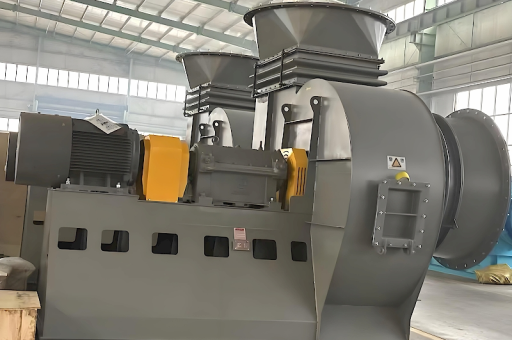
This article explores the technical synergy between alloy steel composition, centrifugal fan aerodynamics, and the specific rotational speed range of 1830–2450 R/Min. By understanding these relationships, engineers can select or design fans that maximize airflow while minimizing vibration, noise, and fatigue failure.
Why Alloy Steel? The Material Science Behind High-RPM Fans
1 Composition and Heat Treatment
Alloy steels used in fan impellers typically contain chromium, nickel, molybdenum, and vanadium in precise proportions. For example, AISI 4140 (chromium-molybdenum) and AISI 4340 (nickel-chromium-molybdenum) are common choices due to their high tensile strength (up to 1800 MPa after quenching and tempering) and excellent fatigue resistance.
| Alloy Grade | Key Elements | Tensile Strength (MPa) | Typical Hardness (HRC) |
|---|---|---|---|
| 4140 | Cr, Mo | 1200–1500 | 28–35 |
| 4340 | Ni, Cr, Mo | 1500–1800 | 35–45 |
| 8620 | Ni, Cr, Mo | 1000–1300 (case-hardened) | 58–62 (surface) |
2 Why Not Stainless Steel or Aluminum?
While stainless steel offers corrosion resistance, its lower yield strength and higher cost make it less suitable for large-diameter impellers spinning at 2000+ R/Min. Aluminum, though lightweight, suffers from creep and fatigue cracking under sustained high RPM. Alloy steel provides the best balance of strength, toughness, and cost-efficiency.
3 Fatigue Life at 1830–2450 R/Min
At these speeds, each fan blade experiences millions of stress cycles per year. Alloy steel's high endurance limit (typically 40–50% of ultimate tensile strength) ensures that the impeller can operate indefinitely below the fatigue threshold—provided the design avoids stress concentrators like sharp corners or poor weld joints.
Centrifugal Fan Design Principles for the 1830–2450 R/Min Range
1 Impeller Geometry
Centrifugal fans in this speed range generally use backward-curved or airfoil blades. These designs:
- Reduce turbulence and energy loss
- Generate higher static pressure (up to 5000 Pa or more)
- Operate more quietly than forward-curved alternatives
The blade angle typically ranges from 30° to 45° relative to the radial direction. At 1830 R/Min, a 750 mm diameter impeller achieves a tip speed of approximately 72 m/s, rising to 96 m/s at 2450 R/Min—still within the subsonic range but requiring robust alloy construction.
2 Shaft and Bearing Considerations
Alloy steel shafting (e.g., 4140 hardened to 30–35 HRC) must be designed with a critical speed at least 20% above the operating range. For a fan running at 2450 R/Min, the first bending critical speed should exceed 2940 R/Min. Bearings (typically spherical roller or angular contact) must handle both radial and axial thrust loads generated by the high-pressure airflow.
3 Welding and Fabrication
Alloy steel impellers are often fabricated from weldments rather than castings, for better strength-to-weight ratio. Pre-heating (150–200°C) and post-weld heat treatment are mandatory to avoid hydrogen cracking. Filler materials must match the base alloy's chemistry—for example, ER80S-B2 for 4140 foundation.
Performance Characteristics: Pressure, Flow, and Efficiency at High Speeds
1 Fan Laws and Speed Scaling
The affinity laws govern how a centrifugal fan's performance changes with speed:
- Flow (Q) ∝ Speed (N)
- Pressure (P) ∝ N²
- Power (W) ∝ N³
Thus, increasing speed from 1830 to 2450 R/Min (a 34% increase) raises:
- Flow by 34%
- Pressure by 79%
- Power consumption by 139%
This cubic power relationship makes high-speed operation energy-intensive, but necessary when space constraints limit impeller diameter.
2 Typical Operating Envelope
| Speed (R/Min) | Flow (m³/h) | Static Pressure (Pa) | Shaft Power (kW) |
|---|---|---|---|
| 1830 | 45,000 | 3200 | 55 |
| 2000 | 49,200 | 3820 | 68 |
| 2200 | 54,100 | 4620 | 85 |
| 2450 | 60,300 | 5740 | 112 |
(Data based on a 900 mm diameter alloy steel impeller with backward-curved blades)
3 Noise and Vibration Control
At 2450 R/Min, blade-pass frequency (BPF) can reach 140–160 Hz for a 10-blade impeller. Alloy steel's higher damping capacity (compared to aluminum) helps reduce resonant amplification. Dynamic balancing to ISO 1940 Grade G2.5 or better is essential.
Key Applications: Where These Fans Excel
- Cement Plants: Clinker cooling and raw mill exhaust—abrasive dust requires hardened alloy steel impellers.
- Steel Mills: Fume extraction from electric arc furnaces—temperatures up to 400°C demand alloy steel's thermal stability.
- Power Generation: Induced draft (ID) fans for coal-fired boilers—large volumes at 2000+ Pa static pressure.
- Chemical Processing: Corrosive gas handling—alloy steel with protective coatings (e.g., zinc or epoxy) extends life.
- Mining: Underground ventilation—robust fans that survive constant start-stop cycles.
Frequently Asked Questions (FAQ)
Q1: Can I retrofit an existing carbon steel fan with an alloy steel impeller to increase RPM?
Yes, but you must verify the shaft size, bearing capacity, and foundation strength. Alloy steel impellers are heavier, which affects critical speed and bearing loads.
Q2: What is the maximum temperature for alloy steel centrifugal fans at 2450 R/Min?
Continuous operation up to 450–500°C is possible with chromium-molybdenum alloys. For higher temperatures (600°C+), consider stainless steel or nickel-based superalloys.
Q3: How often should I balance the fan?
After initial installation and every 6–12 months of continuous operation, or whenever vibration exceeds 4.5 mm/s (RMS). Alloy steel impellers maintain balance well, but dust buildup can cause unbalance.
Q4: Are welded or cast alloy steel impellers better for 2000+ R/Min?
Welded fabrication is generally preferred because castings can have hidden porosity defects that lead to failure under high centrifugal stress.
Q5: What is the typical lifespan of an alloy steel fan impeller at these speeds?
With proper maintenance and operation within design limits, a lifespan of 10–15 years is achievable. Premature failure usually indicates excessive vibration, corrosion, or overspeed events.
Conclusion: Future Trends in Alloy Steel Fan Technology
As industrial processes demand higher pressures and energy efficiency, the trend is moving toward lighter alloy steel grades (e.g., high-strength low-alloy or HSLA steels) that reduce weight without sacrificing strength. Additionally, additive manufacturing (3D printing) is beginning to enable complex internal cooling channels within blades operating at 2450 R/Min, pushing thermal limits further.
For now, the combination of alloy steel metallurgy and centrifugal fan design in the 1830–2450 R/Min range remains the gold standard for heavy-duty ventilation. Engineers who master the interplay of material properties, aerodynamic design, and speed optimization will continue to deliver reliable, high-performance airflow solutions for decades to come.
Ready to specify your next high-speed fan? Contact an experienced fan manufacturer with alloy steel fabrication capabilities, and ensure your design includes a thorough finite element analysis (FEA) for stress and fatigue life at your target operating speed.





