
This article's table of contents introduction:
- What it is: A Heavy-Duty Industrial Workhorse
- Breakdown of the Four Key Terms
- Critical Design Challenges & Solutions for This Specific Fan
- Summary Table: Typical Specifications
- Conclusion
This is a highly specific and technical product description. It combines material science (Carbon Steel), a performance metric (Energy Efficiency), a manufacturing process (Centrifugal Fan), and a specific industrial application (High Temperature Metallurgy).
Here is a detailed breakdown of what this product is, its key design considerations, and why those four descriptors are critical together.
What it is: A Heavy-Duty Industrial Workhorse
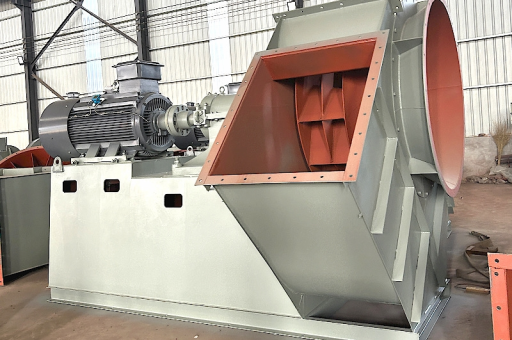
This is a Centrifugal Fan made from Carbon Steel, designed to move large volumes of air or gas at high pressures within a High Temperature Metallurgy environment (like a steel mill, smelter, or foundry) while operating with high Energy Efficiency.
It is not a standard HVAC fan. It is an engineered piece of equipment for a harsh, demanding environment.
Breakdown of the Four Key Terms
High Temperature Metallurgy (The Application)
This defines the operational environment. It is the most critical constraint.
- Temperatures: The gas stream can be 200°C to 500°C (or higher with special coatings/cooling). This is hot enough to make standard steel soft and weak.
- Gas Composition: The air/gas is often dirty, containing:
- Abrasive dust (scale, coke, ore particles).
- Corrosive fumes (SOx, NOx, chlorides).
- Combustible gases (CO, hydrogen).
- Operating Conditions: Often continuous, 24/7 operation. Reliability is paramount. A failure can shut down an entire furnace or processing line.
Carbon Steel (The Material)
The choice of carbon steel is a deliberate balance between cost, strength, and heat resistance.
- Why not Stainless Steel? Carbon steel is significantly cheaper and stronger at lower temperatures. For moderately high temperatures (up to ~400-450°C), it is perfectly adequate.
- Heat Treatment & Grades: The specific grade of carbon steel (e.g., ASTM A36, A516 Gr. 70, or high-temperature-specific grades like A387) is critical. The fan wheel (impeller) is often made from a quenched and tempered carbon steel to improve its high-temperature strength and resistance to creep.
- Thermal Expansion: Carbon steel expands predictably with heat. The fan design must account for this to prevent the impeller from rubbing against the housing.
- Corrosion/Erosion: While not as resistant as stainless, carbon steel can be "sacrificed" (cheaper to replace) or protected with hard-facing (welded overlays) on leading edges of blades to resist erosion from dust.
Centrifugal Fan (The Mechanism)
This is the type of fan. For high-temperature, dusty environments, a specific subtype is usually chosen:
- The Preferred Type: Radial Blade (or "Paddlewheel") Fan.
- Why? These have flat, straight blades. They are the most robust design.
- Self-Cleaning: They resist material buildup (fouling) on the blades much better than forward-curved or backward-inclined blades.
- Strength: The simple blade design is structurally strong against the forces of rotation and thermal stress.
- Other Options:
- Backward-Inclined (Airfoil) Blades: More efficient if the air is clean. Not good for dirty metallurgical gases due to fouling.
- Radial-Tip: A compromise between efficiency and self-cleaning.
Energy Efficiency (The Performance Goal)
This is the modern challenge. Historically, "heavy duty" meant "ignore energy cost." Now, efficiency is a primary design driver.
- How it's Achieved despite the harsh environment:
- Aerodynamic Optimization: Even with simple radial blades, the fan housing (volute) and inlet cone are computer-modeled (CFD) to minimize turbulence and internal recirculation.
- Variable Speed Drives (VFDs): The fan is almost always driven by a VFD. Instead of throttling a damper (like a clogged filter), the fan speed is precisely matched to the process demand. This yields massive energy savings (Power is proportional to the cube of speed).
- Belt vs. Direct Drive: Belt drives allow for speed changes and can isolate the motor from heat, but they have friction losses. Direct drive (motor mounted directly on the fan shaft) is more efficient but requires the motor to be specially designed for the heat or mounted outside the airstream.
- Seals & Leakage: Minimizing gas leakage between the impeller and the inlet cone prevents energy loss.
Critical Design Challenges & Solutions for This Specific Fan
| Challenge | Standard Fan | This High-Temp, High-Efficiency Fan |
|---|---|---|
| Heat Expansion | Ignored or simple clearance. | Impeller disk and shaft designed with a calculated "cold gap" that closes at operating temperature (e.g., a 2mm cold gap becomes a 0.5mm hot gap for efficiency). Materials matched for thermal expansion. |
| Creep & Fatigue | Not a primary concern. | The impeller is stress-relieved and non-destructively tested (NDT - dye penetrant or magnetic particle). The shaft may have a water-cooled labyrinth seal to cool the shaft bearing. |
| Dust Erosion | Filters (common). | Heavy-gauge carbon steel plates on the blades. Replaceable wear plates on the housing where erosion is worst. A "shroudless" impeller design to avoid a plate being eaten through. |
| Energy Waste | Low priority. | Precision balancing (ISO 1940 G2.5 or better). VFD integration. Computational Fluid Dynamics (CFD) to design a housing with minimal pressure drop. Low-friction bearings (spherical roller bearings with high-temp grease). |
| Maintenance | Difficult, in-situ. | Designed with large access doors, split housings, and a removable shaft-bearing assembly (cartridge design) so the fan can be serviced without removing the entire ductwork. |
Summary Table: Typical Specifications
| Feature | Specification for this Fan |
|---|---|
| Type | Centrifugal, Radial Blade (Paddlewheel) or Radial-Tip |
| Material | Carbon Steel (e.g., A516 Gr. 70 for impeller, A36 for housing) |
| Max Gas Temp | ~450°C (standard). Up to 650°C+ with shaft cooling or special alloys. |
| Drive | VFD-controlled motor (e.g., 500 HP, 4,160V induction motor with VFD) |
| Application | Induced Draft (ID) for an Electric Arc Furnace (EAF), Sinter Plant exhaust, or Reheat furnace combustion air. |
| Key Feature | Water-cooled bearings. |
| Efficiency | 70-80% (much lower than a clean-air fan, but very high for this heavy-duty class). |
Conclusion
A "Carbon Steel Energy Efficiency High Temperature Metallurgy Centrifugal Fan" is a specialized, high-cost, engineered capital asset. It's a trade-off. You cannot get the ultimate efficiency of a clean-air, backward-inclined fan, but you get a robust, durable machine that moves large volumes of hot, dirty gas without failing.
The "Energy Efficiency" aspect is the modern differentiator, achieved primarily through VFD control and aerodynamic optimization of the robust, self-cleaning radial-blade design. When sourcing this fan, you must ask about:
- Impeller design (thickness, heat treatment, balance grade).
- Bearing cooling method (shaft cooling fan, water jacket, or isolated pedestal).
- VFD compatibility and control strategy.
- Erosion protection (hard-facing on blades, replaceable liners).





