
This article's table of contents introduction:
- Breaking Down the Specification
- Primary Applications
- Key Design & Engineering Features (What makes it "High-Efficiency" and "High-Flow")
- Performance Parameters (Typical Examples)
- Critical Considerations When Sourcing or Selecting
- Example Manufacturers (Global & Regional)
- Summary Recommendation
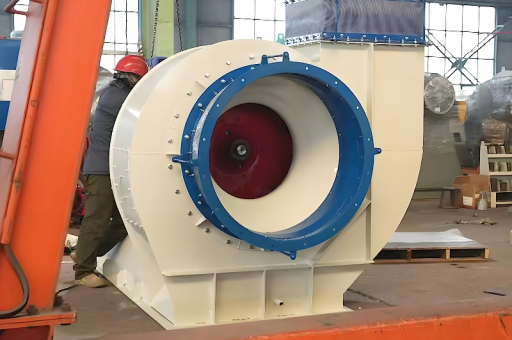
This is a specific industrial equipment specification. A 132kW High-Flow-Rate, High-Efficiency Boiler Fan is typically a forced draft (FD) or induced draft (ID) fan used in large industrial boilers, power plants, or CHP (Combined Heat and Power) systems.
Here is a comprehensive breakdown of what this specification means, its typical applications, key design features, and what to look for when sourcing one.
Breaking Down the Specification
- 132 kW (Power): This is the motor power. It indicates a large, heavy-duty fan.
- Context: A 132kW motor (approx. 177 HP) is significantly larger than standard HVAC fans. It is used for large-scale steam generation (e.g., boilers producing 20-50+ tons of steam per hour) or for high-pressure drops.
- High-Flow-Rate: This refers to a high volumetric air flow, typically measured in m³/h (cubic meters per hour) or m³/s.
- Implication: The fan is designed to move a massive volume of air against a moderate resistance (ductwork, burner, heat exchanger).
- High-Efficiency: This is the key performance metric.
- Meaning: The fan converts electrical power into air movement with minimal losses. Efficiency here usually refers to the impeller efficiency (often >80-85%), overall fan static efficiency, or wire-to-air efficiency (including motor and drive losses).
- Standards: Likely meets IE3 or IE4 motor efficiency standards. The impeller design is likely backward-curved or airfoil blades.
- Boiler Fan: This defines the application.
- Function: Provides combustion air to burn fuel (gas, oil, biomass, coal) or removes flue gas.
- Critical Requirement: Must handle high temperatures (for ID fans) or clean, ambient air (for FD fans). Must be robust and reliable for continuous industrial operation.
Primary Applications
- Industrial Steam Boilers: For process industries (chemical, food processing, textile, refineries, paper mills).
- Power Generation: Small to medium sized power plants (up to 50 MW).
- Waste-to-Energy Plants: To supply air for waste combustion or to handle corrosive flue gases.
- District Heating: Large central boiler plants providing heat to entire cities.
- Biomass Fired Boilers: Typically requires heavy-duty impellers resistant to erosion or corrosion.
Key Design & Engineering Features (What makes it "High-Efficiency" and "High-Flow")
- Impeller Design:
- Backward-curved centrifugal impellers (e.g., Type FC/BI): These are standard for high-efficiency, non-stalling operation. The airfoil blades (like airplane wings) provide the highest efficiency.
- Diameter: Usually 800mm to 1400mm depending on the pressure and flow requirements.
- Housing:
- Spiral/Scroll Design: Optimized for converting velocity pressure into static pressure efficiently.
- Material: Heavy gauge steel (e.g., 5mm or thicker). For ID fans, Corten steel or stainless steel (304/316) to resist corrosion from flue gas condensation.
- Motor & Drive:
- Motor: High-efficiency IE3/IE4 induction motor. Could also be a permanent magnet synchronous motor (PMSM) for even higher efficiency (up to 97%).
- VFD (Variable Frequency Drive): Highly recommended. For a 132kW fan, VFD control is essential for energy savings. Without VFD, the fan runs at or near 100% speed constantly, wasting huge amounts of energy when the boiler is at partial load. VFD also allows for soft-start and precise pressure/flow control.
- Coupling: Direct-drive (shaft-mounted motor or motor with flexible coupling) OR pulley/belt drive (allows speed adjustment via pulley size change).
- Bearings:
- Heavy-duty, self-aligning spherical roller bearings.
- Must have a robust lubrication system (grease or oil bath).
- Vibration monitoring ports (accelerometer mounts) are standard.
- Inlet/Outlet:
- Inlet Box: Often includes turning vanes to straighten airflow, improving efficiency.
- Inlet Damper / IGV (Inlet Guide Vanes): Used in older systems to control airflow. However, VFD is vastly superior in efficiency.
Performance Parameters (Typical Examples)
(These are rough estimates; exact parameters depend on the manufacturer and specific boiler design)
| Parameter | Typical Value | Unit |
|---|---|---|
| Power | 132 | kW |
| Flow Rate | 80,000 - 200,000 | m³/h |
| Static Pressure | 3,000 - 8,000 | Pa |
| Fan Speed | 1,000 - 1,800 | RPM |
| Efficiency (Impeller) | 82 - 88 | % |
| Operating Temp (FD) | 20 - 60 | °C |
| Operating Temp (ID) | 120 - 250 | °C |
Critical Considerations When Sourcing or Selecting
-
Fan Type: FD vs. ID vs. PA (Primary Air)
- FD Fan: Handles clean, cold air. No corrosion issues.
- ID Fan: Handles hot, dirty, corrosive flue gas. Must have: Erosion-resistant impeller, high-temperature shaft seals, cooling system for bearings (often a fan on the shaft).
- PA Fan: For pulverized coal systems. High pressure, moderate flow.
-
Efficiency Verification: Ask for a performance curve.
- The fan should have its highest efficiency at the Normal Operating Point (NOP) of your boiler.
- Look for a flat pressure curve which is less prone to surging.
- Efficiency should be quoted in wire-to-air terms (including motor, VFD, and belt losses if applicable).
-
Sound Levels / Noise Control:
- A 132kW fan at high speed is very loud (often >80-85 dBA).
- May require a silencer (attenuator) on the inlet and/or outlet.
- May require an acoustic enclosure or insulated ductwork.
-
Control System Integration:
- Must be compatible with your boiler's burner management system (BMS) or DCS (Distributed Control System) .
- Needs 4-20 mA input from a VFD, and feedback of fan status, vibration, and temperature.
-
Structural Support:
A 132kW fan is very heavy (several tons). The base/foundation must be strong and vibration-dampened (e.g., with inertia base pads or spring isolators).
Example Manufacturers (Global & Regional)
- European: Korfmann, EBM-Papst (industrial), FläktGroup, TLT-Turbo, Howden.
- American: Greenheck (industrial), Howden, Chicago Blower, New York Blower.
- Asian/Chinese: Many large OEMs (e.g., Shanghai Gofront, Shandong Zhaori). If buying from China, ensure CE or UL certification for motors and VFDs.
- Specialist Boiler Fan Manufacturers: Powerflo, Aerovent, Robinson Fans.
Summary Recommendation
For a 132kW High-Flow-Rate, High-Efficiency Boiler Fan:
- Prioritize a Backward-Curved Airfoil (BC/BA) impeller for maximum efficiency.
- Mandate a Variable Frequency Drive (VFD). This alone will save thousands of dollars per year in energy costs.
- Specify IE4 or IE5 motor efficiency.
- Get verified performance curves (flow vs. pressure vs. power) from the manufacturer.
- If it's an ID fan, insist on high-temperature materials, shaft cooling, and erosion-resistant construction.
- Always include vibration and temperature sensors for predictive maintenance.





