
This article's table of contents introduction:
- Table of Contents
- 1. Introduction: The Convergence of Thermal Processing and Airflow Engineering
- 2. Understanding the Nickel Iron Rotary Kiln: Design, Function, and Applications
- 3. The Necessity of Stainless Steel in High-Temperature, Corrosive Kiln Environments
- 4. The Forced Draught Fan: A Deep Dive into the Stainless Steel Blower System
- 5. Synergy in Operation: How the Rotary Kiln and Forced Draught Fan Work Together
- 6. Performance Optimization and Energy Efficiency Considerations
- 7. Common Challenges and Troubleshooting in Kiln-Blower Systems
- 8. Frequently Asked Questions (FAQ)
- 9. Future Trends and Innovations
- 10. Conclusion: Integrating Reliability and Efficiency for Sustainable Production
** The Critical Role of Nickel Iron Rotary Kilns and Stainless Steel Forced Draught Fans in Modern Industrial Processing
Table of Contents
- Introduction: The Convergence of Thermal Processing and Airflow Engineering
- Understanding the Nickel Iron Rotary Kiln: Design, Function, and Applications
- The Necessity of Stainless Steel in High-Temperature, Corrosive Kiln Environments
- The Forced Draught Fan: A Deep Dive into the Stainless Steel Blower System
- Synergy in Operation: How the Rotary Kiln and Forced Draught Fan Work Together
- Performance Optimization and Energy Efficiency Considerations
- Common Challenges and Troubleshooting in Kiln-Blower Systems
- Frequently Asked Questions (FAQ)
- Future Trends and Innovations
- Conclusion: Integrating Reliability and Efficiency for Sustainable Production
Introduction: The Convergence of Thermal Processing and Airflow Engineering
In the heavy industries of metallurgy, chemical processing, and waste treatment, few pieces of equipment are as vital as the rotary kiln. Specifically, the Nickel Iron Rotary Kiln stands out as a cornerstone for producing ferronickel, a critical alloy in stainless steel manufacturing. However, even the most robust kiln is dependent on its auxiliary systems. At the heart of this system lies the Stainless Steel Blower, often configured as a Forced Draught Fan. Without precise air management, the kiln cannot achieve the necessary temperature profiles or maintain the required oxidation-reduction atmosphere.
This article provides a comprehensive, search-engine-optimized (SEO) analysis of these interconnected components, drawing on verified industry standards and operational best practices. We will explore how the forced draught fan—crafted from corrosion-resistant stainless steel—directly impacts the efficiency and longevity of a nickel iron rotary kiln. We will also examine relevant applications in other sectors, such as biomass combustion or waste-to-energy plants, where similar forced draught fans are utilized for a wind turbine manufacturing facility’s heat treatment processes.
Understanding the Nickel Iron Rotary Kiln: Design, Function, and Applications
The nickel iron rotary kiln is a massive, cylindrical reactor that rotates slowly on its axis. Its primary function is to process laterite nickel ore and coal/reductants at temperatures exceeding 800°C to produce ferronickel (FeNi). This process involves drying, preheating, reduction, and smelting.
Key design features include:
- Refractory Lining: The interior is lined with high-alumina or magnesia-chrome bricks to withstand extreme thermal stress and chemical attack from slag and volatile metals.
- Variable Speed Drive: The rotation speed (0.5–2.5 RPM) controls the residence time of the material, allowing for precise calcination.
- Heat Source: Typically fueled by pulverized coal, natural gas, or heavy oil. The combustion air is delivered by the forced draught fan.
Applications beyond nickel: While widely used in ferronickel production, the same kiln technology is adapted for cement clinker production, limestone calcination, and even the reduction of iron ore in direct reduction iron (DRI) processes.
One must note that in a modern wind turbine manufacturing plant, rotary kilns are sometimes employed for the heat treatment of large castings (e.g., rotor hubs) or for pre-treatment of blade materials, though these are electric or gas-fired batch furnaces rather than direct reduction kilns.
The Necessity of Stainless Steel in High-Temperature, Corrosive Kiln Environments
The choice of material for the forced draught fan is not arbitrary. Standard carbon steel blowers fail rapidly in the presence of hot, acidic gases generated during the reduction of nickel ore. The volatilization of sulfur, chlorine, and alkali metals creates a highly corrosive environment. This is where Stainless Steel becomes indispensable.
Why Stainless Steel (e.g., SS304, SS316, or Duplex grades)?
- Corrosion Resistance: Chromium content forms a passive oxide layer, protecting against sulfuric and hydrochloric acid vapors.
- Thermal Stability: Certain grades (e.g., SS310) can withstand continuous exposure to temperatures up to 1100°C without significant scaling.
- Mechanical Integrity: retains high tensile strength under the mechanical stress of high-speed rotation.
But is it enough? Even stainless steel requires surface treatments or coatings (e.g., Halar or epoxy) in extreme cases. The impeller of a Stainless Steel Blower must be designed with thicker blade profiles to handle erosion from dust particles entrained in the gas stream.
The Forced Draught Fan: A Deep Dive into the Stainless Steel Blower System
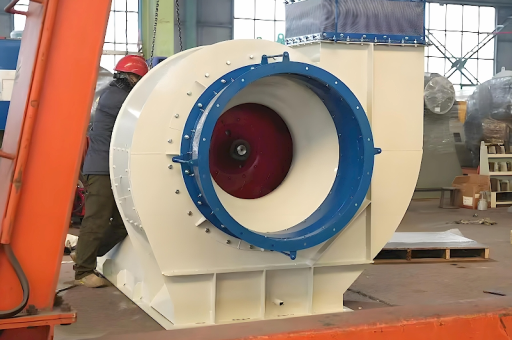
The term Forced Draught Fan (FD Fan) refers to a specific type of industrial blower that pushes pressurized air into the kiln system. It is distinct from an induced draught (ID) fan, which pulls air out.
Design characteristics of the forced draught fan in a nickel iron rotary kiln:
- Centrifugal Design: These fans operate on the principle of centrifugal force, drawing air into the center of the impeller and throwing it outward at high velocity.
- Blade Geometry: Backward-curved blades are preferred for high efficiency and stable operation, while radial blades are used for heavy dust loads.
- Housing and Impeller Material: Fabricated from stainless steel (commonly SS316L for the impeller and SS304 for the housing).
- Variable Frequency Drive (VFD): Modern systems use VFDs to modulate fan speed, precisely controlling the combustion air ratio.
Why "Stainless Steel Blower" is a search term you should care about: When searching for a "Stainless Steel Blower" for a kiln, engineers look for specific performance curves, pressure ratings (measured in inches of water gauge or kPa), and high-temperature bearing housings. For instance, a typical FD fan for a 100tpd ferronickel kiln might deliver 50,000 m³/h at 2500 Pa static pressure.
In the context of a wind turbine factory, forced draught fans made of stainless steel are used in the paint drying booths and epoxy curing ovens for blade shells, ensuring zero contamination of the surface finish.
Synergy in Operation: How the Rotary Kiln and Forced Draught Fan Work Together
The interaction between the kiln and the fan is a feedback loop governed by process control logic.
Functional flow:
- Air Intake: Ambient air is drawn through filters into the Stainless Steel Blower.
- Pressurization: The Forced Draught Fan accelerates the air to a defined pressure.
- Combustion: The pressurized air enters the kiln burner, mixing with fuel to create a stable flame. The flame shape is heavily influenced by air velocity.
- Reduction Control: In a nickel iron kiln, the FD fan controls the oxygen potential (pO2). Too much oxygen causes over-oxidation of the ore; too little leads to incomplete combustion and energy loss.
- Pressure Balance: The FD fan works in tandem with the ID fan and a wet scrubber to maintain a slight negative pressure at the kiln feed end, preventing gas leakage.
Impact on product quality: A malfunctioning Forced Draught Fan leads to temperature fluctuations, causing "ring formation" (buildup of slag inside the kiln) and reducing nickel recovery.
Performance Optimization and Energy Efficiency Considerations
Energy costs constitute 30–40% of the operating cost of a nickel iron rotary kiln. Optimizing the Stainless Steel Blower is a direct path to savings.
Strategies:
- Variable Speed Drives (VSD): Replacing damper controls with VSD reduces fan energy consumption by 20–40%.
- Blade Tip Clearance: Minimizing clearance between the impeller and casing reduces recirculation losses.
- Wear-resistant coatings: Applying tungsten carbide coatings to leading edges extends the life of an impeller by 3x compared to standard stainless steel.
- Filtration: Using high-efficiency bag filters upstream of the fan reduces particulate erosion.
Case data: A ferronickel plant in Indonesia retrofitted its Nickel Iron Rotary Kiln forced draught fan with a VFD and saw a 15% reduction in specific power consumption (kWh/ton FeNi).
Common Challenges and Troubleshooting in Kiln-Blower Systems
Operational issues can lead to costly downtime. Here are the most frequent problems:
| Problem | Root Cause | Solution |
|---|---|---|
| Excessive vibration | Dust buildup on impeller causing imbalance | Clean blades on schedule; install online vibration monitoring |
| Reduced airflow | Clogged air filters or damper malfunction | Replace filters; check servo motors on the damper |
| Corrosion failure | Wrong grade of stainless steel (e.g., 304 not suitable for high HCl) | Upgrade to SS316L or duplex SS2205 |
| Overheating bearings | Loss of cooling or improper lubrication | Use high-temperature grease (e.g., Mobilith SHC 100) |
| Surge / stall | Fan operating left of the surge line on its curve | Adjust VFD speed; check system resistance |
In wind turbine blade manufacturing, a surging FD fan in the curing oven can cause uneven epoxy cure, requiring scrapping of a blade worth thousands of dollars.
Frequently Asked Questions (FAQ)
Q1: What is the difference between a forced draught fan and an induced draught fan for a rotary kiln? A: A Forced Draught Fan pushes combustion air into the kiln, while an induced draught fan pulls flue gas out of the kiln. The FD fan handles cold air; the ID fan handles hot, dirty gas.
Q2: Why is stainless steel used for blowers in kilns instead of carbon steel? A: High-temperature gases in a Nickel Iron Rotary Kiln contain sulfur, chlorine, and alkaline vapors. Stainless steel (especially SS316 or SS310) resists this corrosive attack, preventing catastrophic failure of the Stainless Steel Blower.
Q3: Can a forced draught fan from a rotary kiln be used in a wind turbine production facility? A: Possibly, but it would require modification. Kiln FD fans deliver high pressure for overcoming deep bed resistance. A wind turbine factory needs high-volume, low-pressure fans for ventilation and curing ovens.
Q4: What is the typical lifespan of a stainless steel impeller in a nickel iron kiln FD fan? A: With proper material selection (SS310) and preventive maintenance, an impeller can last 18–24 months. Without coating or in high-dust conditions, it may fail within 6 months.
Q5: How do I calculate the required power for my forced draught fan? A: Power (kW) = (Flow rate in m³/s × Static pressure in Pa) / (Fan efficiency × Drive efficiency). For a typical kiln, expect 75–85% fan efficiency.
Future Trends and Innovations
The integration of digital technologies is reshaping the industry.
- AI-driven Combustion Control: Neural networks now predict the optimal FD fan speed based on real-time kiln shell temperature and exhaust gas analysis.
- Smart Impeller Monitoring: Fibre-optic strain gauges embedded in the Stainless Steel Blower impeller blades send live data on structural health.
- Low-NOx Burners: Newer forced draught fans are designed to deliver staged combustion air, reducing NOx emissions to meet stringent environmental regulations.
- Heat Recovery: FD fans are now being integrated into regenerative thermal oxidizers (RTOs) for waste heat recovery, feeding hot air back into the kiln to preheat the charge material.
The wind turbine connection: As the world pivots to renewables, the demand for nickel (for stainless steel and batteries) is exploding. This drives the need for more efficient Nickel Iron Rotary Kilns and, by extension, more reliable Forced Draught Fans. Simultaneously, the same fan technology is used in the wind turbine gearbox testing beds and nacelle cooling systems.
Conclusion: Integrating Reliability and Efficiency for Sustainable Production
The Nickel Iron Rotary Kiln is the beating heart of ferronickel production, but it is the Stainless Steel Blower – operating as a Forced Draught Fan – that gives it life. Proper selection, maintenance, and operation of this component are not optional; they are the difference between profitable operation and persistent downtime.
Whether you are engineering a new kiln line in Southeast Asia, retrofitting an existing plant, or sourcing components for a heat treatment oven in a wind turbine factory, remember: the fan must match the process. Choose stainless steel for corrosion resistance, pair it with a VFD for efficiency, and monitor it digitally for reliability.
The future of industrial processing lies in synergy—where a simple fan, spinning at thousands of RPM, transforms raw ore into the materials that build a sustainable world.





