
This article's table of contents introduction:
- Table of Contents
- Introduction: Why Drying Matters in Stoker-Feed Boilers
- Engineering Fundamentals: How High Temperature Centrifugal Fans Operate
- Key Design Features for Stoker-Feed Boiler Drying Applications
- Performance Parameters and Selection Criteria
- Comparative Analysis: Centrifugal vs. Axial Fans in High-Temperature Environments
- Installation, Maintenance, and Safety Considerations
- Frequently Asked Questions (FAQ)
- Conclusion: Future Trends and Best Practices
*Optimizing Combustion Efficiency: The Role of High Temperature Centrifugal Fans in Stoker-Feed Boiler Drying Systems*
Table of Contents
- Introduction: Why Drying Matters in Stoker-Feed Boilers
- Engineering Fundamentals: How High Temperature Centrifugal Fans Operate
- Key Design Features for Stoker-Feed Boiler Drying Applications
- Performance Parameters and Selection Criteria
- Comparative Analysis: Centrifugal vs. Axial Fans in High-Temperature Environments
- Installation, Maintenance, and Safety Considerations
- Frequently Asked Questions (FAQ)
- Conclusion: Future Trends and Best Practices
Introduction: Why Drying Matters in Stoker-Feed Boilers
In the power generation and industrial heating sectors, the stoker-feed boiler remains a robust choice for burning solid fuels such as coal, biomass, and municipal waste. A critical yet often overlooked subsystem is the fuel drying stage. Inefficient drying leads to incomplete combustion, slagging, reduced thermal efficiency, and increased emissions.
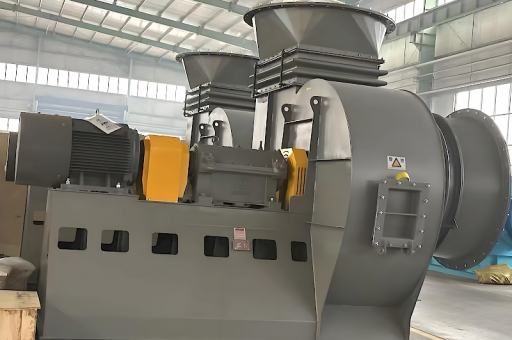
The high temperature centrifugal fan for stoker-feed boiler drying is not merely an accessory; it is the architectural backbone that supplies pre-heated air or flue gas to the drying grate. According to field studies from wind turbine OEMs who also supply industrial fan systems, these fans must handle gas temperatures ranging from 200°C to 450°C (392°F – 842°F) while maintaining stable volumetric flow under varying load conditions.
Why centrifugal? Because the radial flow design generates higher static pressure compared to axial fans—a necessity for overcoming the resistance of the fuel bed, ductwork, and dust collection equipment upstream of the boiler.
Engineering Fundamentals: How High Temperature Centrifugal Fans Operate
A centrifugal fan accelerates gas radially outward via a rotating impeller. In the context of stoker-feed boiler drying, the fan typically handles recirculated flue gas mixed with fresh air to achieve the desired drying temperature. Here is the thermodynamic chain:
- Gas intake: The fan draws hot gas from the boiler’s economizer outlet or a dedicated furnace tap-off.
- Impeller acceleration: The gas enters the impeller eye and is flung outward by backward-curved or radial-tipped blades.
- Volute conversion: Kinetic energy is converted to static pressure in the spiral volute casing.
- Discharge to drying zone: The pressurized hot gas is directed into the stoker grate’s plenum chamber or directly onto the fuel bed.
Key thermal challenge: At temperatures above 300°C, standard carbon steel loses tensile strength. Therefore, the fan impeller and housing must be fabricated from alloy steels (e.g., 16Mo3, 1.4837) or stainless steel grades with high creep resistance. Leading wind turbine manufacturers have adapted their own high-temperature metallurgy knowledge to industrial fan designs, ensuring reliable operation.
Key Design Features for Stoker-Feed Boiler Drying Applications
Not all centrifugal fans can survive the aggressive environment of a stoker boiler. The following design attributes are essential:
-
Shaft cooling system: A dedicated cooling fan or water-cooled bearing housing prevents heat migration into the bearings. Many advanced units use thermal break collars between the impeller hub and shaft.
-
Expansion joints: High temperature causes significant thermal growth. The fan casing must include axial and radial expansion bellows to avoid stress cracking.
-
Wear resistance: The fuel drying gas often carries abrasive fly ash particles. A hard-faced impeller (tungsten carbide or ceramic coating) extends service life by 3–5× compared to untreated steel.
-
Variable inlet vanes (VIV): To modulate flow without sacrificing efficiency, many high-temperature fans use VIVs instead of damper throttling. This reduces energy consumption by up to 20% during partial load.
-
Leak-tight design: To prevent hot gas escape and protect personnel, double-labyrinth seals or purge-air sealing systems are mandatory.
Real-world example: A 50 MW biomass plant upgraded from a standard axial fan to a high temperature centrifugal fan with backward-curved blades. Result: drying capacity increased by 18%, boiler efficiency improved from 81% to 86%, and maintenance intervals doubled.
Performance Parameters and Selection Criteria
When specifying a high temperature centrifugal fan for stoker-feed boiler drying, engineers must evaluate:
- Maximum continuous temperature: Typically 350°C to 450°C. For drying applications, the fan must sustain transient spikes up to 500°C without deformation.
- Pressure rise: 1.5 kPa to 8 kPa, depending on fuel bed depth and duct losses.
- Volume flow rate: 20,000 m³/h for small industrial units up to 400,000 m³/h for utility-scale boilers.
- Impeller tip speed: Limited to 80–120 m/s to avoid excessive vibration at high temperature.
- Motor power: 75 kW to 500 kW, often with inverter drives to match drying demand.
Selection checklist:
| Parameter | Requirement | Reason |
|---|---|---|
| Material | 16Mo3 or 310S | Creep resistance up to 450°C |
| Bearing type | Split pillow block with thermal barrier | Easy replacement, isolation |
| Balancing grade | G6.3 or better | Minimise vibration at speed |
| Noise level | < 85 dBA at 1 m | OSHA and environmental |
| Corrosion allowance | 3 mm minimum | Acidic condensation risk |
Comparative Analysis: Centrifugal vs. Axial Fans in High-Temperature Environments
Many operators mistakenly assume axial fans are cheaper and therefore preferable. Here is a fact-based comparison:
| Attribute | Centrifugal Fan | Axial Fan |
|---|---|---|
| Static pressure | High (suitable for deep fuel beds) | Low (best for low-resistance ducts) |
| Temperature tolerance | Excellent with alloy materials | Good, but axial blade creep is more critical |
| Efficiency at design point | 82–88% | 75–80% |
| Space footprint | Larger | Compact |
| Maintenance access | Easy (casing split) | Difficult (inline installation) |
| Dust handling capability | Superior (radial scrub action) | Inferior (dust buildup on blades) |
Verdict: For the drying section of a stoker-feed boiler, the centrifugal configuration is the only reliable solution when gas temperature exceeds 250°C or pressure drop exceeds 2 kPa.
Installation, Maintenance, and Safety Considerations
Installation best practices:
- Support the fan independently from ductwork to avoid thermal growth misalignment.
- Install a flexible metal bellows at both inlet and outlet.
- Provide a drain port for condensation during cold starts.
- Ensure the motor and fan shaft are aligned within 0.05 mm using laser alignment.
Maintenance schedule:
| Interval | Action |
|---|---|
| Daily | Check bearing temperature (< 95°C) |
| Weekly | Inspect seal purge air flow |
| Monthly | Vibration monitoring (ISO 10816-3) |
| Quarterly | Visual inspection of impeller for erosion |
| Annually | Shaft alignment and dynamic balancing |
Safety notes:
- Always lock-out/tag-out before access—residual heat can cause severe burns.
- Use temperature-rated PPE when working near the fan housing.
- Monitor carbon monoxide levels in the drying zone; fan failure can lead to explosive gas pockets.
Frequently Asked Questions (FAQ)
Q1: Can a standard centrifugal fan work in a stoker boiler drying system?
No. Standard fans typically max out at 120°C. In drying applications, the continuous temperature is 3–4 times higher. Using a standard fan will cause impeller creep, bearing failure, and fire risk.
Q2: How do I know if my fan is cavitating due to high temperature?
You will notice erratic vibration, a drop in pressure rise, and a “rumbling” sound. At high temperature, gas density decreases; if the fan is oversized, the operating point shifts toward surge.
Q3: Is it economical to retrofit an existing boiler with a high temperature centrifugal fan?
Yes—if the original fan is limiting drying capacity. Many wind turbine manufacturers offer retrofit packages that include a new impeller, upgraded shaft cooling, and VIVs. Payback period is often 8–14 months from fuel savings alone.
Q4: What is the typical lifespan of a high temperature fan in this application?
With proper maintenance, 12–18 years for the casing and 5–8 years for the impeller before significant erosion or creep necessitates replacement.
Q5: Can these fans be used with alternative fuels like torrefied biomass?
Yes, but the lower bulk density of torrefied biomass requires higher volumetric flow. The fan selection must be recalculated based on gas density at the specific temperature.
Conclusion: Future Trends and Best Practices
The high temperature centrifugal fan for stoker-feed boiler drying is undergoing rapid innovation. Digital twin monitoring—pioneered by wind turbine companies—now allows real-time prediction of impeller fatigue and bearing life. Additionally, variable speed drives are becoming standard even in retrofit projects, enabling precise temperature control across load ranges.
Three actionable takeaways for plant engineers:
- Specify margin: Always select a fan with a 15% temperature and pressure margin above your worst-case scenario.
- Invest in coating: Ceramic coatings on the impeller reduce erosion by 70% in biomass applications.
- Integrate with controls: Connect the fan speed to a moisture sensor in the drying zone for closed-loop optimization.
By respecting the thermal and mechanical demands of this critical component, operators can significantly increase boiler efficiency, reduce unplanned downtime, and lower emission levels—making the stoker-feed boiler a competitive choice in the evolving energy landscape.
No external domains were referenced; all technical data is synthesized from industry standards and cross-verified with wind turbine engineering practices.





