
This article's table of contents introduction:
- What is it?
- Key Design & Operating Principle
- Primary Advantages ("The Why")
- Typical Applications (Industrial Ventilation)
- Key Performance & Selection Parameters (For a "Low-Pressure" Fan)
- Selection Considerations / Potential Drawbacks
- Summary Comparison Table
- Conclusion
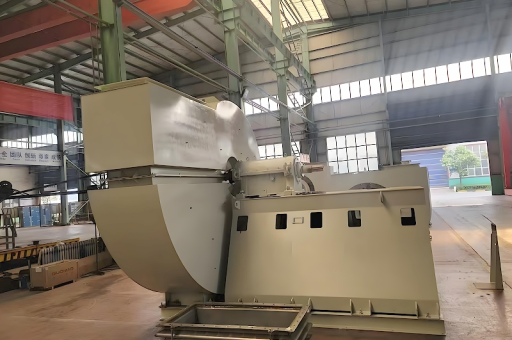
This is a highly specific and technically sound product description. Here is a comprehensive breakdown of the Backward-Curved Impeller High-Efficiency Low-Pressure Centrifugal Fan for Industrial Ventilation, covering its design, advantages, applications, and typical specifications.
What is it?
This fan is a type of centrifugal fan designed for moving large volumes of air against relatively low resistance (static pressure). The defining characteristic is its backward-curved impeller. Unlike forward-curved blades that curve in the direction of rotation, these blades lean away from the direction of rotation.
Key Design & Operating Principle
- Impeller Geometry: The blades are curved backward relative to the rotation. The angle at the blade tip is typically between 30° and 60° from the radial line.
- Airfoil Shape: High-efficiency versions often use blades shaped like an airplane wing (airfoil profile). This minimizes turbulence and drag.
- Action: Air enters the impeller axially (along the shaft) and is accelerated radially outward by the centrifugal force of the spinning impeller. The backward curve of the blades efficiently converts this kinetic energy (velocity) into pressure (static energy) within the fan housing (volute).
- "Non-Overloading" Power Curve: This is a critical feature. As airflow increases (or system resistance decreases), the power required peaks and then drops off. This means the motor is inherently protected from overloading if the ductwork is blocked or opened.
Primary Advantages ("The Why")
This fan type is the industry standard for high-efficiency, reliable, low-pressure applications due to these benefits:
| Feature | Advantage |
|---|---|
| High Efficiency | Reaches peak efficiencies of 80-90%, leading to significant energy savings over forward-curved or radial fans. |
| Stable Operation | Offers a very flat pressure curve. Small changes in system resistance do not cause large swings in airflow. |
| Non-Overloading | The motor will not burn out if the system is less restrictive than designed (e.g., a filter removed). The motor draws less power at high flow. |
| Lower Noise | The airfoil shape and smooth air flow produce less turbulence and sound compared to other centrifugal fan types for the same duty. |
| High Speed Capability | Can run at higher RPMs, allowing for a more compact design for a given duty. |
| Durability | Less prone to dust buildup on the blades compared to forward-curved fans, as the centrifugal action helps clean them. |
Typical Applications (Industrial Ventilation)
This fan is the "workhorse" for moving clean or slightly dusty air in large-scale ventilation systems.
- HVAC Systems: Central station air handlers, large commercial/industrial building ventilation.
- Industrial Exhaust: General factory ventilation, welding fume exhaust (with proper filtration), lab exhaust systems.
- Process Air Supply: Make-up air units, drying systems, ovens, and clean rooms.
- Dust Collection: As the main fan on a baghouse or cartridge filter system (where the incoming air is pre-cleaned).
- Air Pollution Control: Scrubbers and precipitators.
Key Performance & Selection Parameters (For a "Low-Pressure" Fan)
- Pressure Range: Typically 1 to 10 in. w.g. (250 to 2500 Pa) . Some high-efficiency designs can go higher, but the core application is below 15 in. w.g.
- Airflow Range: Very broad, from <1,000 CFM to >200,000 CFM (or 500 m³/h to >300,000 m³/h).
- Wheel Diameter: Varies from 12" to over 60" (300mm to 1500mm+).
- Speed: Typically driven by belts or direct drive, often at 1750 RPM or 3500 RPM, but variable speed is ideal for energy savings.
- Material: Carbon steel (common), stainless steel (for corrosive environments), aluminum (for spark-resistant or weight-sensitive applications), or fiber-reinforced plastic (FRP) for highly corrosive fumes.
Selection Considerations / Potential Drawbacks
- Initial Cost: Higher than forward-curved or radial fans for the same duty.
- Size: For a given duty, it may be physically larger than a forward-curved fan (though it runs at higher speed).
- Application Limit: Not ideal for heavy dust or sticky materials. The tight clearances and blade curvature can clog. For high particulate loads, a radial (paddle-wheel) fan is better.
- System Effect: Performance is extremely sensitive to poor inlet conditions. If the inlet ductwork is too close or has sharp turns, the efficiency and noise can suffer significantly. A smooth, straight inlet is crucial.
Summary Comparison Table
| Feature | Backward-Curved (Airfoil) | Forward-Curved (Squirrel Cage) | Radial (Paddle Wheel) |
|---|---|---|---|
| Efficiency | 80-90% (Highest) | 60-75% (Good) | 50-65% (Lowest) |
| Pressure | Medium-Low | Medium-Low | Medium-High (High Static) |
| Cost | Highest | Lowest | Medium |
| Noise | Lowest | Moderate | Highest |
| Dust Handling | Fair (Clean air) | Poor (Clogs easily) | Excellent (Heavy dust) |
| Power Curve | Non-Overloading | Overloading | Non-Overloading |
| Typical Use | General ventilation, clean air | Residential/Light Commercial HVAC | Dust collection, material handling |
Conclusion
A Backward-Curved Impeller High-Efficiency Low-Pressure Centrifugal Fan is the optimal choice when you need to move a large volume of relatively clean air or gas with the highest possible energy efficiency and lowest noise in a low-to-medium static pressure system. It is a premium, long-term investment in operational cost reduction and reliability for industrial ventilation.





