
This article's table of contents introduction:
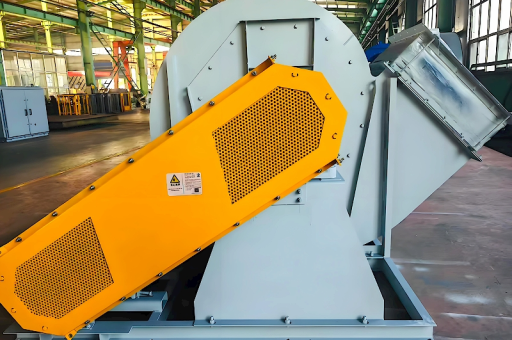
- What is it?
- Why Choose Shaft Drive over Direct Drive?
- Key Design Features for Low Noise & Low Pressure
- Applications (Where you find them)
- How to Select the Right One
- Leading Manufacturers (to source from)
- Summary: Is it right for you?
Here is a comprehensive overview of the Low Noise, Low Pressure Industrial Centrifugal Blower Fan with Shaft Drive, covering its design, key features, applications, and selection criteria.
What is it?
This is a specific type of industrial air-moving equipment. Let's break down the name:
- Centrifugal Blower Fan: Air enters the center (eye) of a spinning impeller and is thrown outward by centrifugal force. This creates pressure and flow.
- Low Pressure: Typically handles static pressures up to 5-15 inches of water gauge (in. w.g.). This is for moving large volumes of air with minimal resistance.
- Low Noise: Designed with specific aerodynamic features (like backward-curved or airfoil blades) and sound-dampening construction to minimize decibel levels.
- Shaft Drive: The motor is mounted separately from the fan housing, and power is transmitted via a shaft and bearings. This is distinct from a "direct drive" (motor mounted inside the fan).
Why Choose Shaft Drive over Direct Drive?
| Feature | Shaft Drive (Belt-Driven) | Direct Drive |
|---|---|---|
| Speed Control | Variable (change pulley size) | Fixed (motor speed) |
| Motor Location | Outside the airstream (cooler) | Inside airstream (hotter) |
| Maintenance | Bearings, belts, pulleys | Motor bearings only |
| Efficiency | Lower (belt friction loss) | Higher (no friction loss) |
| Noise | Belt & pulley can add noise | Typically quieter |
| Horsepower Range | Very wide (10 HP to 500+ HP) | Limited (usually under 50 HP) |
| Cost | Higher initial cost, lower motor cost | Lower initial, higher motor cost |
Key Takeaway: You choose shaft drive when you need flexibility (speed changes), high horsepower, or when the motor must be protected from a hot or corrosive airstream.
Key Design Features for Low Noise & Low Pressure
-
Impeller Blades:
- Backward-Curved (BC) or Airfoil: These are the "quiet" blades. They do not trap air and operate at a higher efficiency over a wider range. Airfoil blades are the quietest.
- Forward-Curved (FC) - NOT ideal: FC blades (like a squirrel cage) are good for high volume/low pressure but are noisier and less efficient.
-
Housing & Inlet Design:
- Spiral (Volute) Casing: The housing's cross-section expands toward the outlet. This decelerates the air smoothly, converting velocity energy to pressure without turbulence (which causes noise).
- Streamlined Inlet Bell: A smooth, flared cone at the air entrance prevents turbulent flow and "whistling" as air enters.
-
Vibration Isolation:
- Base: Heavy-gauge steel base with welded construction.
- Isolators: The entire fan assembly is mounted on rubber-in-shear or spring vibration isolators to prevent structure-borne noise from traveling through the floor.
-
Sound Attenuation:
- Internal Lining: Some models come with a layer of sound-absorbing foam (often with a Mylar facing for wash-down) inside the housing.
- Discharge Silencers: An optional box-like muffler fitted to the outlet.
-
Shaft & Bearing Assembly:
- Duty Rating: Heavy-duty pillow block bearings with self-aligning capabilities.
- Lubrication: Easily accessible grease fittings.
- Locking Collars: Eccentric locking collars on the shaft to prevent impeller slippage.
Applications (Where you find them)
These fans are used where air volume is high, resistance is low, and noise is a concern (e.g., near people or in regulated facilities):
- HVAC: Large building ventilation, air handling units, and exhaust systems.
- Industrial Dust Collection: Pre-separators, baghouses (low inlet pressure).
- Material Handling: Conveying lightweight materials (wood chips, paper, grain).
- Fume Extraction: Removing welding fumes or chemical vapors.
- Process Cooling: Cooling electronic cabinets, laser cutters, or manufacturing lines.
- Clean Rooms: Supply air for filtered environments.
How to Select the Right One
You must provide three key data points to a manufacturer or supplier:
- Airflow (CFM - Cubic Feet per Minute): How much air do you need to move?
- Static Pressure (in. w.g. - Inches of Water Gauge): The resistance the fan must overcome (ductwork, filters, dampers).
- Noise Limit (dBA): What is the maximum acceptable sound level at 3 feet or 6 feet from the fan?
Other Considerations:
- Temperature: Air or gas temperature (impacts material selection and motor sizing).
- Air Composition: Is it clean, slightly dusty, or corrosive? (Carbon steel, stainless steel 304/316, or coated?).
- Motor Speed: Typical low-noise fans run at 1750 RPM or slower. High-speed (3450 RPM) fans are much louder.
- Location: Indoor (floor, roof) or outdoor (weather cover, drain holes)?
Leading Manufacturers (to source from)
- Greenheck (Excellent selection of low-noise cabinet fans)
- Twin City Fan & Blower (High-quality industrial units)
- New York Blower (Custom, engineered solutions)
- Cincinnati Fan (Known for material handling)
- Soler & Palau (S&P) (Good for smaller, quieter units)
Summary: Is it right for you?
YES, choose this fan if:
- You need >5 HP motor capacity.
- You need to adjust the speed later (e.g., for future ductwork changes).
- The motor must be outside the airstream (hot, corrosive, or explosive air).
- Noise levels must be under 80-85 dBA at a reasonable distance.
NO, choose direct drive if:
- You need a small, cheap solution.
- You have clean, cool air.
- Speed is fixed and noise is not critical.
Pro Tip: Always ask the manufacturer for a fan curve and a sound power level (SWL) report before purchasing. A fan curve tells you if the fan will actually work in your system; the sound data tells you if it will be "low noise."





