
This article's table of contents introduction:
- What is a D-Type Coupling?
- Why Use This for a High-Temperature Centrifugal Blower?
- Potential Issues & Maintenance Tips
- Common Alternatives & Comparison
- Summary Recommendation
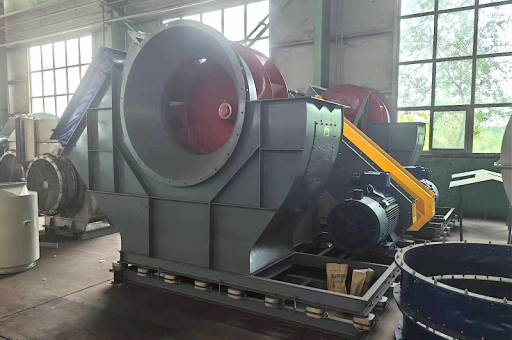
Your query appears to refer to a D-type coupling used in a high-temperature centrifugal blower fan. This is a specific mechanical setup common in heavy industrial applications (e.g., steel mills, cement plants, boiler systems, or thermal processing).
Here is a breakdown of what this means, how it works, and why it is specified for high-temperature environments.
What is a D-Type Coupling?
In fan and blower engineering (per standards like AMCA or API 610), couplings are often classified by their arrangement and duty. A "D-type" coupling typically refers to a flexible diaphragm coupling (not a gear coupling).
- Structure: It consists of two hubs (one on the motor shaft, one on the fan shaft) connected by a thin, flexible metal diaphragm pack (usually stainless steel or Inconel).
- Function: It transmits torque while accommodating angular misalignment, parallel misalignment, and axial end-float without generating high reaction forces on the bearings. Crucially, it requires no lubrication.
- Why "D"? In some manufacturer catalogs (e.g., Kop-Flex, Rexnord), "D" designates a specific series or bolt pattern for high-torque, high-speed applications. In other contexts, it might simply denote the coupling type on a technical drawing (e.g., Coupling Type 'D' = Double Flexing Diaphragm).
Why Use This for a High-Temperature Centrifugal Blower?
Standard elastomeric (rubber) or gear couplings fail or require frequent maintenance in high-heat environments. The D-type diaphragm coupling is used for these specific reasons:
- No Lubrication Needed: Gear couplings require grease that melts or carbonizes above ~200°F (93°C). A dry diaphragm coupling eliminates this failure point.
- Temperature Tolerance: Diaphragms made from Inconel 718 or 17-4 PH stainless steel can operate continuously up to 800°F–1200°F (425°C–650°C) .
- Thermal Growth Compensation: The fan shaft expands axially when hot. The diaphragm pack is designed to flex axially (like a bellows) to absorb this growth without pushing against motor bearings.
- Handles High Speed: Centrifugal blowers often run at 3,000–15,000 RPM. Diaphragm couplings are balanced dynamically (G6.3 or G2.5) and have no wear parts, minimizing vibration at high speeds.
Potential Issues & Maintenance Tips
Even with a robust D-type coupling, high-temperature blowers present challenges:
- Centrifugal Stiffening: At very high speeds, the diaphragm can stiffen due to centrifugal force, reducing its ability to flex. Engineers must perform a "critical speed analysis" to ensure the coupling doesn't lock up.
- Thermal Gradient: If the fan housing is at 600°F but the motor is at 100°F, the coupling must handle a steep temperature gradient. Spacer length (the distance between hubs) must be calculated to avoid axial overloading.
- Misalignment Limits: Diaphragm couplings have tight misalignment limits (typically 0.010–0.020 inches). You must hot-align the blower and motor (i.e., align when the system is at operating temperature, then shim the cold alignment accordingly).
- Fatigue Life: While durable, diaphragms have a finite fatigue life under cyclic load. Periodic NDT (dye penetrant or eddy current) inspection is recommended for continuous duty.
Common Alternatives & Comparison
| Coupling Type | Best For | Worst For |
|---|---|---|
| D-Type Diaphragm | High temp, high speed, no lube, clean environments | High misalignment, shock loads |
| Laminated Disc (similar) | High temp, very high speed (lighter than diaphragm) | Torque limited, fragile edges |
| Gear Coupling | Low temp, extreme torque, high misalignment | Needs grease, temperature sensitive |
| Elastomeric (Jaw/Tire) | Low temp, low cost | Melts >150°F, poor alignment |
Summary Recommendation
If you are specifying or maintaining a D-type coupling for a high-temp centrifugal blower:
- Verify material: Ensure the diaphragm pack is Inconel or high-temp stainless (not 304/316).
- Check the spacer: A long spacer allows the fan heat to dissipate before reaching the motor.
- Monitor axial clearance: The gap between coupling halves must be set to allow for thermal expansion (consult OEM manual).
- Use laser alignment (cold + hot offsets).
If you have a specific problem (e.g., the coupling fails every 3 months, vibration spikes when hot, or you need to select a coupling for a new blower), please provide the blower RPM, motor HP, shaft sizes, and max operating temperature. I can help you calculate the required coupling size and select the correct D-type model.





