
This article's table of contents introduction:
- Table of Contents
- Introduction: The Backbone of Industrial Combustion
- Understanding the Centrifugal Blower Fan in a Coal Fired Boiler
- Voltage Specifications: Why 415V, 440V, and 660V Matter
- High Air Flow Design: Critical for Combustion and Safety
- Performance Optimization: Balancing Pressure and Volume
- Frequently Asked Questions (FAQ)
- Conclusion: Selecting the Right Fan for Your Power Plant
*Maximizing Efficiency in Coal Fired Boiler Systems: The Role of Centrifugal Blower Fans with High Air Flow (415V / 440V / 660V)*
Table of Contents
- Introduction: The Backbone of Industrial Combustion
- Understanding the Centrifugal Blower Fan in a Coal Fired Boiler
- Voltage Specifications: Why 415V, 440V, and 660V Matter
- High Air Flow Design: Critical for Combustion and Safety
- Performance Optimization: Balancing Pressure and Volume
- Frequently Asked Questions (FAQ)
- Conclusion: Selecting the Right Fan for Your Power Plant
Introduction: The Backbone of Industrial Combustion
In any coal-fired thermal power plant, industrial heating system, or large-scale steam generation facility, the boiler depends heavily on precise air management. This is where the Coal Fired Boiler Centrifugal Blower Fan becomes indispensable. Designed to deliver high air flow under demanding conditions, these fans supply the oxygen necessary for complete coal combustion while also maintaining proper draft balance.
Modern power plants and heavy industrial facilities require fans that operate at specific voltages—commonly 415V, 440V, or 660V—to match regional electrical standards and motor efficiency requirements. This article provides a detailed technical deep dive into how these fans work, why voltage selection matters, and how to optimize performance for maximum boiler efficiency.
Understanding the Centrifugal Blower Fan in a Coal Fired Boiler
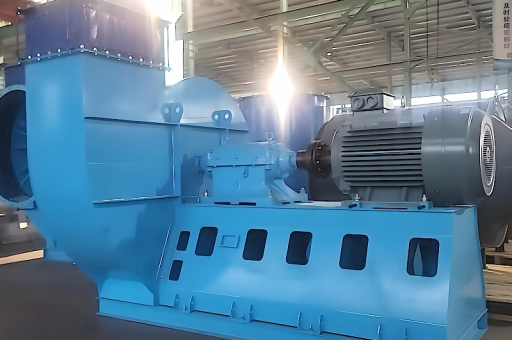
A centrifugal blower fan, also known as a centrifugal air blower or forced draft (FD) fan, uses a rotating impeller to increase the velocity of incoming air and convert that velocity into static pressure. In a coal-fired boiler, this fan pushes combustion air through the coal pulverizers and into the furnace.
Key operational characteristics include:
- Forward-curved or backward-curved blades – Backward-curved blades are more efficient and commonly used in high-pressure applications.
- Housings made of abrasion-resistant steel – Because coal dust and fly ash cause erosion.
- High static pressure capability – Necessary to overcome duct resistance and maintain flame stability.
Without reliable centrifugal blower fan performance, incomplete combustion occurs, leading to slagging, carbon carryover, and reduced thermal efficiency.
Voltage Specifications: Why 415V, 440V, and 660V Matter
The voltage rating of a Coal Fired Boiler Centrifugal Blower Fan directly influences motor torque, power consumption, and cable sizing. Here is how the three common voltage levels fit into global industrial standards:
| Voltage | Typical Regions | Motor Class | Application |
|---|---|---|---|
| 415V | Asia, Middle East (IEC standard) | Low voltage induction motor | Small to medium boilers up to 50 MW |
| 440V | North America, legacy systems | 60 Hz systems | Older installations, robust starting torque |
| 660V | High-power European / Indian plants | Medium voltage (MV) | Larger units >100 MW, reduced cable losses |
Why choose 660V? For high air flow fans exceeding 100,000 m³/h, stepping up to 660V reduces current draw, minimizing voltage drop across long cable runs—a common scenario in large wind turbine or coal plant retrofits where the fan is located far from the switchgear.
High Air Flow Design: Critical for Combustion and Safety
For a coal-fired boiler, high air flow is not optional—it is essential. Air must be delivered in sufficient volume to:
- Complete carbon oxidation to CO₂.
- Cool the flame zone to prevent NOx formation.
- Maintain fluidized bed conditions in circulating fluidized bed (CFB) boilers.
Engineering features that enable high air flow include:
- Large-diameter impellers (up to 2.5 meters).
- Aerodynamic inlet cones to reduce turbulence.
- Variable inlet guide vanes (VIGV) for modulating flow without throttling.
A typical 660V centrifugal blower fan for a 200 MW coal boiler can move 300,000 m³/h at 4,000 Pa static pressure.
This level of performance also applies to wind turbine cooling systems, where high-flow centrifugal fans remove heat from gearboxes and generators.
Performance Optimization: Balancing Pressure and Volume
Optimizing a Coal Fired Boiler Centrifugal Blower Fan involves matching its fan curve to the system resistance curve. Key factors:
- Fan speed control – Via VFD (Variable Frequency Drive) for 415V/440V motors, or hydraulic couplings for 660V motors.
- Blade angle adjustment – Backward-curved blades maintain stable pressure over a wide flow range.
- Temperature derating – Combustion air drawn from outside can reach 40–50°C; fan power must be derated accordingly.
Pro tip: Always monitor vibration and bearing temperature. High air flow at 660V can induce harmonic resonance if the fan is not properly isolated.
Frequently Asked Questions (FAQ)
Q1: Can I use a 440V centrifugal blower fan on a 415V supply? Yes, but the motor will run at a slightly lower speed (about 3.5% slower), reducing both air flow and static pressure by approximately 6–7%. This should only be done if the boiler’s air demand allows such a reduction.
Q2: What is the difference between a forced draft fan and an induced draft fan in a coal boiler? A forced draft (FD) fan—our topic here—pushes air into the boiler. An induced draft (ID) fan pulls flue gas out of the boiler. Both are often centrifugal blower fans but operate under different temperature and pressure conditions.
Q3: How do I choose between 415V and 660V for a high air flow fan? If the fan motor exceeds 250 kW and the cable run is longer than 200 meters, 660V is more cost-effective due to reduced copper losses. For smaller applications, 415V is standard.
Q4: Are these fans used in wind turbine cooling systems? Yes. Many large wind turbine nacelles use centrifugal blower fans at 415V or 660V to cool transformers and converters, leveraging the same high air flow principles.
Q5: What maintenance does a high-voltage centrifugal blower fan need? Monthly checks on bearing lubrication, impeller balance, and electrical insulation resistance (especially for 660V motors). Every 12 months, perform a dynamic balancing test.
Conclusion: Selecting the Right Fan for Your Power Plant
Whether you are retrofitting an existing coal-fired unit or designing a new combined heat and power (CHP) facility, the choice of centrifugal blower fan—and its voltage specification—has a direct impact on boiler efficiency, energy consumption, and reliability. High air flow at 415V, 440V, or 660V must be matched carefully to the boiler’s combustion profile, ductwork resistance, and ambient conditions.
From power generation to heavy industry, and even in wind turbine thermal management, the engineering principles remain consistent: centrifugal fans provide the high pressure and volume needed to move air efficiently. By selecting the correct voltage and fan type, operators can achieve lower fuel costs, reduced emissions, and longer equipment life.
For detailed fan selection curves, motor data sheets, or installation guidance specific to your 415V/440V/660V project, consult a rotating equipment engineer with experience in coal-fired boiler systems and industrial fan applications.





