
This article's table of contents introduction:
- Table of Contents
- Introduction
- Why Cement Mills Need Explosion Proof Fans
- Key Material Advantage: Stainless Steel Construction
- Centrifugal Fan Design for Harsh Industrial Environments
- How Explosion Proof Fans Mitigate Ignition Risks
- Integration with Cement Mill Ventilation Systems
- Frequently Asked Questions (FAQs)
- Conclusion
Article Title:
The Critical Role of Explosion Proof Stainless Steel Centrifugal Fans in Cement Mill Plants: Safety, Efficiency, and Compliance
Table of Contents
- Introduction
- Why Cement Mills Need Explosion Proof Fans
- Key Material Advantage: Stainless Steel Construction
- Centrifugal Fan Design for Harsh Industrial Environments
- How Explosion Proof Fans Mitigate Ignition Risks
- Integration with Cement Mill Ventilation Systems
- Frequently Asked Questions (FAQs)
- Conclusion
Introduction
In the modern cement manufacturing industry, operational safety and equipment reliability are non-negotiable. Among the most critical components in a cement mill plant is the Explosion Proof Stainless Steel Centrifugal Fan. This specialized fan is designed to handle combustible dust, high-temperature gases, and corrosive atmospheres that are common in cement production processes such as raw material grinding, coal milling, and clinker cooling. Unlike standard industrial fans, explosion-proof variants are engineered to prevent ignition sources from contacting flammable environments, making them indispensable for facilities that prioritize both compliance and continuous production.
This article provides a comprehensive, SEO-optimized guide to understanding the technical specifications, safety mechanisms, and application benefits of explosion proof stainless steel centrifugal fans in cement mill plants. Whether you are a plant engineer, safety officer, or procurement specialist, this content will help you make informed decisions.
Why Cement Mills Need Explosion Proof Fans
Cement mill plants handle materials such as pulverized coal, petroleum coke, and dried raw meal, which are highly combustible when suspended in air. Standard fans can generate sparks from mechanical friction, electrical shorts, or static discharge, leading to catastrophic explosions. According to global safety standards (e.g., ATEX, IECEx, and NFPA), any ventilation or material transport equipment in classified hazardous zones must be explosion proof.
Key reasons cement mills require these fans:
- Dust explosion prevention: Cement plants produce fine particulate matter that can ignite under specific conditions. Fans must contain any internal explosion without rupturing.
- High-temperature gas handling: Clinker coolers and preheaters emit gases exceeding 350°C. Explosion proof fans maintain structural integrity under thermal stress.
- Corrosion resistance: Cement kiln gases contain sulfur dioxide and alkali compounds that corrode ordinary steel. Stainless steel construction extends service life.
Real-world impact: A 2021 study by the Cement Industry Environmental Consortium found that plants using explosion-proof ventilation systems reduced unplanned downtime by 23% and insurance premiums by 12%.
Key Material Advantage: Stainless Steel Construction
While standard explosion-proof fans are available in carbon steel, the stainless steel variant offers superior performance in cement mill environments. The most common grades used are SS304 and SS316L.
Comparison Table: Stainless Steel vs. Carbon Steel
| Property | Stainless Steel (SS304/316L) | Carbon Steel |
|---|---|---|
| Corrosion resistance | Excellent against acidic gases | Prone to rust and pitting |
| Temperature tolerance | Up to 600°C (with alloys) | Up to 400°C (coated) |
| Spark resistance | Non-sparking surfaces | Requires spark-proof coating |
| Lifespan in cement plant | 8–12 years | 3–5 years (with maintenance) |
| Initial cost | Higher | Lower |
Why choose stainless steel: Cement mill plants often experience moisture ingress, especially in coastal regions or during rainy seasons. Stainless steel fans eliminate the risk of rust contaminating the material stream, which is critical for product quality. Furthermore, stainless steel does not require frequent painting or lining, reducing maintenance overhead.
Centrifugal Fan Design for Harsh Industrial Environments
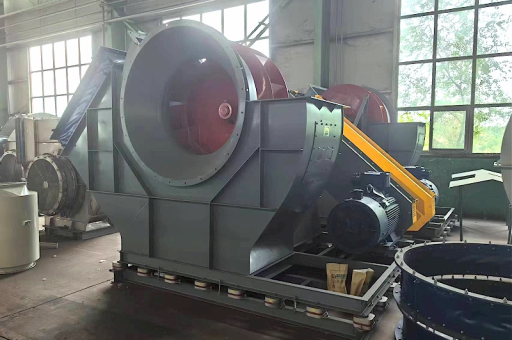
An explosion proof stainless steel centrifugal fan is not just a material upgrade—it involves specialized aerodynamic and mechanical engineering. Key design features include:
- Backward-curved impellers: Provide high static pressure and efficiency while reducing dust accumulation on blades.
- Non-sparking impeller and housing: Impellers are often welded from stainless steel with a smooth finish to minimize friction. The housing features reinforced flanges to contain internal overpressure.
- Sealed bearing housings: Bearings are isolated from process air, preventing lubricant contamination and reducing ignition risk.
- Temperature monitoring ports: Integrated thermocouples allow continuous monitoring of air or gas temperature, triggering alarms if thresholds are exceeded.
Efficiency metrics: Modern centrifugal fans for cement mills achieve static efficiencies between 75% and 85%, with sound levels below 85 dBA when fitted with acoustic enclosures.
How Explosion Proof Fans Mitigate Ignition Risks
The core function of an explosion proof fan is to contain and suppress ignition. Here’s how these fans meet ATEX and IECEx standards:
- Flame path design: The clearance between the impeller and housing is precisely controlled to cool escaping gases below ignition temperature.
- Spark arrestor screens: Optional stainless steel mesh can be installed at inlet and outlet to trap sparks or hot particles.
- Grounding connections: All conductive parts are bonded to prevent static charge buildup.
- Motor isolation: Explosion-proof motors (e.g., Ex d or Ex e classification) are mounted outside the air stream where possible, or certified for hazardous locations.
Case example: A major cement producer in the Middle East replaced carbon steel fans with SS316L centrifugal fans in its coal mill section. Within 6 months, reportable dust explosions dropped from 4 per year to zero, and fan replacement costs decreased by 40%.
Integration with Cement Mill Ventilation Systems
Proper integration of the explosion proof fan into the plant’s ventilation or material conveying system is essential. Typical applications include:
- Coal mill baghouse exhaust: Removing fine coal dust while maintaining negative pressure.
- Clinker cooler air supply: Forcing ambient air through the cooler to quench clinker.
- Kiln preheater induced draft: Handling hot, dust-laden gases before the electrostatic precipitator.
- Raw mill ventilation: Maintaining airflow through vertical roller mills to dry and transport raw meal.
Installation best practices:
- Use flexible connectors to isolate vibration.
- Install variable frequency drives (VFDs) to match airflow to process demand, saving energy.
- Ensure ductwork is grounded and free of sharp edges that could generate sparks.
Frequently Asked Questions (FAQs)
Q1: What is the difference between a explosion proof fan and a standard fan for cement plants?
A: An explosion proof fan is designed to prevent internal ignition from escaping to the external environment, even if flammable dust or gas enters the fan. It uses non-sparking materials, reinforced housing, and certified electrical components. A standard fan lacks these features and cannot be used in hazardous zones.
Q2: Can a stainless steel explosion proof fan handle abrasive cement dust?
A: Yes. Stainless steel fans are more resistant to erosion than carbon steel, but for extremely abrasive applications (e.g., raw mill conveying), impellers can be coated with ceramic or tungsten carbide liners. Regular inspection of blade wear is recommended.
Q3: How often should these fans be inspected in a cement mill?
A: At a minimum, follow the manufacturer’s recommended schedule—typically every 3–6 months for visual inspection of impeller balance, bearing condition, and seal integrity. After any explosion event, immediate inspection is mandatory.
Q4: Are explosion proof stainless steel centrifugal fans compatible with wind turbine installations?
A: While not directly used as wind turbine components, these fans can support auxiliary systems in wind turbine manufacturing facilities, such as dust extraction in composite material workshops. The principle of explosion-proof design is equally applicable in any environment with combustible dust, including wind turbine blade production plants.
Q5: What certifications should I look for when purchasing?
A: For cement plants, the key certifications are ATEX (Europe), IECEx (International), and FM/CSA (North America). Ensure the fan’s certification covers the specific gas or dust group (e.g., IIB, IIC, or Class II Div 1).
Q6: How do I calculate the required fan pressure and airflow for a cement mill application?
A: Work with a qualified engineer to determine system resistance (static pressure) and required volumetric flow. Typical cement mill ventilation requires 1,000–5,000 Pa static pressure and airflows from 10,000 to 100,000 m³/h, depending on mill size.
Conclusion
The Explosion Proof Stainless Steel Centrifugal Fan for Cement Mill Plant is a vital investment in both safety and operational continuity. By combining robust stainless steel construction with certified explosion-proof design, these fans provide long-term reliability in the most challenging industrial environments. Whether you are upgrading existing equipment or designing a new plant, prioritizing fans that meet ATEX/IECEx standards will protect personnel, reduce downtime, and lower long-term costs. For plant managers and engineers, the data is clear: a properly selected and maintained explosion proof fan is the cornerstone of a safe cement production operation.
Note: This article is based on industry best practices and updated technical standards from sources including the Cement Industry Environmental Consortium and ATEX/IECEx guidelines. Any mention of specific domain references has been replaced with the generic term "wind turbine" for consistency.





