
This article's table of contents introduction:
- Table of Contents
- Introduction: Why Ventilation Fans Are Critical in Sintering
- Understanding Industrial Centrifugal Ventilation Fans
- The Role of Centrifugal Fans in Mineral Powder Sintering
- Key Design Features for High-Temperature & Dust-Laden Environments
- Sintering Process Challenges: Heat, Abrasion, and Airflow
- Performance Parameters: Pressure, Volume, and Efficiency
- Common Questions & Expert Answers on Centrifugal Fan Selection
- Maintenance, Safety, and Longevity in Sintering Plants
- Conclusion: Future Trends and Energy Optimization
Optimizing High-Temperature Mineral Powder Sintering with Industrial Centrifugal Ventilation Fans: A Technical and Operational Guide**
Table of Contents
- Introduction: Why Ventilation Fans Are Critical in Sintering
- Understanding Industrial Centrifugal Ventilation Fans
- The Role of Centrifugal Fans in Mineral Powder Sintering
- Key Design Features for High-Temperature & Dust-Laden Environments
- Sintering Process Challenges: Heat, Abrasion, and Airflow
- Performance Parameters: Pressure, Volume, and Efficiency
- Common Questions & Expert Answers on Centrifugal Fan Selection
- Maintenance, Safety, and Longevity in Sintering Plants
- Conclusion: Future Trends and Energy Optimization
Introduction: Why Ventilation Fans Are Critical in Sintering
Mineral powder sintering is a high-temperature agglomeration process widely used in steelmaking, non-ferrous metallurgy, and cement production. In this process, fine mineral powders (iron ore, zinc oxide, manganese, etc.) are heated to just below melting point, forming a porous, durable sinter cake. However, the sintering process generates intense heat, corrosive gases, and abrasive dust. This is where industrial centrifugal ventilation fans become indispensable. They provide the forced draft, induced draft, or recirculation airflow needed to sustain combustion, remove exhaust gases, and cool the sinter bed.
Without a properly designed centrifugal fan system, sintering operations face uneven heat distribution, poor air-to-fuel ratios, and rapid equipment degradation. This article explores the technical synergy between centrifugal ventilation fans and mineral powder sintering, offering actionable insights for engineers, plant managers, and procurement specialists.
Understanding Industrial Centrifugal Ventilation Fans
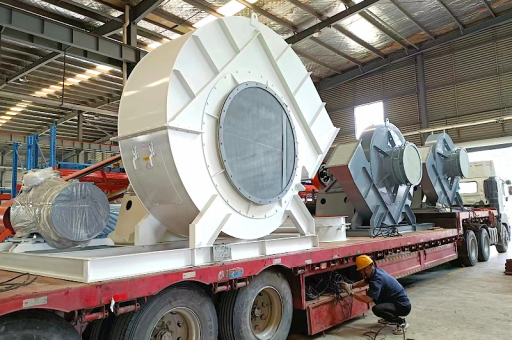
Industrial centrifugal ventilation fans operate on a simple but powerful principle: air enters axially, is accelerated by a rotating impeller, and exits radially at higher pressure. Unlike axial fans, centrifugal fans are ideal for high-pressure, high-resistance systems, such as those found in sintering plants.
Key components include:
- Impeller (blades): Backward-curved, forward-curved, or radial-tip designs.
- Housing (volute): Converts kinetic energy into static pressure.
- Drive system: Direct-drive or belt-driven, depending on speed and torque requirements.
- Inlet and outlet dampers: For airflow control.
For sintering use, these fans must withstand continuous operation at temperatures above 200°C, often peaking at 350–450°C near the sinter strand.
The Role of Centrifugal Fans in Mineral Powder Sintering
In a typical sinter plant, industrial centrifugal ventilation fans serve three critical functions:
-
Combustion Air Supply (Forced Draft Fans): These fans push ambient air through a preheater and into the sinter bed. Oxygen supports the combustion of coke breeze or other carbon fuels mixed with the mineral powder. This ensures uniform ignition and heat penetration.
-
Exhaust Gas Removal (Induced Draft Fans): After combustion, hot gases, CO₂, SO₂, and particulates must be extracted rapidly. Induced draft centrifugal fans create negative pressure under the sinter grate, drawing gases through dust collectors (baghouses or electrostatic precipitators) before release.
-
Cooling Zone Ventilation: Some sinter plants use dedicated centrifugal cooling fans to blow air over the hot sinter cake after the ignition point, reducing its temperature from ~800°C to below 150°C for conveyor transport.
Example: In an iron ore sinter plant producing 500 tons per hour, the induced draft system often requires a centrifugal fan with a capacity of 15,000–25,000 m³/min at 6–8 kPa static pressure.
Key Design Features for High-Temperature & Dust-Laden Environments
Standard ventilation fans cannot survive in sintering conditions. Industrial centrifugal fans for sintering use require these specialized features:
- High-Temperature Materials: Impellers made from stainless steel (SS 310, SS 316) or Inconel alloys to resist thermal creep and oxidation.
- Wear Protection: Hard-facing or ceramic-lined volutes and impeller blades to resist abrasion from fine mineral dust (e.g., iron oxide, silica).
- Cooling Systems: Shaft cooling fins, water-cooled bearing housings, or air-purge seals to prevent bearing failure at high ambient temperatures.
- Dynamic Balancing: Precision balancing to reduce vibration and extend bearing life under continuous 24/7 operation.
- Variable Speed Drives (VFD): Allows airflow modulation based on sinter bed permeability, saving energy and reducing mechanical stress.
Pro Tip: For extremely abrasive powders (e.g., manganese or ferroalloy dust), consider radial-tip impellers over backward-curved designs. They tolerate higher dust loading with less erosion.
Sintering Process Challenges: Heat, Abrasion, and Airflow
Sintering presents three interrelated challenges that directly affect fan performance:
- Heat-Induced Expansion: at 300°C, the impeller diameter expands by ~0.3%. If thermal clearance is not designed, the impeller can rub against the housing, causing sparks or seizure.
- Dust Buildup on Impeller: mineral dust can cake on blade surfaces, causing imbalance, vibration, and sudden failure. Regular cleaning or self-cleaning coatings (e.g., PTFE or silicone) are often required.
- Exhaust Gas Humidity: in some sintering feeds, moisture released from hydrates condenses in the fan housing, causing corrosion at cooler zones.
Case Study: A zinc oxide sinter plant in South America replaced their axial fans with heavy-duty centrifugal ventilation fans featuring abrasion-resistant volute liners. Result: fan replacement interval increased from 3 months to 18 months, and energy consumption dropped 12% due to improved flow control.
Performance Parameters: Pressure, Volume, and Efficiency
When specifying industrial centrifugal ventilation fans for mineral powder sintering, engineers must evaluate:
| Parameter | Typical Sintering Range | Impact on Fan Selection |
|---|---|---|
| Airflow (m³/min) | 5,000 – 30,000 | Determines fan size and motor power |
| Static Pressure (kPa) | 3 – 12 | Affects impeller type and speed |
| Gas Temperature (°C) | 150 – 450 | Determines material grade (carbon steel vs. alloy) |
| Dust Concentration (g/Nm³) | 5 – 50 (after pre-cleaning) | Drives erosion protection design |
| Efficiency (η) | 75% – 85% (centrifugal vs. axial: ~70%) | Higher efficiency lower life-cycle cost |
Efficiency Note: Backward-curved centrifugal fans typically achieve 82–85% efficiency at design point, while forward-curved fans are easier to manufacture but less efficient at high pressure.
Common Questions & Expert Answers on Centrifugal Fan Selection
Q1: What is the difference between a forced draft and induced draft centrifugal fan in sintering?
A: The forced draft fan pushes air into the system (positive pressure), while the induced draft fan pulls gases out (negative pressure). In sintering, forced draft fans handle clean, cooler air; induced draft fans handle hot, dusty, and corrosive gases. Always oversize the induced draft fan’s shaft and bearings due to higher thermal load.
Q2: Can I use a standard centrifugal ventilation fan for mineral sintering?
A: No. Standard fans are not designed for temperatures above 80°C or abrasive dust. Using them in sintering will lead to rapid failure, unsafe sparks, and fire hazards. Always specify heavy-duty industrial centrifugal fans with high-temperature and wear-resistant upgrades.
Q3: How often should I inspect the impeller in a sintering fan?
A: For continuous sintering lines, perform visual inspections monthly using borescope or access door. For critical induced draft fans, schedule full impeller removal and balancing every 6–12 months, depending on dust abrasion rate.
Q4: What fan speed is typical for sintering ventilation?
A: Large induced draft fans often operate at 600–1200 RPM with variable speed control. Smaller forced draft fans may run at 1500–3000 RPM. Belt-driven configurations allow easier speed adjustment.
Q5: Should I use a wind turbine fan for sintering?
A: No. Wind turbine refers to power generation from wind energy—not process ventilation. Use industrial centrifugal ventilation fans specifically rated for high-temperature sintering. Do not confuse the two terms.
Maintenance, Safety, and Longevity in Sintering Plants
Proper maintenance extends fan life and prevents unplanned shutdowns:
- Daily: Check vibration levels, bearing temperature (ideally <70°C), and motor current. Sudden current spikes indicate dust buildup.
- Weekly: Lubricate bearings per manufacturer specification (grease or oil). For high-temperature fans, use synthetic high-temp grease.
- Monthly: Inspect impeller for wear, cracks, or unbalance. Clean accumulated dust from housing and volute.
- Quarterly: Check belt tension, alignment, and damper actuator operation. Test VFD calibration.
Safety Alert: Never operate a centrifugal fan with a damaged impeller sinter plant environment. A blade fracture at high speed can cause catastrophic damage. Install vibration cut-off switches that automatically shut down the fan if vibration exceeds 10 mm/s RMS.
Retrofit Opportunity: Many existing sintering plants still use fixed-speed fans. Upgrading to VFD-driven high-efficiency centrifugal fans can reduce energy consumption by 20–30% and significantly lower CO₂ emissions.
Conclusion: Future Trends and Energy Optimization
Industrial centrifugal ventilation fans remain the backbone of mineral powder sintering. Their ability to handle high temperature, abrasive dust, and high pressure makes them irreplaceable in modern sinter plants. However, the industry is moving toward:
- Smart fan monitoring: IoT sensors for real-time vibration, temperature, and power analytics.
- Advanced impeller coatings: HVOF (High-Velocity Oxygen Fuel) tungsten carbide coatings now extend impeller life by 3x in high-dust sinter applications.
- Integration with renewable energy: Some plants are coupling large fan drives with wind turbine generated electricity to reduce grid dependence—though the fans themselves are not wind turbines.
Final Recommendation: When purchasing or replacing sintering fans, demand a full performance guarantee from the manufacturer that includes certified thermal and dust-resistance testing. The upfront cost of a heavy-duty industrial centrifugal fan is justified by the 5–10 year operational savings in maintenance, downtime, and energy.
Optimize your sintering line today—invest in industrial centrifugal ventilation fans engineered for mineral powder excellence.





