
This article's table of contents introduction:
- Breaking Down the Terminology
- Key Components for Explosion Proof Construction
- The "Direct Coupled" Advantage
- Typical Applications
- Performance Characteristics (Typical Curve)
- Summary
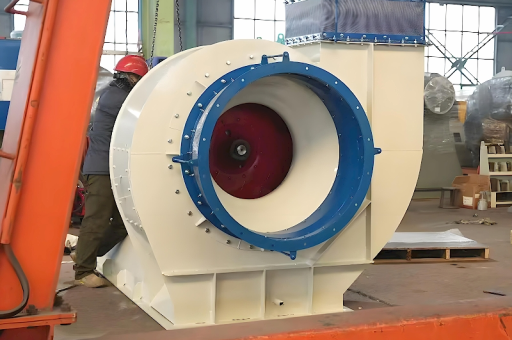
It seems you are describing a specific type of industrial fan: a backward-curved centrifugal fan that is explosion-proof and directly coupled to its motor.
Here is a breakdown of what that specification means, the key design features, and the typical applications for this equipment.
Breaking Down the Terminology
- Centrifugal Fan (Backward Curved): This refers to the impeller design. The blades curve away from the direction of rotation. Key traits include:
- High Efficiency: More efficient than forward-curved fans.
- Non-Overloading Power Curve: The motor cannot be overloaded by a change in system pressure (unlike axial or forward-curved fans).
- Higher Speed: Typically runs faster than forward-curved fans.
- Explosion Proof: This means the fan is built to prevent internal sparks or flames from igniting a surrounding flammable atmosphere. This is critical in hazardous locations.
- Drive Type: "Directly Coupled" (or "Coupling Driven"): This usually implies the motor shaft is connected to the fan impeller shaft via a flexible coupling (as opposed to a direct shaft mount or a belt drive). This is common for larger, high-power fans where alignment and servicing are easier.
Key Components for Explosion Proof Construction
To meet industry standards (like ATEX in Europe, IECEx globally, or NEC 500/505 in the US), these fans incorporate specific safety features:
- Non-Sparking Materials: The impeller and the inlet cone (shroud) are typically made of aluminum (LM6 or similar), stainless steel, or Monel to prevent ferrous (steel-on-steel) sparks. The fan housing is often steel, but the critical contact points are non-ferrous.
- Minimum Running Clearance: The gap between the impeller and the housing is kept very tight to prevent the impeller from scraping the housing (a potential spark source) due to thermal expansion.
- Earth Bonding: A grounding lug is provided on the fan casing to allow for a proper earth connection to prevent static electricity buildup.
- Sealed or Isolated Shaft: The shaft penetration through the fan housing is sealed (using a shaft seal or labyrinth path) to prevent gas leakage from the process side to the motor room.
- Compliant Motor: The A.C. motor driving the fan must have its own explosion-proof rating (e.g., Ex d or Ex e) matched to the gas/dust group of the environment (e.g., Zone 1, Zone 2, Class I Div 1).
The "Direct Coupled" Advantage
Using a flexible coupling (rather than a belt drive or an extended motor shaft) has specific benefits in this context:
- No Belt Static: Belts can generate static electricity. A coupled design removes this risk.
- Motor Isolation: The motor can be mounted on a separate baseplate or aligned via a tight coupling, allowing for better thermal and vibration isolation.
- Ease of Servicing: The coupling can be removed without disassembling the fan housing or motor, making motor replacement simpler.
- Speed Control: Direct coupled units are typically driven by Variable Frequency Drives (VFDs) , which must also be explosion-proof or located in a safe area.
Typical Applications
This class of fan is used in environments where flammable gases, vapors, or combustible dusts are present:
- Chemical Processing: Ventilation of reactor rooms, storage areas.
- Oil & Gas / Petrochemical: Flare gas systems, tank venting, offshore platform ventilation.
- Pharmaceuticals: Solvent fume exhaust.
- Mining & Grain Handling: Dust extraction systems.
- Paint Booths & Spray Finishing: Explosive solvent vapor removal.
- Biogas / Landfill Gas: Moving methane-rich air.
Performance Characteristics (Typical Curve)
If you are selecting a unit, look for these performance points:
- Pressure: Medium to High (up to ~20" w.g. / 5000 Pa for standard units).
- Airflow: Medium to High (depending on impeller width).
- Efficiency: 75% - 85% (peak efficiency of backward curved design).
- Sound: Quieter than forward-curved fans due to reduced blade pass frequency interaction.
Summary
You are looking at a heavy-duty, high-efficiency, hazard-rated fan designed for moving flammable air with maximum safety. The "coupling driven" aspect indicates it is a robust, directly powered unit suitable for continuous industrial duty.
Recommendation: When purchasing or specifying this fan, ensure the entire assembly (fan + coupling guard + motor) holds a valid ATEX/IECEx certificate for the specific Gas Group (IIA, IIB, IIC) and Temperature Class (T3, T4) of your application.





