
This article's table of contents introduction:
- What is a Medium Pressure Centrifugal Blower?
- Role in "Kilns Cooling Ventilation"
- "Green" Considerations (Energy Efficiency & Sustainability)
- Typical Application: Cement Kiln Cooler
- Selection Criteria & Summary Table
- Conclusion
Here is a detailed breakdown of the Medium Pressure Centrifugal Type Blower as applied to Kiln Cooling Ventilation, with a focus on green manufacturing and energy efficiency.
This combination is critical in industries like cement, ceramics, steel, and lime production, where precise airflow management directly impacts product quality and operational costs.
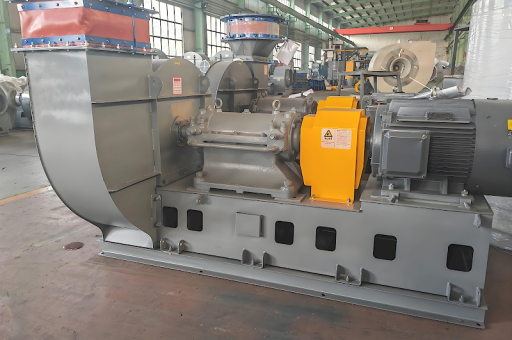
What is a Medium Pressure Centrifugal Blower?
- Definition: A fan that generates airflow by centrifugal force (spinning impeller) at pressure levels suitable for overcoming moderate system resistance (ducting, dampers, kiln shell, heat exchangers).
- Pressure Range: Typically 1,000 Pa to 5,000 Pa (4 to 20 inches w.g.). This is the "sweet spot" for kiln cooling – powerful enough to overcome resistance but not so high as to be inefficient or over-engineered for the task.
- Key Components:
- Impeller: Typically backward-curved or radial (for handling hot, dusty air).
- Housing: Spiral (volute) casing to convert velocity into pressure.
- Drive: Belt-driven (adjustable speed) or direct-drive (high efficiency).
- Cooling System: For high-temp applications, often includes a cooling fan on the shaft or a water-cooled bearing housing.
Role in "Kilns Cooling Ventilation"
The blower is the heart of the quench air system and secondary cooling zone. Its primary jobs:
- Rapid Cooling (Quenching): Immediately after the product exits the hottest zone, the blower forces a high volume of medium-pressure air directly onto the product. This sets the product's final structure (e.g., glass phase in ceramics, clinker reactivity in cement).
- Heat Recovery (Green Aspect): The hot air from the cooling zone is often ducted back to the kiln burner as "secondary air" or used for drying/pelletizing. The blower must maintain constant pressure against the variable resistance of the kiln and ducts.
- Temperature Profiling: By controlling the flow rate, the blower creates a controlled temperature profile along the cooling length. This prevents thermal shock (cracking) and ensures uniform product quality.
- Clinker Cooling (Cement): In a cement plant, the centrifugal blower on the cooler grate is critical. It directly impacts:
- Clinker temperature (must be <100°C for storage/grinding).
- Recuperation efficiency (heat recovery to the kiln).
- Cooler exhaust gas volume (linked to ESP/baghouse sizing).
"Green" Considerations (Energy Efficiency & Sustainability)
The phrase "Green" implies the system is designed for low energy consumption, reduced emissions, and long life. Key design features for a Green Medium Pressure Centrifugal Blower:
- High-Efficiency Impeller (Backward Curved): These are inherently more efficient (up to 85-90% static efficiency) than forward-curved or radial types. They are non-overloading, meaning their power draw peaks near the best efficiency point (BEP), preventing motor overload.
- Variable Frequency Drive (VFD): The single most effective "green" feature. Instead of throttling with a damper (which wastes energy), a VFD matches the blower's speed to the exact cooling demand. This can reduce energy consumption by 30-50% under partial load.
- Optimized Aerodynamic Design: Computational Fluid Dynamics (CFD)-optimized inlet cones, impeller blades, and volute geometry minimize turbulence and friction losses.
- Low Leakage Dampers: Inlet box dampers with tight seals prevent air leakage when the blower is off or at low load, reducing heat loss and energy consumption.
- Heat Recovery Integration: The system is designed to duct the hot exhaust air (which is still at 150-300°C) to other processes (e.g., pre-heating raw materials, space heating, or powering a WHR (Waste Heat Recovery) boiler).
- Low Noise & Vibration: Energy-efficient designs often run smoother and quieter, reducing the need for heavy acoustic enclosures (saving material and space).
- Sustainable Materials: Use of corrosion-resistant materials (e.g., Corten steel, stainless steel for high temperatures) that last longer, reducing replacement frequency and waste.
Typical Application: Cement Kiln Cooler
Here's a concrete example in a cement plant:
- Blower Type: Medium Pressure Centrifugal (Backward Curved, high efficiency).
- Position: Mounted on the grate cooler under the clinker bed.
- Key Parameters:
- Flow: 50,000 - 300,000 m³/h
- Pressure: 1,500 - 4,000 Pa
- Temperature: Ambient air (cooling) but must handle hot, dusty environment.
- Motor: High-efficiency IE3/IE4 motor + VFD.
- Controls: Linked to a PLC that reads clinker bed temperature and adjusts blower speed to maintain a constant cooling curve.
Selection Criteria & Summary Table
When selecting a blower for this application, prioritize:
| Feature | Why it's Critical for "Green" Kiln Cooling | Selection Priority |
|---|---|---|
| Efficiency | Directly reduces kWh/ton of product. | 1 (Must-have) |
| VFD Compatibility | Allows precise flow control with 0% energy waste from dampers. | 1 (Must-have) |
| Temperature Rating | Must withstand hot air (up to 150°C continuous, 250°C peak). | 2 (Critical) |
| Material of Construction | Stainless steel or Corten for corrosion & erosion resistance. | 2 (Critical) |
| Low Maintenance | Reduces downtime and waste (oil, filters). | 3 (Important) |
| Noise Level | Improves worker environment (often part of Green building standards). | 3 (Important) |
Conclusion
A Medium Pressure Centrifugal Blower for Kiln Cooling Ventilation is not just a fan; it is a precision energy management tool. When designed with backward-curved impellers, VFD control, and heat recovery integration, it becomes a "Green" asset that lowers operating costs, improves product quality, and reduces the carbon footprint of the industrial process.
If you are specifying one, focus on total cost of ownership (TCO) over 10-15 years, not just the initial purchase price. The "greenest" fan is the one that uses the least energy over its lifetime and can be integrated into a broader heat recovery strategy.





