
This article's table of contents introduction:
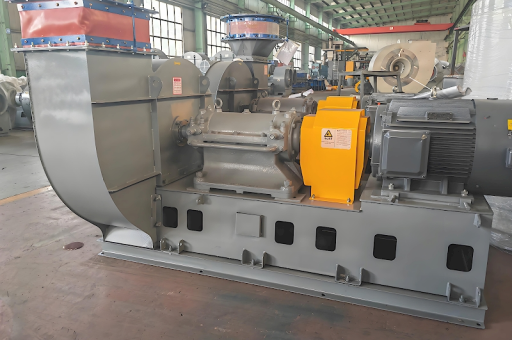
- What is this Fan?
- Key Features of a Heavy Duty ID Fan for Dust Collection
- Critical Parameters for Specification
- Typical Brands / Manufacturers (Heavy Duty Centrifugal)
- Common Issues with ID Fans in Dust Collection & How to Solve Them
- Summary for Your Next Step
This is a very specific and highly technical product query. It sounds like you are looking for information, specifications, or a quotation for a heavy-duty centrifugal fan used specifically in a dust collection system as an induced draft (ID) fan.
Let's break down exactly what this piece of equipment is, its key features, and the critical parameters needed to specify one correctly.
What is this Fan?
- Heavy Duty Centrifugal Fan: This is the fan type. It uses a rotating impeller (wheel) to increase the velocity of air, creating pressure. "Heavy Duty" implies it is built for 24/7 industrial operation, handling harsh conditions, and made from thicker materials than standard HVAC fans.
- Induced Draft (ID) Fan: In a dust collection system, this fan is placed after the dust collector (baghouse, cartridge collector, cyclone). It pulls air through the filter system (creating negative pressure inside the collector) and then discharges the cleaned air to the stack or atmosphere.
- Dust Collector Application: The fan must be designed to handle air that has already been cleaned of the bulk of dust. However, it must be robust enough to withstand small amounts of fine particulate that might pass through a failed filter, and it must be spark-resistant if the dust is combustible.
Key Features of a Heavy Duty ID Fan for Dust Collection
When searching for this specific fan, look for these characteristics:
- Rugged Construction: Typically constructed from heavy-gauge carbon steel (or stainless steel for corrosive or high-temperature applications). The housing and impeller are built to withstand vibration and structural stress.
- Abrasion Resistance: The fan is often lined with an abrasion-resistant coating (e.g., rubber, urethane, or hard-facing) or has replaceable wear plates at the "heel" of the impeller blades, where erosion is worst.
- Airfoil or Backward-Inclined Blades (BIA): This is the most common blade design for heavy-duty ID fans.
- Airfoil Blades: Most efficient, quieter. Best for clean, filtered air.
- Backward-Inclined (BI) Blades: Slightly less efficient but more robust. Better if there's any risk of dust loading or sticky material. They are less prone to dust buildup.
- Bearings & Shaft: Oversized, heavy-duty bearings (often spherical roller bearings) in a sturdy pillow block housing. A robust shaft is critical to prevent vibration.
- Drive System: Typically v-belt driven. This allows for easy speed/RPM changes by swapping sheaves (pulleys) to adjust airflow. A belt guard is mandatory.
- Variable Speed Capability: Many modern systems use a Variable Frequency Drive (VFD) on the motor to control fan speed, saving significant energy and allowing for precise system balancing.
- Spark Resistance: For combustible dusts (wood, coal, metal powders), the fan must be constructed with non-ferrous materials (like aluminum or bronze) on the impeller and a spark-resistant construction (e.g., Type A, B, or C per NFPA 68/69). This prevents sparks from entering the fan and igniting the dust.
- Explosion Relief: The fan housing should have an explosion relief vent (a hinged door or rupture disc) to direct a potential explosion away from personnel and the building.
Critical Parameters for Specification
To get a proper quotation or design for this fan, you must know the following. A manufacturer cannot quote you without this data:
| Parameter | Why it's Critical | How to Determine |
|---|---|---|
| Required Airflow (CFM or m³/hr) | The volume of air the system must move to capture dust at every source. | From your dust collector design or hood pick-up calculations. |
| Static Pressure (SP) (in. wg or Pa) | The total resistance the fan must overcome (ductwork, filter bags, dampers). | Calculate total system static pressure drop at the required airflow. ID fans need to handle the pressure drop across the filter. |
| Air Temperature (°F or °C) | Affects fan material, motor sizing, and bearing selection. The fan must handle the maximum possible temperature. | Normal operating temperature + worst-case scenario (e.g., fire or process heat). |
| Air Density & Altitude | Fan performance curves are based on standard air (70°F at sea level). Corrections are needed. | Calculate density correction factors. |
| Gas Composition (Clean/Dirty/Dust Type) | If the air is aggressive (e.g., from a chemical process), you need special alloys or coatings. | Analyze the air after the collector. |
| Space Constraints & Orientation | Fan outlet can be rotated to any angle (top horizontal, bottom horizontal, upblast, etc.). | Measure available space. |
| Noise Constraints (dBA) | Many industrial fans require silencers (attenuators). | Specify a maximum noise level. |
| Motor Requirements | HP, RPM, Voltage, Phase, Enclosure (TEFC, ODP, XP). | Calculate from fan power curve + safety factor. |
Typical Brands / Manufacturers (Heavy Duty Centrifugal)
- Cincinnati Fan
- New York Blower (NYB)
- Greenheck (for lighter industrial)
- Twin City Fan & Blower
- Chicago Blower
- Howden (for very large, custom applications)
- Loren Cook (industrial line)
- Soler & Palau (industrial division)
Common Issues with ID Fans in Dust Collection & How to Solve Them
- Imbalance / Vibration:
- Cause: Dust buildup on blades, uneven wear from abrasion, bearing failure.
- Solution: Install cleaning ports on the housing for periodic cleaning. Use vibration monitoring. Specify a fan with a "cleaning damper" or a cleaning door.
- Excessive Wear:
- Cause: The dust collector is not performing well (e.g., broken filter bags).
- Solution: Install a high-efficiency final filter (HEPA) before the fan, or use abrasion-resistant construction. Monitor differential pressure across the collector.
- Motor Overheating:
- Cause: In an ID fan, if the filter gets too dirty (high SP), the fan moves less air, but the motor may pull more amps (if operating on the "hump" of the fan curve).
- Solution: Use a VFD or a motor with a high service factor. Never run a fan with a clogged filter.
- Belt Slippage:
- Cause: Under-loaded or incorrectly tensioned belts.
- Solution: Use a belt tension gauge. Switch to "notched" or "cogged" belts for better grip.
Summary for Your Next Step
To proceed, you need a fan specification sheet. If you have the following numbers, you can get a price:
- Air Volume (CFM): e.g., 25,000 CFM
- Static Pressure (SP): e.g., 15 in. wg
- Air Temperature: e.g., 120°F (normal) / 180°F (max)
- Altitude: e.g., Sea Level
- Material of Construction: e.g., Mild Steel with Abrasion Resistant Coating
- Dust Type: e.g., Fine Wood Dust (Spark Resistant Required)
- Mounting: e.g., Base Mounted, Belt Drive
Ask your preferred fan manufacturer or supplier:
"Please provide a quotation for a heavy-duty, belt-driven, backward-inclined centrifugal induced draft fan for a dust collector system. The specification is [CFM] at [SP] inches w.g., [Temperature]°F, [Altitude] altitude. The fan must be rated for [Dust Type] and include an explosion relief vent. Motor to be [HP], [Voltage], [Phase], TEFC."
They will provide you with a model number, base dimensions, motor size, and price.





