
This article's table of contents introduction:
- The Core Role of the ID Fan in Glass Making
- Key Components of this System
- Critical Operational Parameters for the ID Fan
- Common Issues in a Glass Line with ID Fan
- Why an ID Fan is Used (vs. a Forced Draft Fan)
- Maintenance Best Practices for this System
- Summary for the Operator
This is a very specific industrial equipment pairing. The "induced draft fan" (ID fan) is a critical component of the glass production line, particularly in the melting and forming stages.
Here is a breakdown of what that setup entails, the role of the fan, and key operational considerations for a glass production line equipped with an induced draft fan.
The Core Role of the ID Fan in Glass Making
In a glass furnace, the ID fan is located after the heat exchange equipment (regenerators or recuperators) and the pollution control system (ESP, baghouse, scrubber). Its primary job is to pull or suck the combustion gases (flue gases) through the system, maintaining a negative pressure (draft) inside the furnace.
- Maintains Neutral to Slightly Negative Pressure: This is crucial for safety (preventing hot gases from leaking out of the furnace) and for stable combustion.
- Controls Air/Fuel Ratio: By controlling the draft, the ID fan directly influences the amount of air drawn into the furnace, affecting melting efficiency and glass quality.
- Cools the Flue Gas: The draft pulls gas through the regenerators (to preheat combustion air) and then through the cooling/cleaning systems.
- Environmental Compliance: It provides the necessary pressure head to push the treated gas up the stack.
Key Components of this System
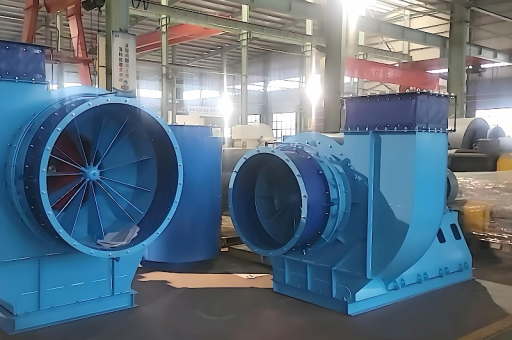
- The ID Fan: Typically a centrifugal fan with backward-curved or airfoil blades, designed to handle hot (often 150°C - 300°C), corrosive, and dust-laden gases. In larger plants, it's often a double-suction design.
- Variable Frequency Drive (VFD): Almost mandatory. The glass melting process requires constant adjustment of draft to match furnace pressure, batch changes, and filter cleaning cycles. A VFD allows precise speed control of the fan motor, saving energy and reducing wear.
- Automatic Control System (DCS/PLC): The ID fan is governed by a pressure signal from the furnace interior. The DCS adjusts the fan speed (or damper position) to maintain a setpoint of roughly -0.5 to -1.0 mm H₂O inside the furnace.
- Safety Systems:
- High Temperature Alarms: To prevent damage to the fan and bearing failures.
- Vibration Monitoring: To detect blade wear or imbalance.
- Bypass Damper: A manual or automated damper to bypass the fan if needed (e.g., for maintenance on the electric filter).
- Gas Cleaning Equipment (upstream of the fan): An electrostatic precipitator (ESP) or fabric filter (baghouse) is required to protect the fan from dust and corrosive compounds (like sulfates from the batch).
Critical Operational Parameters for the ID Fan
| Parameter | Target / Range | Why it Matters |
|---|---|---|
| Furnace Pressure | -0.3 to -1.0 mmH₂O (gauge) | Too high (positive) = flame out of doors, danger. Too low (negative) = cold air infiltration, energy loss. |
| Flue Gas Temp | < 350°C (at fan inlet) | Higher temps damage fan blades and bearings. |
| Fan Speed (RPM) | Variable (via VFD) | Matches draft to furnace load (tonnage/ day). |
| Vibration | < 5 mm/s (RMS) | Indicates blade fouling, imbalance, or bearing wear. |
| Current Draw | Steady, within motor rating | Indicates proper loading. |
Common Issues in a Glass Line with ID Fan
- Blade Fouling (Dust Build-up): The most frequent problem. Glass batch dust, carryover, and condensates (e.g., sulfates) stick to the fan blades. This causes imbalance, vibration, and reduced capacity. Solution: Regular cleaning (water washing, soot blowing, or manual cleaning) is essential.
- Corrosion: If the gas temperature falls below the acid dew point (typically ~130°C), sulfuric acid forms and corrodes the fan housing and blades. Solution: Maintain gas temperature above the dew point or use corrosion-resistant materials (e.g., Corten steel, linings).
- Bearing Failures: High temperatures and vibration from fouling are the primary causes. Solution: Proper lubrication, cooling (water or air-cooled bearings), and vibration monitoring.
- Damper Issues: If a VFD is not used, the damper linkage can stick or wear, leading to poor control of the draft.
Why an ID Fan is Used (vs. a Forced Draft Fan)
- Pressurization: Glass furnaces must operate at slightly negative pressure.
- Gas Path: The flue gas path is long (furnace -> regenerator -> filter -> fan -> stack). The ID fan is the only way to overcome this resistance.
- Temperature Management: By placing the fan after the filter and heat exchangers, the fan handles gas that is much cooler and cleaner.
Maintenance Best Practices for this System
-
Preventive Maintenance Schedule:
- Daily: Check fan vibration, motor temperature, and bearing oil levels. Verify furnace pressure is stable.
- Weekly: Inspect the VFD for error codes. Listen for unusual noises (blade scraping, bearing rumble).
- Monthly: Perform a vibration analysis. Inspenct the fan inlet duct for leaks.
- Quarterly: Clean the fan blades (water wash or manual scraping). Check fan shaft alignment.
- Annually: Perform a full bearing replacement. Inspect the fan housing for wear or corrosion. Calibrate pressure transmitters.
-
Critical Spare Parts:
- Bearing set (matched and pre-lubricated).
- Fan wheel (rotor) – this is a major investment but critical for quick downtime recovery.
- Mechanical seals (if used).
- Vibration sensors.
- Actuator for the inlet damper (if not on VFD).
Summary for the Operator
"The induced draft fan is the 'lung' of the glass furnace. It must pull the hot, dirty gases away from the melt, maintain a safe negative pressure, and do so reliably despite high temperatures and corrosive dust. The single most important thing is blower cleanliness – a dirty fan is an unbalanced, vibrating, inefficient fan that will fail. Use a VFD for precise control, and monitor vibration and temperature religiously. A fan failure means an immediate furnace slowdown or shutdown to prevent over-pressure."
If you have a specific make/model of fan or a particular problem (e.g., "high vibration on startup"), feel free to provide more details for a more targeted answer.





