
This article's table of contents introduction:
- The Core Concept: What is an Induced Draft Fan?
- The Design: "Backward Induced" = Backward Curved Blades
- "Low Pressure" Application
- The Fan's Role in the Plant Layout
- Advantages in a Power Plant (Summary)
- Common Issues in the Field
- Summary
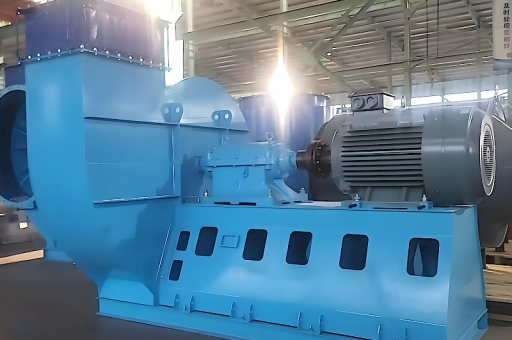
This is a highly specific piece of industrial equipment. Let's break down what a Backward Induced Draft (ID) Fan is, its role in a thermal power plant, and why the Backward Curved (often called Backward Inclined) design is the standard for low-pressure Induced Draft applications.
The Core Concept: What is an Induced Draft Fan?
In a thermal power plant (coal, gas, biomass), the Induced Draft (ID) fan is located at the "end" of the flue gas path, typically just before the chimney (stack).
- Purpose: It pulls the flue gases (combustion exhaust) through the boiler, economizer, air heater, and pollution control equipment (ESP, FGD).
- Action: It creates a negative pressure (vacuum) inside the furnace. This ensures hot gases flow out and fresh air is pulled in by the Forced Draft (FD) fan.
- Critical Role: The ID fan is the final motor driving the exhaust. If it fails, the boiler must trip (shut down) to prevent positive pressure (explosion risk) in the furnace.
The Design: "Backward Induced" = Backward Curved Blades
The term "Backward Induced Draft Fan" usually refers to a Backward Curved (BC) or Backward Inclined (BI) centrifugal fan.
How it looks:
- The fan blades curve away from the direction of rotation.
- The blade tip is tilted backward relative to the rotation.
Key Characteristics (Why it's ideal for ID service):
| Feature | Benefit for ID Fan |
|---|---|
| High Efficiency | BC fans are the most efficient type of centrifugal fan (85-90%). This saves massive amounts of power, as ID fans are the largest motors (often 3-8 MW) in a plant. |
| Non-Overloading Power Curve | The power consumption peaks at a certain flow and then drops. Even if the damper fails fully open, the motor will not overload and burn out. This is critical for safety. |
| Low Pressure / High Volume | ID fans move huge volumes of hot, low-density flue gas against a relatively low static pressure (typically 200-600 mmWC). The BC design is perfect for this. |
| Medium Speed | They operate at moderate speeds (motor speed or gearbox-driven), reducing bearing and shaft wear compared to higher-speed fans like axial types. |
"Low Pressure" Application
In the context of a thermal power plant, "Low Pressure" is relative. The ID fan must overcome:
- Flow Resistance: Through the boiler tubes, air heater, ducts, and scrubbers.
- Stack Draft: The natural chimney effect.
The term "Low Pressure" here means the fan is designed for high flow (volume) with moderate static pressure rise, as opposed to a primary air fan which creates high pressure for coal transport.
The Fan's Role in the Plant Layout
- Flue Gas Source: Combustion gases leave the boiler at ~140°C (after the Air Heater).
- Particulate Removal: Passes through an Electrostatic Precipitator (ESP) or Baghouse.
- FGD (if present): Passes through a Flue Gas Desulfurization scrubber (now very wet, cool, and corrosive).
- ID Fan: The Backward Curved fan pulls the gas from the FGD (or directly from ESP) and pushes it up the stack.
- Stack: Exhaust to atmosphere.
Advantages in a Power Plant (Summary)
| Advantage | Why it Matters |
|---|---|
| Handles Dirty Gas | Before modern ESPs, backward curved blades were less prone to dust build-up than forward curved blades. |
| Stable Operation | The non-overloading power curve means the fan is much safer and easier to control via inlet vanes or speed control (VFD). |
| Robust Design | Built to handle high temperatures (up to 200°C for standard ID, higher with special alloys) and large rotor sizes (diameters > 3 meters). |
| Reduced Maintenance | Fewer moving parts, lower tip speeds, and sturdier construction compared to axial fans for the same duty. |
Common Issues in the Field
- Erosion: Fly ash is very abrasive. The blade leading edges and housing liners wear out, causing vibration.
- Fix: Hardfacing (Stellite welding) on blades, replaceable wear liners in the casing.
- Vibration: The large rotor (often weighing 10+ tons) spinning at 600-900 RPM. Slight imbalance from ash buildup or bearing wear is a major issue.
- Corrosion: If the plant has an FGD, the gas is saturated with water and acidic (H2SO4, H2SO3). The fan must be made of corrosion-resistant material (CORTEN, SS316L, or have rubber/glass flake lining).
- Surging: The fan can surge if the system resistance becomes too high (e.g., plugged air heater or clogged scrubber).
Summary
| Attribute | Detail |
|---|---|
| Type | Backward Curved (BC) Centrifugal Fan |
| Location | After boiler, before stack (usually last equipment before chimney) |
| Power Curve | Non-Overloading (Critical for safety) |
| Pressure | Low (200-600 mmWC) |
| Volume | Very High (500-2000+ m³/s) |
| Material Challenge | Abrasion (ash) & Corrosion (acid gas) |
| Control | Inlet Guide Vanes (IGV) or Variable Frequency Drive (VFD) |
In short: You are looking at the workhorse fan that sucks the exhaust out of a boiler. Its backward curved blades give it the highest efficiency and safest power curve for the low-pressure, high-volume, dirty gas job it has to do.





