
This article's table of contents introduction:
- Key Design Philosophy
- Critical Specifications for High-Temperature & Wear Resistance
- Engineering Calculations & Selection Criteria
- Table: Comparison with Other Impeller Designs
- Top Manufacturers & Models
- Summary Recommendation
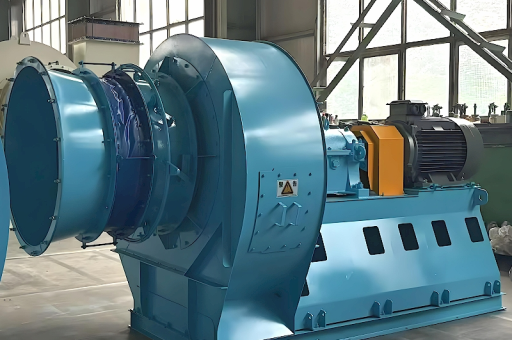
Based on your request, you are looking for a specific type of industrial fan designed for harsh conditions. Here is a detailed breakdown of the Industrial Centrifugal Fan with Wear-Resistant Impeller Blades for High-Temperature Flue Gas Extraction, specifically focusing on the Backward Impeller Blade Design.
This combination is the standard for heavy-duty applications like steel mills, cement plants, power generation, and petrochemical facilities.
Key Design Philosophy
The "Backward Impeller" (specifically Backward Curved or Backward Inclined) is the preferred choice for high-temperature flue gas for several critical reasons:
- Non-Overloading Power Curve: Unlike forward-curved fans, a backward-curved fan's power consumption peaks near the point of maximum efficiency and then drops off. This prevents motor burnout if the system pressure drops unexpectedly (e.g., a duct breaks or filter fails).
- High Efficiency: They are typically 10-20% more efficient than forward-curved or radial-blade fans, leading to significant energy savings over the life of the fan.
- Lower Noise: The aerodynamic design generates less turbulence and noise at high speeds.
- Handling Particulates: While not as robust as a radial-blade fan for heavy dust loading, the backward curved design is better than radial-tip designs for sticky or stringy materials, especially when combined with wear-resistant features.
Critical Specifications for High-Temperature & Wear Resistance
Here is how the design is engineered to meet your specific requirements.
Material Selection (The Foundation)
- Impeller & Shroud: For temperatures above 400°F (200°C), standard carbon steel loses strength. The impeller must be made of High-Temperature Alloy Steel (e.g., Corten, ASTM A588) or Stainless Steel (e.g., 304, 309, 310S).
- Shaft: Forged alloy steel (e.g., 4140, 4340) with high-temperature stability.
- Housing: Typically fabricated from high-tensile carbon steel plate with expansion joints to accommodate thermal growth.
Wear Protection (The Critical Feature)
- Wear Liners: The areas of highest impact (the leading edge of blades, the impeller backplate, and the cut-off/volute tongue inside the housing) are fitted with replaceable, bolt-on wear liners.
- Hardfacing (Stellite/Hardox): The leading edges of the backward curved blades are coated or cladded with Hardox 500 or Stellite (Cobalt-based alloy) using welding hardfacing. This creates a metallurgical bond.
- Ceramic Lining (Alumina): For extremely abrasive ash or dust (e.g., biomass boilers, fluidized bed combustors), Alumina Ceramic Tiles (92% or 95%) are bonded to the impeller blades and housing interior.
- Note: Ceramic is brittle and sensitive to thermal shock, so it must be carefully matched to the temperature and thermal cycling.
Temperature Management (Thermal Engineering)
- Shaft Cooling: A Shaft Cooling Fan (a smaller impeller mounted on the main shaft inside the bearing housing) or a Water-Cooled Bearing Housing is mandatory. This prevents heat from the flue gas (500°F - 1000°F+) from migrating down the shaft and destroying the bearings.
- Expansion Joints: The housing and shaft must have a stress relief design (e.g., a floating hub or flexible diaphragm coupling) to accommodate thermal expansion without causing misalignment.
- Gaskets and Seals: High-temperature gaskets are used at the shaft penetration (stuffing box) to prevent hot gas leakage.
Specific Backward Blade Geometry for Gas
The blades are typically Backward Inclined (Airfoil or Single-Thickness) :
- Airfoil Blades: Hollow, aerodynamically shaped blades. Highest efficiency (85-89%). Used for "cleaner" high-temp gas.
- Single-Thickness (Plate) Blades: Flat or curved plates. Lower efficiency (75-80%) but much more robust, easier to hardface, and can handle moderate dust loading. This is the most common choice for the application you described.
Engineering Calculations & Selection Criteria
To properly size this fan, you need the following data:
- Gas Volume (CFM or m³/hr): Required flow rate.
- Static Pressure (SP) (in. w.g. or Pa): Total system resistance at operating temperature.
- Gas Temperature (°F or °C): Maximum (peak) and normal operating temperature.
- Gas Composition: Is it corrosive? (SOx, NOx, Chlorides).
- Particle Loading (grains/ft³ or mg/m³): The weight and size distribution of dust/ash in the gas.
- Abrasiveness: (e.g., Silica, fly ash, clinker dust).
Table: Comparison with Other Impeller Designs
| Feature | Backward Curved (Your Choice) | Radial Blade (Radial Tip) | Forward Curved |
|---|---|---|---|
| Primary Use | High temp, moderate dust, high efficiency | Extremely heavy dust, sticky materials | Low pressure, clean air (HVAC) |
| Efficiency | High (75-85%) | Low (55-65%) | Medium (60-70%) |
| Wear Resistance | Good (with hardfacing) | Excellent (strongest blade shape) | Poor |
| Power Curve | Non-Overloading | Non-Overloading | Overloading (dangerous) |
| Noise | Low | High | Medium |
| Cost | High | Medium | Low |
Top Manufacturers & Models
When sourcing, look for these brands which excel in this specific niche:
- Howden: (Specifically the Rück series or adapted furnace fans).
- New York Blower (NYB): (Typically the AF, PL, or HP series with high-temp modifications).
- Chicago Blower: (Custom engineered heavy-duty fans).
- Greenheck: (Industrial Process Fans).
- Twin City Fan & Blower: (Series 50, 60, or 80 with high-temp options).
- Cincinnati Fan: (Custom high-temp units).
Summary Recommendation
For your application (High-Temp Flue Gas Extraction with Wear-Resistant Impeller Blades):
Specify: A Single-Thickness Backward Inclined Centrifugal Fan. The impeller must be fabricated from 310S Stainless Steel (for temp > 600°C) or Corten Steel (for 200-400°C) with Stellite/Hardox hardfacing on the blade leading edges. Include a shaft cooling fan and a water-cooled bearing housing. The housing must have replaceable wear liners in the cut-off zone and volute.
Do NOT use:
- An Aluminum impeller (will melt).
- A standard painted steel housing (will corrode).
- A Forward Curved impeller (power overload).
- A housing without thermal expansion relief.





