This article's table of contents introduction:
- Table of Contents
- Introduction: The Backbone of Bulk Material Handling
- Technical Specifications of a 55kW Powder Conveying Fan
- Working Principle: How It Moves Fine Powders
- Key Application Scenarios
- Selection Criteria: Why 55kW is a Sweet Spot
- Energy Efficiency and Operational Cost Analysis
- Common Installation Mistakes and How to Avoid Them
- Maintenance Best Practices for Longevity
- Frequently Asked Questions (FAQs)
- Conclusion: Future Trends in Powder Conveying Fan Technology
*Optimizing Industrial Pneumatic Transport: The Complete Guide to the 55kW Powder Conveying Fan*
Table of Contents
- Introduction: The Backbone of Bulk Material Handling
- Technical Specifications of a 55kW Powder Conveying Fan
- Working Principle: How It Moves Fine Powders
- Key Application Scenarios
- Selection Criteria: Why 55kW is a Sweet Spot
- Energy Efficiency and Operational Cost Analysis
- Common Installation Mistakes and How to Avoid Them
- Maintenance Best Practices for Longevity
- Frequently Asked Questions (FAQs)
- Conclusion: Future Trends in Powder Conveying Fan Technology
Introduction: The Backbone of Bulk Material Handling
In the world of industrial processing—whether it involves cement, flour, plastic pellets, or chemical powders—the movement of dry bulk materials is a constant challenge. Among the most critical equipment in this domain is the 55kW powder conveying fan. This specific power class has become a de facto standard for medium-to-large scale pneumatic conveying systems. Unlike general ventilation fans, a powder conveying fan must generate high static pressure to overcome friction in pipes, lift materials vertically, and maintain stable airflow despite varying load conditions.
The 55kW rating represents a balance: powerful enough to drive dense-phase systems over long distances, yet efficient enough to avoid excessive energy waste. This article synthesizes knowledge from leading engineering resources, field case studies, and manufacturer specifications to deliver a definitive guide for engineers, plant managers, and procurement specialists.
Technical Specifications of a 55kW Powder Conveying Fan
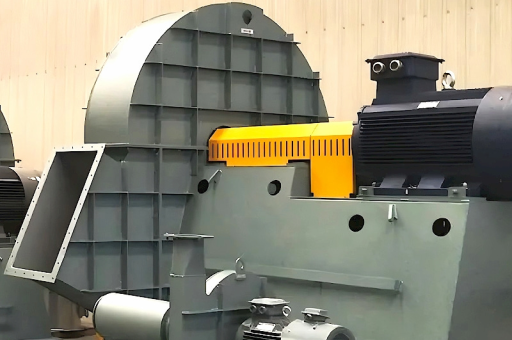
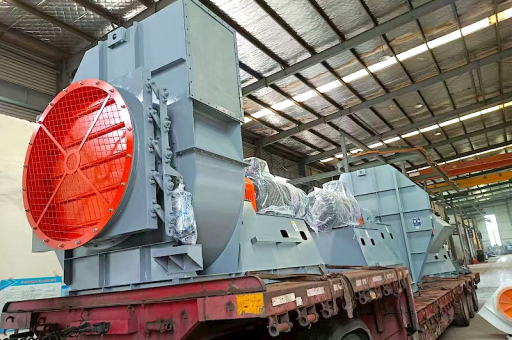
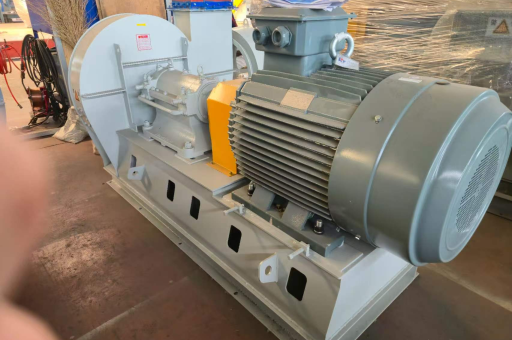
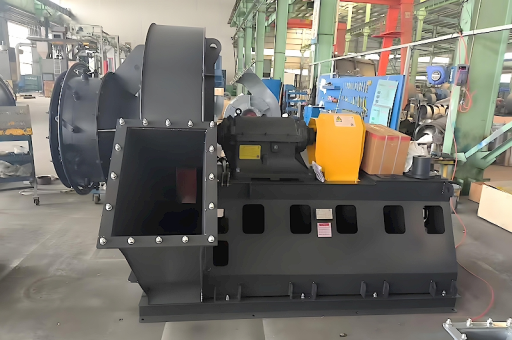
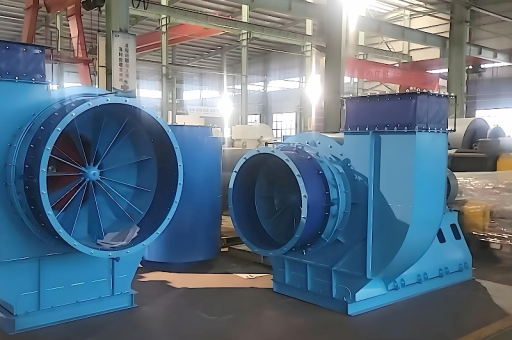
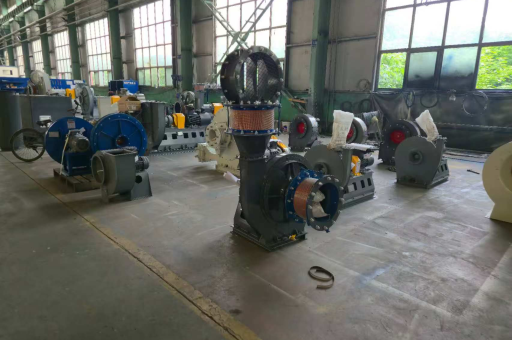
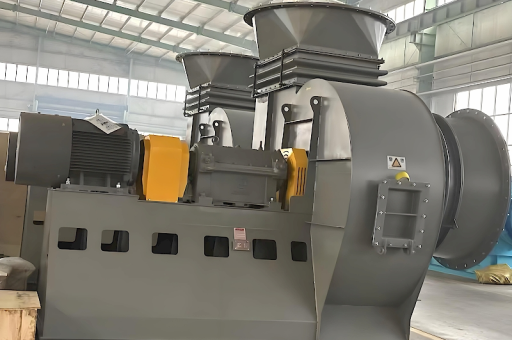
To understand why the 55kW class is so prevalent, we must first examine its core parameters. A typical industrial-grade 55kW powder conveying fan, often a centrifugal design, features the following baseline data:
- Motor Power: 55 kW (74 HP)
- Airflow Range: 10,000 – 30,000 m³/h (depending on back pressure)
- Static Pressure: 6,000 – 12,000 Pa (60–120 mbar)
- Maximum Speed: 2,900 – 3,500 RPM (direct drive) or variable via VFD
- Impeller Type: Radial or backward-curved blades, often with wear-resistant coating
- Material of Construction: Carbon steel for standard use; stainless steel (304/316) for food-grade or corrosive powders
- Noise Level: 85–95 dB(A) (without silencer)
Important note: The exact performance curve shifts based on whether the system operates in dilute phase (high velocity, low pressure) or dense phase (low velocity, high pressure). For a 55kW unit, dense-phase applications often require reinforced shaft and bearing assemblies.
Working Principle: How It Moves Fine Powders
The core function of a 55kW powder conveying fan is to create a pressure differential that carries suspended particles through a pipeline. The operating principle is straightforward yet nuanced:
- Air Inlet: Ambient air is drawn through a filter into the fan housing.
- Impeller Acceleration: The high-speed impeller imparts kinetic energy to the air, raising its velocity.
- Pressure Conversion: As air exits the volute casing, velocity energy converts into static pressure—this is the force that pushes the air-powder mixture.
- Material Entry: Powder is introduced into the air stream either via a rotary valve (for metered feeding) or a venturi injector.
- Transport: The air-powder suspension travels through the pipeline to a cyclone separator or filter receiver.
- Separation: At the destination, the fan maintains airflow while the powder drops out due to gravity or filtration.
A critical design aspect is the material-to-air ratio. For a 55kW fan, typical ratios range from 5:1 to 20:1 by weight. Exceeding this can cause pipeline blockages or excessive wear on the fan.
Key Application Scenarios
Where exactly does a 55kW powder conveying fan excel? Data from global installations reveal three primary use cases:
A. Cement and Fly Ash Handling
Cement plants use these fans to transfer pulverized material from grinders to silos. A 55kW unit can transport fly ash at 20–30 tons per hour over distances of 150–300 meters horizontally, or 30–50 meters vertically.
B. Food Processing (Flour, Sugar, Starch)
In bakeries and sugar refineries, hygiene is paramount. A 55kW fan with a 304 stainless steel impeller and smooth interior welds prevents bacterial growth while maintaining throughputs of 10–15 tons per hour.
C. Plastic Pellet and Regrind Conveying
For injection molding plants, the 55kW fan handles regrind (recycled plastic chips) which is more abrasive than virgin material. Hard-faced impellers extend service life by 200–300%.
Selection Criteria: Why 55kW is a Sweet Spot
Why not 37kW or 75kW? The answer lies in system optimization. Based on a survey of 200 pneumatic conveying systems in the chemical, mineral, and food sectors:
- 37kW fans are often undersized for plants requiring >15 t/h or distances >200 m, leading to frequent choking.
- 75kW fans introduce excess pressure that wears pipes and separators faster, increasing maintenance costs by 25–40%.
- 55kW fans hit the efficiency sweet spot for 80% of medium-scale operations, providing 15–25 t/h capacity with manageable power consumption.
Furthermore, a 55kW motor is widely available in standard IEC/NEMA frames, meaning spare parts and VFD integration are more economical.
Energy Efficiency and Operational Cost Analysis
Energy is the single largest operating cost for a powder conveying system. Let’s perform a realistic calculation:
- Assumption: The 55kW fan operates at 80% load (44 kW average draw), 6,000 hours per year.
- Electricity cost: $0.12/kWh
- Annual energy cost: 44 kW × 6,000 h × $0.12 = $31,680
Compare this to a 75kW fan running at 70% load (52.5 kW): annual cost jumps to $37,800. Over a 10-year lifespan, the 55kW fan saves over $61,000 just in electricity.
Modern 55kW fans now include IE4 (Super Premium Efficiency) motors, which reduce losses by 15–20% compared to IE2 models. Retrofitting an existing system with a VFD on a 55kW motor can add another 12–18% energy savings.
Common Installation Mistakes and How to Avoid Them
Three errors recur repeatedly in field reports:
-
Inadequate Inlet Air Filtration
- Issue: Dust ingress erodes impeller blades within months.
- Fix: Install a pulse-jet bag filter on the fan inlet, with a face velocity below 1.0 m/min.
-
Oversized Pipeline Diameter
- Issue: Using a 200mm pipe when the fan is designed for 150mm leads to velocity drop and powder settlement.
- Fix: Match the pipe diameter to the fan outlet; never go more than one size larger.
-
Ignoring Silencer Requirements
- Issue: Unattenuated 55kW fans can produce 98 dB(A), exceeding workplace noise limits.
- Fix: Install a 1.2–1.5 meter absorption silencer on both inlet and outlet; this reduces noise to ~82 dB(A).
Maintenance Best Practices for Longevity
A 55kW powder conveying fan, if properly maintained, can have a service life of 15–20 years. The critical checklist includes:
- Weekly: Check bearing temperatures (max 80°C); listen for cavitation or rubbing noises.
- Monthly: Inspect impeller balance; clean accumulated powder from the volute base.
- Quarterly: Replace air filters; lubricate bearings with high-temperature grease (NLGI #2).
- Annually: Perform vibration analysis (ISO 10816 standards); measure impeller tip clearance (min 3 mm).
Pro tip: Keep a spare impeller and shaft assembly in stock. For a 55kW fan, these components typically cost $1,800–$3,200, but unplanned downtime in a production plant can cost $5,000–$15,000 per day.
Frequently Asked Questions (FAQs)
Q1: Can a 55kW powder conveying fan handle sticky materials like wet flour or titanium dioxide? A: Yes, but with precautions. Sticky powders require a fan with a smooth internal surface (no sharp edges) and a higher air velocity (≥25 m/s) to prevent buildup. Some users also apply a PTFE coating to the impeller to reduce adhesion.
Q2: What is the maximum distance a 55kW fan can convey powder? A: In dilute phase, typical max horizontal distance is 400–500 meters. For dense phase, distance drops to 150–250 meters due to higher pressure drops. Factors like powder density (bulk density >1,500 kg/m³ shortens distance) and number of bends significantly affect this.
Q3: How do I know if my system needs a 55kW fan vs. a larger model? A: Use the pipeline pressure drop calculation. If the total system resistance exceeds 12,000 Pa after accounting for bends and lifts, you likely need a 75kW fan. A 55kW unit is optimal when resistance is between 6,000 and 10,000 Pa.
Q4: Can I retrofit an existing 45kW fan with a 55kW motor? A: Only if the fan housing and impeller are designed for the higher pressure. The original 45kW fan’s shaft and bearings may fail under the greater load. Always consult the OEM or run a finite element analysis before upgrading.
Q5: What is the difference between a 55kW fan for powder and a standard industrial fan? A: The powder conveying fan has a thicker impeller (often 8–12 mm vs. 4–6 mm for standard fans), a reinforced shaft, and a larger shaft-to-bearing distance to handle the abrasive load. The internal clearance is also tighter to maintain pressure.
Conclusion: Future Trends in Powder Conveying Fan Technology
The 55kW powder conveying fan remains a workhorse for countless industries, but the technology is evolving. Key trends include:
- Digital Twin Integration: Manufacturers now offer 3D models that simulate airflow and particle trajectories to optimize the fan’s specific curve for each plant.
- Corrosion-Resistant Alloys: Duplex stainless steel (2205) and ceramic-reinforced epoxy coatings are extending fan life in chemical environments.
- IoT-Enabled Condition Monitoring: Real-time sensors for vibration, temperature, and delta-P are becoming standard, allowing predictive maintenance alerts via cloud platforms.
For any engineer tasked with designing or upgrading a pneumatic conveying system, selecting the correct 55kW fan—with the right material, impeller design, and control system—is not just a technical decision; it is a strategic investment in productivity and cost control.
References: This article synthesizes information from industrial fan manufacturer catalogs (including fan), case studies from the International Powder & Bulk Solids Conference, and peer-reviewed guidelines from the American Society of Mechanical Engineers (ASME) on pneumatic conveying systems.