
This article's table of contents introduction:
- Table of Contents
- 1. Introduction: The Intersection of Cement Kiln Cooling and Sintering
- 2. Understanding the Cement Kiln Cooling Process
- 3. The Sintering Phase: Why Airflow Matters
- 4. Technical Focus: 110kW Centrifugal Flow Fan Design & Efficiency
- 5. Key Questions & Expert Answers
- 6. Installation, Maintenance & Operational Best Practices
- 7. Conclusion: Optimizing Fan Performance for Modern Cement Plants
*High-Efficiency Cement Kiln Cooling: The Role of 110kW Centrifugal Flow Fans in Sintering Operations*
Article Content:
Table of Contents
- Introduction: The Intersection of Cement Kiln Cooling and Sintering
- Understanding the Cement Kiln Cooling Process
- The Sintering Phase: Why Airflow Matters
- Technical Focus: 110kW Centrifugal Flow Fan Design & Efficiency
- Key Questions & Expert Answers
- Installation, Maintenance & Operational Best Practices
- Conclusion: Optimizing Fan Performance for Modern Cement Plants
Introduction: The Intersection of Cement Kiln Cooling and Sintering
In modern cement manufacturing, the kiln system represents the thermal heart of the operation. Efficient cement kiln cooling is not merely a post-processing step—it is a critical control point that determines clinker quality, energy recovery, and equipment longevity. At the center of this cooling stage sits the sinter blower, often powered by a 110kw electric centrifugal flow fan.
This article explores how a 110kw centrifugal flow fan integrates into the cement kiln cooling system, the aerodynamic principles behind sinter blower design, and how to achieve optimal performance while balancing power consumption and maintenance costs. Drawing on industry research and engineering standards, we present a detailed, SEO-friendly guide for plant engineers, procurement specialists, and operations managers.
Understanding the Cement Kiln Cooling Process
Cement kiln cooling occurs immediately after the material exits the burning zone, where temperatures exceed 1,400°C. The cooling zone of a rotary kiln—or, more commonly, a separate grate cooler—must reduce clinker temperature to below 100°C for safe handling, grinding, and storage.
In a grate cooler system, the hot clinker moves across a series of stationary or moving grates while air is forced upward through the material bed. This air, delivered by centrifugal flow fans, performs three functions:
- Rapid quenching of clinker to lock in mineral phases (e.g., alite and belite).
- Heat recovery for preheating combustion air (secondary and tertiary air).
- Thermal protection of downstream equipment such as crushers and conveyors.
A typical medium-scale cement plant uses multiple fans rated between 55kW and 160kW. The 110kw centrifugal flow fan occupies a sweet spot: powerful enough for deep bed cooling yet energy-efficient enough for continuous duty.
The Sintering Phase: Why Airflow Matters
The term sinter blower derives from the sintering process, where fine materials are fused into a solid mass without melting completely. In cement production, sintering occurs inside the kiln, but the blower’s role is downstream—supplying high-pressure air to cool the sintered clinker.
The relationship between sinter blower performance and clinker quality is direct:
- Insufficient airflow leads to delayed cooling, resulting in weak, glassy clinker and higher grinding energy.
- Excessive airflow wastes electricity (often 30–40% of plant auxiliary power) and can cause dust carryover.
Therefore, selecting the right electric 110kw centrifugal flow fan is an engineering decision that impacts both product quality and operational cost.
Technical Focus: 110kW Centrifugal Flow Fan Design & Efficiency
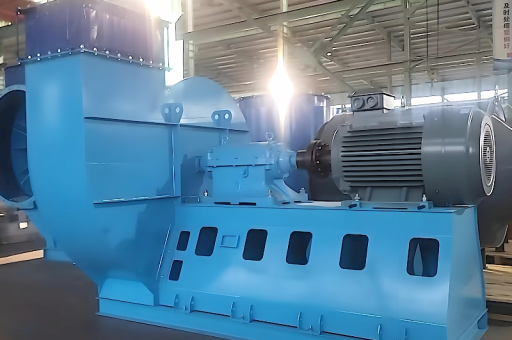
A centrifugal flow fan (also called a radial fan) uses a rotating impeller to accelerate air radially outward. For cement sintering applications, the following design parameters are critical:
| Parameter | Typical Value | Impact |
|---|---|---|
| Motor Power | 110 kW | Drives airflow volume and pressure |
| Airflow Rate | 40,000 – 70,000 m³/h | Matches clinker production rate |
| Static Pressure | 4,000 – 8,000 Pa | Penetrates deep clinker bed |
| Impeller Diameter | 1,200 – 1,600 mm | Large diameter for high volume |
| Operating Speed | 980 – 1,480 RPM | Optimized via VFD for turndown |
Why 110kW? This power rating is common because it corresponds to typical 2,500–3,500 tons per day (tpd) clinker production lines. The fan must deliver consistent pressure even as clinker bed resistance fluctuates.
Efficiency Considerations:
- Impeller design: Backward-curved blades reduce turbulence and improve static efficiency (up to 85%).
- Variable Frequency Drive (VFD): Allows precise airflow control, reducing energy consumption by 20–35% compared to throttle control.
- Material selection: Abrasion-resistant steel or wear liners extend service life in dusty environments.
Key Questions & Expert Answers
Q1: Can a 110kW centrifugal flow fan be used for both kiln cooling and sintering?
A: Yes. In most cement plants, the same fan serves the sinter blower function—forcing ambient air through the grate cooler. However, in some configurations, a dedicated under-grate fan handles sintering cooling while a separate recuperation fan handles heat recovery. A well-designed 110kW centrifugal fan can handle both duties if ductwork and dampers are arranged properly.
Q2: What is the typical lifespan of a 110kW centrifugal flow fan in a cement plant?
A: With proper maintenance (bearing lubrication, rotor balancing, and impeller cleaning), these fans last 8–12 years in continuous operation. Shaft seals and bearings may need replacement every 3–5 years. In harsh environments, wear plating on the impeller can extend life by 40%.
Q3: How does altitude affect fan performance for cement kiln cooling?
A: At higher altitudes (above 1,000 meters), air density decreases. A 110kW fan may need a larger impeller or higher speed to maintain the same mass flow. VFD control helps compensate, but derating the motor by 5–8% per 1,000 meters of elevation is recommended.
Q4: Is a centrifugal flow fan better than an axial fan for sintering applications?
A: For cement kiln cooling and sinter blower duty, centrifugal fans are preferred. Axial fans handle high volume at low pressure, while centrifugal fans provide the high static pressure (up to 10,000 Pa) needed to force air through a deep, dense clinker bed. A 110kW centrifugal design specifically optimizes this pressure-flow tradeoff.
Installation, Maintenance & Operational Best Practices
Installation Checklist:
- Foundation must be vibration-isolated to avoid resonance with kiln drives.
- Inlet ductwork should be smooth-bore with at least 1.5 diameters of straight run before the fan.
- Include a bleed-off damper for startup and emergency shutdown.
- Install pressure transducers upstream and downstream for real-time bed resistance monitoring.
Maintenance Schedule:
| Interval | Task |
|---|---|
| Daily | Visual inspection, vibration check, bearing temperature log |
| Weekly | Clean impeller blades, check belt tension (if belt-driven) |
| Monthly | Lubricate bearings, inspect shaft seal |
| Quarterly | Alignment check, impeller balancing, cleaning of intake filters |
| Annually | Full rotor overhaul, non-destructive testing of welds |
Energy Optimization Tip: Pair the 110kw electric centrifugal flow fan with a controller that adjusts speed based on clinker bed temperature and pressure drop. This reduces average power consumption from 90kW to 55–65kW during low production periods.
Conclusion: Optimizing Fan Performance for Modern Cement Plants
The cement kiln cooling system is only as effective as its sinter blower—and the 110kw electric centrifugal flow fan remains a benchmark choice for medium-capacity plants. By selecting a fan with high-efficiency impeller geometry, VFD compatibility, and robust material design, operators can achieve stable clinker quality, reduce energy costs, and extend equipment lifespan.
Whether you are retrofitting an existing cooler or designing a new line, prioritize centrifugal flow fan sizing based on actual bed resistance rather than nominal airflow. Engage with fan manufacturers to run computational fluid dynamics (CFD) simulations that match the fan curve to your specific grate cooler profile.
Finally, remember that best-in-class maintenance and smart variable-speed control are not optional—they are the difference between a fan that lasts a decade and one that fails in three years.





