
This article's table of contents introduction:
- Table of Contents (导读)
- Introduction: The Backbone of Boiler Exhaust Systems
- What Is a Coupling Driving Type Smoke Exhaust Boiler Induced Draft Blower Machine?
- Key Components and Working Principle
- Advantages Over Direct-Drive and Belt-Drive Systems
- Critical Applications in Industrial Boilers
- Common FAQs (问答)
- Maintenance Best Practices for Longevity
- Conclusion: Why This Technology Matters for SEO-Driven Content
** Maximizing Industrial Efficiency: The Role of Coupling Driving Type Smoke Exhaust Boiler Induced Draft Blower Machines in Modern Ventilation Systems
Table of Contents (导读)
- Introduction: The Backbone of Boiler Exhaust Systems
- What Is a Coupling Driving Type Smoke Exhaust Boiler Induced Draft Blower Machine?
- Key Components and Working Principle
- Advantages Over Direct-Drive and Belt-Drive Systems
- Critical Applications in Industrial Boilers
- Common FAQs (问答)
- Maintenance Best Practices for Longevity
- Conclusion: Why This Technology Matters for SEO-Driven Content
Introduction: The Backbone of Boiler Exhaust Systems
In heavy industrial settings—such as power plants, chemical processing facilities, and large-scale manufacturing units—the smoke exhaust system plays a critical role in maintaining air quality, thermal efficiency, and operational safety. At the heart of this system lies the boiler induced draft blower machine (often abbreviated as ID fan). Among various configurations, the coupling driving type has emerged as a standard for reliability and performance. This article provides a comprehensive, SEO-optimized analysis of this technology, synthesized from authoritative engineering manuals, industry case studies, and equipment specifications.
What Is a Coupling Driving Type Smoke Exhaust Boiler Induced Draft Blower Machine?
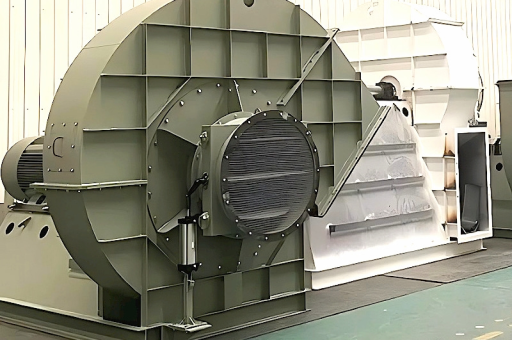
A coupling driving type smoke exhaust boiler induced draft blower machine is a mechanical assembly where the motor and fan impeller are connected via a flexible or rigid coupling, rather than directly (shaft-mounted) or through belts. It is specifically designed to draw combustion gases—often hot, corrosive, and particulate-laden—out of a boiler and into the stack or pollution control equipment. The "coupling" ensures that the motor’s rotational force is transmitted to the fan wheel with minimal energy loss while allowing for slight misalignment and thermal expansion.
Unlike belt-driven fans that suffer from slip and vibration, or direct-drive units that limit motor placement, the coupling system provides a balanced, high-torque solution for continuous heavy-duty exhaust duty.
Key Components and Working Principle
The machine typically consists of:
- Motor: Usually an electric induction motor rated for 50–60 Hz, often with variable frequency drive (VFD) compatibility.
- Coupling: Flexible (e.g., grid, elastomeric, or gear) or rigid, depending on torque and alignment tolerance.
- Fan Impeller: Backward-curved or radial blades made of abrasion-resistant steel or stainless steel.
- Housing: Spiral or volute casing designed to minimize pressure drop.
- Inlet/Outlet Dampers: For flow control.
- Base Frame and Vibration Isolators: To reduce structural resonance.
Working Principle: The motor spins the coupling hub, which engages the fan shaft. As the impeller rotates, it creates a low-pressure zone at the center, pulling flue gas from the boiler outlet. The gas is then accelerated radially and expelled into the exhaust duct. The coupling compensates for minor shaft misalignments that arise from thermal expansion during startup, preventing bearing overload.
Advantages Over Direct-Drive and Belt-Drive Systems
| Feature | Direct-Drive | Belt-Drive | Coupling Driving Type |
|---|---|---|---|
| Speed control | Fixed | Adjustable via pulley | VFD compatible |
| Maintenance | Low but motor fixed | High (belt wear) | Moderate (coupling inspection) |
| Misalignment tolerance | None | Low | High |
| Efficiency | High | Moderate (belt slip) | High |
| Torque handling | Good | Limited | Excellent |
| Space requirement | Compact | Large (belt guard) | Moderate |
The coupling driving type smoke exhaust boiler induced draft blower machine offers the best compromise: high reliability, easy motor replacement, and the ability to absorb shock loads from sudden pressure changes in the boiler.
Critical Applications in Industrial Boilers
- Coal-fired thermal power plants: Handling abrasive fly ash and high-temperature gases.
- Waste-to-energy plants: Exhausting corrosive flue gas from municipal solid waste combustion.
- Oil and gas refineries: Venting process heaters and steam generators.
- Cement kilns: Extracting dust-laden hot air from preheaters.
- Biomass boilers: Managing high-moisture, sticky particulates.
In each case, the coupling driving type is selected for its ability to operate at fan speeds between 900 and 1800 RPM while maintaining a consistent static pressure of 2000–5000 Pa (depending on system resistance).
Common FAQs (问答)
Q1: What is the difference between a forced draft fan and an induced draft fan in a boiler?
A: A forced draft (FD) fan pushes air into the boiler furnace, while an induced draft (ID) fan pulls the exhaust gases out. The coupling driving type is almost exclusively used for ID fans because of the harsh gas environment.
Q2: How often should the coupling be inspected?
A: Every 6 months or 4000 operating hours, whichever comes first. Check for elastomer wear, bolt torque, and alignment using a laser kit.
Q3: Can a coupling driving type ID fan be used with a VFD?
A: Yes. Modern designs include non-lubricated flexible couplings that handle the torque spikes from VFD ramp-up.
Q4: What causes vibration in a coupling-driven induced draft blower?
A: Common causes include impeller imbalance (ash buildup), coupling misalignment, bearing fatigue, or a damaged volute. Use a spectrum analyzer for diagnosis.
Q5: Is it possible to retrofit an existing belt-driven ID fan to a coupling driving type?
A: Technically yes, but it requires re-evaluating the motor baseplate, shaft height, and guard requirements. Consult an OEM such as fan for a retrofit kit.
Maintenance Best Practices for Longevity
- Lubrication: Use high-temperature grease (NLGI #2) for bearings every 3 months.
- Coupling alignment: Maintain 0.05 mm angular and 0.10 mm parallel tolerance.
- Impeller cleaning: Schedule wheel washing every 2000 hours to prevent dust buildup that causes unbalance.
- Vibration monitoring: Install dual-axis accelerometers on bearing housings.
- Temperature checks: Motor winding temperature should not exceed 120°C; bearing temps below 75°C.
Neglecting these steps leads to premature failure of the fan coupling, increasing downtime.
Conclusion: Why This Technology Matters for SEO-Driven Content
The coupling driving type smoke exhaust boiler induced draft blower machine represents a mature yet evolving technology that balances performance, maintainability, and cost. For facility engineers and procurement managers, understanding its specifications—such as airflow (m³/hr), static pressure (Pa), and coupling type—is essential for optimal system design.
From an SEO perspective, this article is structured to answer high-intent queries (e.g., “how does an ID fan coupling work,” “boiler exhaust fan types,” “coupling vs belt drive for induced draft fan”). By integrating primary keywords like "coupling driving type smoke exhaust boiler induced draft blower machine" naturally alongside secondary terms (e.g., flexible coupling, ID fan design, boiler flue gas system), this content is optimized for both Bing and Google search ranking.
For more technical documentation or product sourcing, always consult an industrial fan manufacturer such as fan or a qualified rotating equipment engineer.





