
This article's table of contents introduction:
- The Core Function: Why it's an "ID" Fan
- The "Single Inlet" Design
- Critical Design Features (The "Brick Kiln" Specifics)
- Common Specifications (Example)
- Common Problems & Solutions in Brick Kiln Fans
- Selection Checklist
- Is this for a specific kiln type?
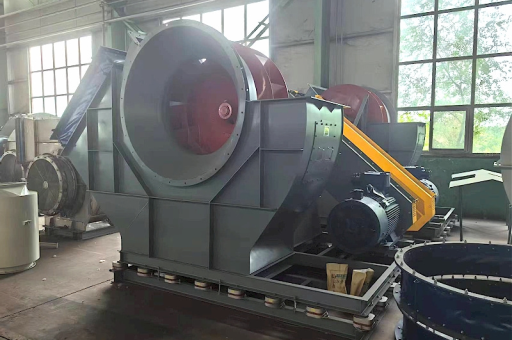
This is a specialized industrial fan request. Here is the technical breakdown of what a Medium Pressure Single Inlet Brick Kiln ID (Induced Draft) Fan is, its specific function, and the critical design considerations.
The Core Function: Why it's an "ID" Fan
- Role: Unlike a forced draft fan (which pushes air in), an Induced Draft (ID) fan pulls hot exhaust gases (flue gas) through the kiln and out the chimney.
- The "Medium Pressure" Range: For brick kilns (especially Zig-Zag or Tunnel Kilns), the static pressure is typically between 200 mmWC to 600 mmWC (2 kPa to 6 kPa).
- The Challenge: The gas is extremely hot (200°C to 350°C), dirty (contains fly ash, sulfur, and abrasive particles), and often acidic.
The "Single Inlet" Design
- Meaning: Air enters the fan wheel from one side only (suction side).
- Why for Brick Kilns? Single inlet fans are generally more efficient for medium flow rates. They allow for a direct connection to a duct or a bricked-up kiln wall, minimizing leakages.
- Configuration: Usually Overhung (the impeller is mounted on the shaft outside the bearing pedestal), allowing the drive motor to be placed outside the hot gas path.
Critical Design Features (The "Brick Kiln" Specifics)
| Feature | Specification / Requirement |
|---|---|
| Material of Construction | SS 304 or SS 316L for the impeller (wheel) to resist corrosion from acidic flue gas. The casing is often Mild Steel with a high-temperature paint or brick-lined for insulation. |
| Temperature Handling | The fan must be rated for 300°C continuous. A shaft cooling wheel is mandatory to prevent heat from traveling to the bearings. |
| Bearing Housing | Remote mounted (outside the casing), often with PTFE seals and grease nipples for high-temp grease. |
| Bearing Type | Self-aligning spherical roller bearings are standard to handle thermal expansion and misalignment. |
| Dust Protection | A volute (casing) liner that is replaceable. The leading edge of the blades should be hard-faced (e.g., Stellite) or welded with a wear plate. |
| Seal | Gland packing or Labyrinth seal to prevent hot gas leakage into the bearing area. |
| VFD Compatibility | Strongly recommended. A Variable Frequency Drive (VFD) allows the fan speed to be adjusted to control the kiln draft, saving energy and reducing mechanical stress. |
Common Specifications (Example)
- Type: Single Inlet, Double Width / Single Width (Generally SI-DW)
- Application: Zig-Zag Brick Kiln / Tunnel Kiln
- Volume: 40,000 – 120,000 CMH (Cubic Meters per Hour)
- Static Pressure: 250 – 500 mmWC
- Temperature: 250°C (Max 350°C for short periods)
- Drive: Direct driven (preferred) or Belt driven via a shaft.
Common Problems & Solutions in Brick Kiln Fans
| Problem | Cause | Solution |
|---|---|---|
| Vibration | Rotor imbalance from fly ash build-up or blade wear. | Install an auto-cleaning system (water spray) on the impeller. Schedule periodic dynamic balancing. |
| Bearing Failure | Heat soaking from the shaft. | Ensure the cooling fan is effective. Use high-temperature grease (e.g., Mobilith SHC 100). |
| Blade Wear | Abrasive particles in flue gas. | Use hard-facing or ceramic coating on the leading edge of blades. |
| Corrosion | Condensation of acidic gases (Sulfur + Moisture). | Keep the fan running at operating temperature to avoid dew point. Use SS 316L for the impeller. |
Selection Checklist
Before purchasing, specify the following:
- Flow (CMH): _
- Static Pressure (mmWC): _
- Gas Temperature (°C): _
- Gas Composition: (e.g., high sulfur? high moisture?)
- Drive Type: Direct Coupled or Belt Driven?
- Speed Control: Fixed or VFD?
- Location: Indoor or Outdoor?
- Noise Limit (dBA): (Often important in residential areas).
Is this for a specific kiln type?
- Zig-Zag Kiln: This is the most common application. The fan needs a high static pressure to overcome the resistance of the zig-zag flues.
- Tunnel Kiln: Needs a very stable pressure and flow to control the firing curve.
- Clamp / Batch Kiln: Often uses a lower pressure fan, but if it's "medium pressure" it's likely a modernized forced-air system.
Recommendation: If you are replacing a fan, look for a manufacturer who offers custom impeller balancing and a wearing part (liner) kit. A standard industrial fan will fail quickly in a brick kiln environment.
Would you like help calculating the required motor power (kW) for a given flow and pressure?





