
This article's table of contents introduction:
- What is it?
- Key Characteristics of the Backward Curved (BC) Design
- Construction for "Smoke Exhaust" & "Induced Draft"
- Applications
- Advantages for Smoke Exhaust
- Disadvantages / Considerations
- Typical Naming / Model Spec Example (China & Global)
- Summary
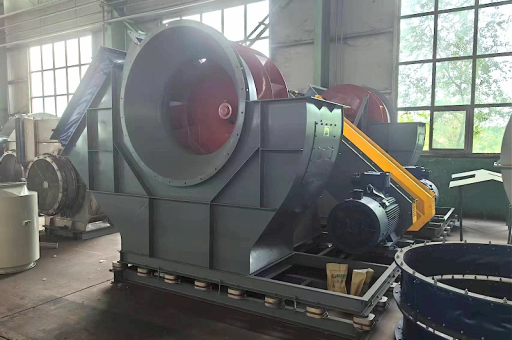
This is a specialized piece of industrial equipment used for moving hot, particulate-laden, or corrosive air and gases. The name itself combines three key specifications:
- Function: Smoke Exhaust & Induced Draft (Moving hot, often dirty air under negative pressure).
- Design: Backward Curved Centrifugal Fan.
- Application: Boiler, furnace, or industrial process exhaust.
Here is a detailed breakdown of what this is, how it works, and where it is used.
What is it?
This is a centrifugal fan designed specifically for induced draft (ID) applications. "Induced draft" means the fan is placed at the end of the air path (after the furnace, boiler, or process). It creates a vacuum or negative pressure, "sucking" the exhaust gases (smoke, flue gas) out of the system and pushing them up the chimney or stack.
The backward curved (or backward inclined) impeller is the critical design feature.
Key Characteristics of the Backward Curved (BC) Design
- Impeller Blades: The blades curve away from the direction of rotation.
- Efficiency: This is the most efficient centrifugal fan design (>85% static efficiency). It handles air more aerodynamically than forward-curved or radial bladed fans.
- Non-Overloading Power Curve: This is critical for induced draft. As the system resistance (static pressure) drops, a backward curved fan's power consumption peaks and then decreases. A forward-curved fan's power consumption would skyrocket, potentially burning out the motor. This makes BC fans very safe for variable system conditions.
- Self-Cleaning: The blade shape resists dust and particulate buildup because the airflow path has less turbulence and "dead zones" where material can stick.
- Speed: Typically runs at higher speeds (RPM) than forward-curved fans.
Construction for "Smoke Exhaust" & "Induced Draft"
Standard fans fail quickly in these harsh environments. A proper Induced Draft Backward Curved Fan is built with heavy-duty materials:
| Component | Standard Fan | Heavy-Duty ID Fan |
|---|---|---|
| Impeller Material | Mild Steel (MS) | Corten Steel, Alloy Steel, or Stainless Steel (SS 304/316) to resist high-temp corrosion and erosion. |
| Housing | Light gauge steel | Heavy plate steel with external stiffeners (ribs) to withstand vacuum. Often lined with abrasion-resistant (AR) plates. |
| Shaft & Bearings | Standard bearings | Oversized, self-aligning, spherical roller bearings with cooling fins or remote cooling for heat dissipation. |
| Drive | Direct Drive or Belt | Belt Drive is preferred (allows speed change for performance tuning). Often has Vibration Isolators and Inlet Box Dampers. |
| Seals | Simple labyrinth seals | High-temperature shaft seals with air purging to prevent hot gas leakage. |
Applications
This specific fan type is essential in settings where hot, dirty gases must be moved reliably and efficiently:
- Thermal Power Plants: Boiler Induced Draft (ID) fans.
- Cement Plants: Exhaust from kilns and clinker coolers.
- Steel Mills: Exhaust from blast furnaces, sintering plants, and electric arc furnaces (EAFs).
- Waste-to-Energy Plants: Sucking combustion gases from incinerators.
- Industrial Boilers: Large steam generators in refineries, chemical plants, and food processing.
- Pollution Control Systems: Moving gases through scrubbers, baghouses, or electrostatic precipitators (ESP).
Advantages for Smoke Exhaust
- High Efficiency: Lowers operational electricity costs (the most expensive part of running a fan).
- Stable Operation: The non-overloading power curve prevents motor burnout.
- Durability: Handles high temperatures (350°C - 450°C / 660°F - 840°F and higher with special cooling) and abrasive ash.
- Low Maintenance: The self-cleaning design reduces buildup, and robust bearings last longer.
- Quiet Operation: Backward curved fans are generally quieter than radial or paddle-wheel fans at similar performance levels.
Disadvantages / Considerations
- Higher Initial Cost: More expensive to manufacture than forward-curved or radial fans.
- Sensitivity to Over-Speed: The impeller is heavier and the blades are more delicate if oversped.
- Requires Cleaner Inlet Air (relative): While better than radial fans, severe sticky particulate can still cause problems if the material cakes on the blade face. Often paired with a dust collector upstream.
Typical Naming / Model Spec Example (China & Global)
You might see a model like:
- GY-4-73-No.8D
- G: Boiler Fan (Guo lu)
- Y: Induced Draft (Yin feng)
- 4-73: Series designation (high efficiency, backward curved)
- No.8: Impeller diameter in decimeters (800mm)
- D: Drive type (D = Direct drive via coupling)
Summary
| Feature | Benefit for Smoke Exhaust |
|---|---|
| Backward Curved Impeller | High efficiency, non-overloading motor, self-cleaning. |
| Induced Draft Setup | Creates negative pressure, prevents hot gas leakage into the plant. |
| Smoke Exhaust Design | High-temp alloys, abrasion-resistant liners, cooled bearings. |
| Belt Drive (Often) | Allows tuning of fan speed to match exact system resistance. |
In short: If you need to reliably and efficiently pull hot, dirty smoke out of an industrial furnace or boiler, a Smoke Exhaust Backward Curved Centrifugal Fan (Induced Draft Blower) is the industry standard choice. It is not a cheap fan, but its durability and energy savings make it the most cost-effective option for critical service.





