
This article's table of contents introduction:
- Induced Draught (ID) Fan
- V-Belt Driven
- Centrifugal Fan
- Abrasion Resistant (The Critical Feature)
- Summary: The Perfect Application
- Other Common Applications:
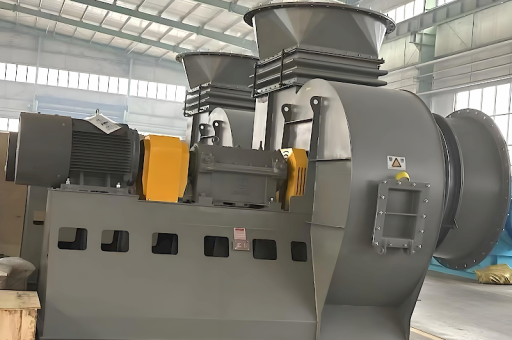
This appears to be a description of a specific type of industrial fan, likely used in demanding environments like power plants, cement factories, steel mills, or mining operations.
Here is a detailed breakdown of what each part of the description means and why it is designed that way.
Induced Draught (ID) Fan
- Definition: An ID fan is located at the "downstream" end of a system (e.g., after a boiler, furnace, or baghouse). It pulls (induces) hot, dirty, or corrosive gases through the system by creating a negative pressure or vacuum.
- Key Characteristics:
- Handles Dirty Gases: The fan moves air that has already passed through the process, often containing fly ash, dust, soot, or chemical fumes.
- High Temperature: The gas is often very hot (e.g., 150°C to 400°C or more).
- Negative Pressure: The casing and ductwork must be sealed to prevent air from leaking in.
V-Belt Driven
- Meaning: The fan's impeller is not directly coupled to the motor shaft. Instead, a V-belt connects a pulley on the motor to a larger pulley on the fan shaft.
- Advantages for this Application:
- Speed Control: V-belts allow the fan speed (RPM) to be easily changed by swapping pulleys. This is critical for matching fan performance to the specific system resistance.
- Motor Protection: The belt acts as a mechanical fuse. If the fan jams or seizes, the belt will slip or break, protecting the expensive motor from burning out.
- Speed Reduction: ID fans often need to run slower than a standard motor's speed to manage the high torque and gas flow efficiently. Belt drives are an excellent, cost-effective way to reduce speed.
Centrifugal Fan
- Operating Principle: Air is drawn into the center (eye) of the fan and then flung outward by a rotating impeller. The centrifugal force creates pressure and airflow.
- Type of Impeller: For abrasion resistance, the impeller is almost certainly a Radial Blade (or Paddle Wheel) type.
- Why? These blades are strong, simple, and self-cleaning. They are the best at handling high dust loads and large particles without clogging.
Abrasion Resistant (The Critical Feature)
This is the most important design specification for this fan, as ID fans process air filled with hard, sharp particles (like coal ash, silica dust, or iron ore fines).
- Thickened Plate Work: The impeller blades, backplate, and shroud are made from much thicker steel than a standard fan.
- Wear Liners: The fan casing (volute) is lined with replaceable, hardened steel or ceramic plates in the areas where particle impact is highest.
- Hard Facing: Welding a layer of very hard, wear-resistant alloy (e.g., chromium carbide) onto the leading edges of the impeller blades.
- Replaceable Tips: The most vulnerable part of the impeller (the blade tips) are often designed as bolt-on or welded-on replaceable pieces.
- Material Choice: The fan is made from high-tensile, abrasion-resistant steel (e.g., Hardox, AR400, or similar).
Summary: The Perfect Application
This specific fan description—Abrasion Resistant, Induced Draught, V-Belt Driven Centrifugal Fan—is a textbook example of a fan used for:
Boiler Flue Gas Extraction in Coal-Fired Power Plants
- Why it needs to be abrasion resistant: The gas is full of abrasive fly ash.
- Why it's an Induced Draught fan: It pulls the gas through the boiler, combustion air preheater, and electrostatic precipitator (ESP) or baghouse.
- Why it uses a V-belt drive: It allows for precise speed tuning to maintain furnace draft and protect the large motor.
- Why it's centrifugal: It can handle the high static pressure needed to overcome the resistance of the pollution control equipment (ESP, scrubbers).
Other Common Applications:
- Cement Plants: Exhaust from the kiln and raw mill.
- Steel Mills: Exhaust from sinter plants, electric arc furnaces (EAF), or basic oxygen furnaces (BOF).
- Mining: Ventilation and dust extraction from crushers and conveyors.
- Chemical Plants: Exhaust from fluidized bed dryers or reactors.





