
This article's table of contents introduction:
- The Core Problem
- The "Cooling" Mechanism
- Key Design Features for High-Temp SWSI ID Fans
- Critical Physics: Affinity Laws & Density
- Common Failure Points & Solutions
- Operational Sequence (Crucial for ID Fans)
- Summary of Your Request
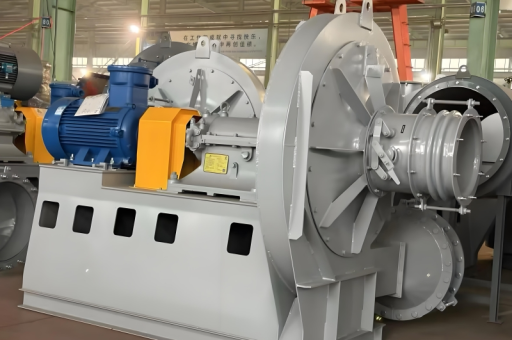
It appears you are asking about SWSI (Single Width, Single Inlet) Centrifugal Fans used as Induced Draft (ID) Fans in applications requiring high-temperature cooling.
This is a highly specific industrial configuration, typically found in power plants, steel mills, cement kilns, or chemical processing where hot, dirty flue gas must be moved and cooled.
Here is a breakdown of how this system works, the engineering challenges, and the key components.
The Core Problem
- SWSI Fan: A single-inlet fan. For large ID fans, this often implies a single-sided rotor (overhung or between bearings) drawing gas from one side.
- Induced Draft (ID) Fan: Located after the process (e.g., boiler, furnace) to pull hot gas through the system, creating negative pressure.
- High Temperature: The gas entering the fan can be 200°C to 400°C+ (400°F to 750°F+). At these temperatures, standard fan materials fail, and the gas density drops, affecting fan performance.
The "Cooling" Mechanism
The "high temperature cooling" does not usually mean the fan actively refrigerates the gas. Instead, it refers to a cooling system designed to protect the fan itself from the hot gas.
The three main cooling strategies are:
A. Air-Cooled Shaft & Bearings
- Problem: Heat conducts down the fan shaft from the hot impeller to the bearings (which fail above ~80°C / 176°F).
- Solution: A cooling fan (a small, separate fan wheel) is mounted on the main shaft between the bearing and the housing. This small fan pushes ambient air over the shaft and bearing housing to remove conducted heat.
- Alternative: Some designs use a radiator disc (a flat plate on the shaft) that spins to dissipate heat.
B. Water-Cooled Bearings & Pedestals
- Problem: Extreme radiant heat from the fan housing can overheat the bearing pedestals.
- Solution: The bearing pedestals (housings) are jacketed, and cool water is circulated through them. This is critical when gas temperatures exceed 300°C (572°F).
C. Dilution Air or Quenching (For SWSI specifically)
- Problem: In SWSI ID fans, the hot gas enters one side of the impeller. If the gas is too hot for the wheel material (e.g., Carbon Steel vs. Stainless Steel), the wheel can warp or creep.
- Solution: Cold ambient air is deliberately leaked into the fan casing (often through a dedicated inlet damper slot or an open port on the non-drive side). This mixes with the hot gas, reducing the gas temperature at the impeller by 30-60°C (50-100°F).
Key Design Features for High-Temp SWSI ID Fans
| Feature | Standard Application | High-Temp SWSI ID Fan |
|---|---|---|
| Material | Carbon Steel | Alloy Steel (e.g., Corten, 16Mo3) or Stainless Steel (309/310) for impeller. |
| Shaft Cooling | None (Standard) | Integral Cooling Fan or Water-Cooled Pedestal. |
| Bearings | Standard Grease / Oil | Water-Cooled, High-temp grease, or Circulating Oil System. |
| Housing | Standard | Insulated externally (to reduce radiant heat) and often doubled-walled with an air gap. |
| Shaft Seal | Simple labyrinth | High-Temp Labyrinth with forced air purge to prevent hot gas from escaping. |
Critical Physics: Affinity Laws & Density
When an SWSI fan moves hot gas, the gas density is lower. This has a specific effect:
- Mass Flow (kg/s) drops for the same volume flow (m³/s).
- Pressure developed by the fan is lower (because pressure is proportional to density).
- Motor power drops (good for the motor, but the fan must be oversized in volume to achieve the required mass flow for cooling).
Common Failure Points & Solutions
| Failure | Cause | Mitigation |
|---|---|---|
| Bearing Seizure | Heat migration via shaft | Install shaft cooling fan; verify water flow in pedestals. |
| Impeller Creep / Warping | Local hot spots or exceeding metal temp limit | Introduce quenching air; upgrade impeller to 310 Stainless. |
| Rotor Unbalance | Fly ash / particulate buildup on hot blades | Install online washing system or blade coatings. |
| Thermal Expansion Lock-up | Fan casing expands more than shaft | Ensure expansion joints are installed on inlet/outlet ducts; verify slide base for motor. |
Operational Sequence (Crucial for ID Fans)
You must never start an ID fan moving cold gas and then heat it up rapidly.
- Pre-Heat: Before starting, allow the fan casing to warm up slowly to avoid thermal shock.
- Start Cooling Systems: Activate cooling water to bearings and the shaft cooling fan before the main fan motor starts.
- Start Fan: Bring the fan to speed with the inlet damper closed or slightly open.
- After Stop: Run the fan for 15-30 minutes after shutting down the heat source to cool the rotor. Never stop the cooling water immediately after the fan stops, or heat will soak into the stationary bearings and damage them.
Summary of Your Request
You are likely specifying an SWSI Centrifugal Fan with:
- A heavy-duty, high-temperature alloy impeller (often backward-curved blades for efficiency).
- Integral shaft cooling.
- Water-cooled bearing housings.
- Quenching air injection on the SWSI inlet side if gas temperatures exceed material limits.
- Outer insulation on the fan casing.
Bottom Line: The "cooling" in this context is primarily for fan survival, not process cooling. If you are trying to cool the gas itself, you likely need a quench chamber or heat exchanger upstream of the fan.
Would you like me to help you source a specific manufacturer’s datasheet (e.g., Howden, TLT-Babcock, or Robinson Fans) or calculate the required quenching air flow for a specific gas temperature?





