
This article's table of contents introduction:
- The Primary Application: Steam Power Plant Draft Systems
- Why "Belt-Driven" (vs. Direct Drive)? Pros & Cons
- Key Components of this Specific Fan
- Operational Challenges & Critical Design Factors
- Summary of Selection/Design Questions
- A Word on Safety
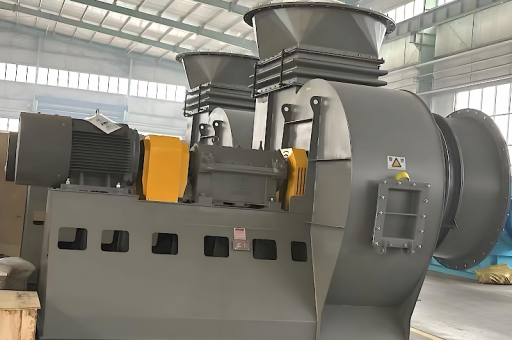
This is a very specific industrial equipment description. You are referring to a centrifugal fan used in a steam power plant to deliver gas (usually flue gas or combustion air), which is belt-driven.
Let's break down what this system is and the critical engineering considerations.
The Primary Application: Steam Power Plant Draft Systems
In a power plant, there are two main types of large centrifugal fans that move gas, typically designated by their position in the boiler system:
- Forced Draft (FD) Fans: These pull fresh air from the atmosphere and push it through the air heater and into the boiler furnace. The "gas" here is combustion air.
- Induced Draft (ID) Fans: These pull hot, dirty flue gas (the products of combustion) from the boiler, through the pollution control equipment (ESP, scrubbers, baghouse), and out the stack. The "gas" here is corrosive, hot, and laden with fly ash.
Given the description "Gas Delivery," this fan is most likely an ID fan (moving flue gas) or a Secondary Air Fan (if "gas delivery" refers to delivering hot gas for combustion). However, the core design for a belt-driven centrifugal fan remains similar.
Why "Belt-Driven" (vs. Direct Drive)? Pros & Cons
This is a key design choice. Most large utility-scale fans are direct-drive (motor shaft directly connected to fan shaft). Belt-drive is more common in smaller, industrial, or auxiliary power plant applications.
Advantages:
- Speed Flexibility: You can change the fan's rotational speed (RPM) easily by changing the pulley (sheave) sizes on the motor or fan. This allows for tuning the fan's performance (flow and pressure) to match the exact system requirements without expensive motor or fan changes.
- Motor Protection: A belt drive acts as a mechanical fuse. If the fan seizes (e.g., from a massive buildup of fly ash or bearing failure), the belts will slip or snap, protecting the expensive electric motor from burning out.
- Damping: Belts can absorb minor torsional vibrations and shock loads from the fan, smoothing out the operation.
- Standard Motor Use: Allows the use of a standard, off-the-shelf, high-speed motor (e.g., 1800 or 3600 RPM) to drive a fan that needs to run much slower (e.g., 600-900 RPM). This is often cheaper than a custom low-speed, high-torque direct-drive motor.
Disadvantages:
- Lower Efficiency: Belt drives have inherent power losses (typically 2-5%) due to belt slippage and flexing. In a 24/7 power plant, this translates to significant energy waste over time.
- Higher Maintenance: Belts stretch, wear, and need periodic tensioning and replacement. This is a routine maintenance task.
- Power Limitation: Very high horsepower applications (e.g., > 2000 HP) are difficult and impractical for multiple V-belts. At that scale, direct-drive, gearbox, or variable frequency drive (VFD) are preferred.
- Space Requirements: Belt drives require more physical space for the pulleys and guards.
Key Components of this Specific Fan
Let's look at the anatomy of this system:
| Component | Function & Power Plant Specific Notes |
|---|---|
| Impeller (Rotor) | The heart of the fan. For heavy dust (ID fans), it's typically a radial blade or radial tip design (strong, self-cleaning, but less efficient). For cleaner air (FD fans), backward-curved or airfoil blades (high efficiency, quiet). Made of abrasion-resistant steel. |
| Housing (Volute) | A spiral-shaped casing that converts velocity pressure into static pressure. For hot gas, it has expansion joints. For corrosive gas, it may be lined with stainless steel or rubber. |
| Shaft & Bearings | Heavy-duty. Bearings are typically split pillow-block roller bearings designed for high load and temperature. Must be cooled (by air or water) if handling hot flue gas (250°F - 350°F+). |
| Inlet Box | Directs gas into the impeller eye. Often includes inlet dampers (louver or radial) for flow control. |
| Belt Drive System | Motor Sheave (driver), Fan Sheave (driven), and multiple V-belts (B, C, D section or banded belts). Key maintenance point. |
| Motor | Standard TEFC (Totally Enclosed Fan Cooled) or ODP (Open Drip Proof) induction motor. Often high-efficiency (IE3/IE4). |
| Baseplate & Isolation | A heavy steel frame (I-beams) with vibration isolators (spring or rubber) to prevent transmitting vibration to the building structure. |
Operational Challenges & Critical Design Factors
- Gas Temperature: ID fans handle hot (often 150°C - 180°C) flue gas. This requires:
- Thermal expansion allowance in the shaft and housing.
- Special high-temperature grease for bearings.
- A cooling fan on the shaft between the bearing and the housing to prevent heat soak.
- Erosion: Fly ash is abrasive. The impeller blades and housing at the "cut-off" (closest point between blade and housing) suffer severe wear. Solution: hardfacing (welding on chromium carbide), ceramic tiles, or replaceable wear plates.
- Corrosion: If burning high-sulfur coal or oil, flue gas can form sulfuric acid below the acid dew point. This causes rapid corrosion.
- Belt Tension: Critical. Too loose → slipping, reduced flow, belt burning. Too tight → reduced bearing life, shaft bending, belt stretching.
- Vibration: The #1 diagnostic tool. Unbalance from dust buildup or erosion, misalignment of sheaves, bearing failure, or belt resonance all show up in vibration analysis.
Summary of Selection/Design Questions
If you are specifying or troubleshooting this fan, the key questions are:
- Gas Type: Air (FD) or Flue Gas (ID)?
- Gas Temperature: (°F/°C) – Impacts material choice and thermal clearance.
- Gas Cleanliness: Is there dust? What concentration and particle size? (Determines blade type and wear protection).
- Required Flow & Pressure: (CFM / m³/hr & Inches WG / Pa).
- Motor Horsepower: What is the maximum power draw? (Especially important if cold starting a hot flue gas fan – cold gas is denser!).
- Control Method: Inlet vanes? Outlet dampers? Variable speed via VFD on the motor? (Belt drive allows a mechanical speed change, but a VFD is better for continuous modulation).
A Word on Safety
This is heavy rotating equipment. Key safety points:
- Guarding: The belt drive and exposed shaft must have a locked guard.
- Lockout/Tagout (LOTO): Never work on the fan or belts without verifying the motor is de-energized and isolated.
- Hot Gas: If the fan is an ID fan, all metal parts can be hot enough to cause severe burns, even after the boiler is off.





