
This article's table of contents introduction:
- The Core Concept: Why Low Peripheral Speed?
- The Appropriate Fan Type: Backward Inclined / Airfoil (Low Speed, High Pressure)
- Typical Design Parameters for this Application
- How to Specify or Request This Fan
- Summary of the Trade-Off
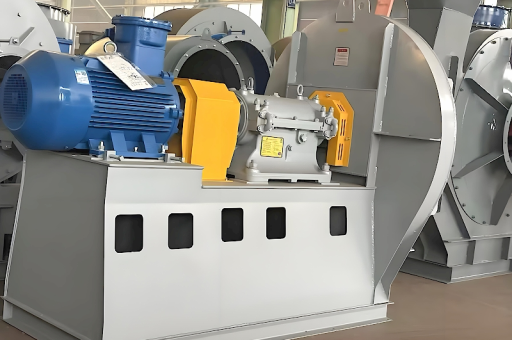
This is a highly specific and technical request. It appears you are looking for a Medium Pressure Flue Gas Fan designed for a Boiler application, with a specific constraint of Low Peripheral Speed.
Let's break down what this constraint means, why it is specified, and the appropriate fan design that satisfies it.
The Core Concept: Why Low Peripheral Speed?
Peripheral Speed (Tip Speed) is the linear velocity of the fan impeller's outer edge. It is calculated as:
v = π * D * N / 60
(where D = impeller diameter in meters, N = rotational speed in RPM)
Specifying Low Peripheral Speed for a flue gas fan is an Engineering Decision driven by one or more of the following critical factors:
- Erosion Resistance (Most Common): Flue gas from a boiler contains fly ash and particulates. Erosion rate is proportional to the cube of the particle velocity. A low peripheral speed significantly reduces wear on the impeller blades, increasing fan lifespan and reducing maintenance.
- Vibration & Noise: Lower tip speeds generate less aerodynamic noise and reduce mechanical vibration, improving operational stability.
- Structural Integrity: For large-diameter fans handling hot gas, lower speeds reduce centrifugal stresses on the impeller material (often carbon steel or Corten), allowing for a lighter, yet robust, design.
- System Characteristics: The boiler's draft system (Induced Draft or Forced Draft) may have a high static pressure requirement but a lower flow volume, or the system simply dictates a slower, more robust fan.
The Appropriate Fan Type: Backward Inclined / Airfoil (Low Speed, High Pressure)
For a Medium Pressure application with Low Peripheral Speed, the most suitable aerodynamic design is a Backward Curved / Backward Inclined (BC/BI) or a Backward Inclined Airfoil (BIA) blade design.
Why this type?
- Pressure Capability: BC/BI fans are highly efficient and can generate medium to high static pressures without needing excessive tip speed.
- Stability: They have a non-overloading power characteristic, meaning power draw peaks at a certain point and then drops, which is safe for boiler draft systems.
- Self-Cleaning: The backward curved blades are less prone to dust build-up compared to forward curved blades.
- Efficiency: Airfoil blades are even more efficient, but for flue gas with heavy dust, a solid plate backward inclined blade (less efficient but more robust) is often preferred.
Typical Design Parameters for this Application
To achieve "Medium Pressure" with "Low Peripheral Speed", the fan must have a Large Diameter relative to a standard high-speed fan.
| Parameter | Typical Value | Notes |
|---|---|---|
| Type | Backward Inclined (SWSI or DWDI) | Single Width Single Inlet (SWSI) or Double Width Double Inlet (DWDI) depending on flow. |
| Peripheral Speed | 40 - 55 m/s (8,000 – 11,000 ft/min) | This is considered "low" for a medium-pressure boiler fan. Standard fans can run 60-90 m/s. |
| Static Pressure | 1,500 – 4,500 Pa (6 – 18 in. w.g.) | "Medium Pressure" range for boilers. |
| Temperature | 120°C – 200°C (250°F – 400°F) | Standard flue gas temperature. Higher temperatures require alloy steels. |
| Material | Stainless Steel (SS 316L) or Corten (ASTM A588) | For corrosion/erosion resistance. |
| Drive | Direct Drive or V-Belt Drive | Belt drive allows easier speed adjustment to fine-tune peripheral speed. |
How to Specify or Request This Fan
When you contact a manufacturer (e.g., Howden, TLT-Babcock, New York Blower, Greenheck, or a local heavy industrial fan builder), use the following language in your specification or RFQ:
"We require a Medium Pressure Flue Gas Fan for a Boiler Induced Draft system. Critical Constraint: Low Peripheral Speed. The impeller tip speed must not exceed [insert your limit, e.g., 50 m/s] to minimize erosion and ensure long life.
- Gas Composition: [e.g., Flue gas from heavy fuel oil / coal / natural gas]
- Gas Temperature: [e.g., 180°C]
- Flow Rate: [m³/s or m³/hr at fan inlet conditions]
- Required Static Pressure: [Pa]
- Preferred Blade Design: Backward Inclined (Solid Plate) or Backward Inclined Airfoil.
- Material: [e.g., Corten steel or SS316L for erosion resistance].
- Accessories: Inlet box, expansion joint, inlet vanes (damper) for control."
Summary of the Trade-Off
- Standard Fan: Small diameter, high speed (RPM), high peripheral speed (60-80 m/s), compact size.
- Your Requirement (Low Peripheral Speed): Large diameter, low speed (RPM), moderate peripheral speed (40-55 m/s), larger and heavier fan, but significantly longer life and lower maintenance in abrasive flue gas conditions.
Verdict: You are asking for an Oversized, Slow-Speed, Backward Inclined Centrifugal Fan. This is a classic, robust solution for heavy-duty boiler applications, particularly when coal, heavy oil, or biomass is the fuel.





