
This article's table of contents introduction:
- Deconstructing the Name
- Why Stainless Steel and "High Volume"?
- Typical Applications
- Critical Engineering Specifications
- Common Issues with These Fans
- Alternatives to "Full Stainless Steel"
- Key Questions for a Supplier
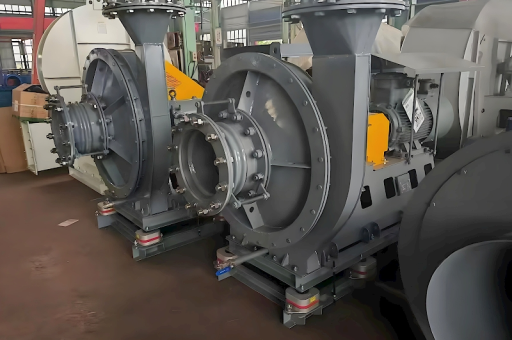
This is a highly specific industrial equipment description. It sounds like you are describing a Centrifugal Fan (Blower) designed for a Flue Gas Desulfurization (FGD) system, a Biomass Power Plant, or a Waste-to-Energy facility.
Here is a detailed breakdown of what this description entails, the engineering specifications, and why these materials are chosen.
Deconstructing the Name
- High Volume Air Supply: The fan moves a large mass flow of gas (measured in m³/hr or CFM) at relatively low pressure differentials compared to compressors.
- Flue Gas: The medium is hot, corrosive, and often contains particulate matter (fly ash, SOx, NOx, HCl, dioxins).
- Fan: A rotating machine that creates airflow.
- Stainless Steel: The construction material is corrosion-resistant alloy (typically 316L, 904L, or Duplex 2205) to handle acidic condensate.
- Centrifugal Blower: The operating principle. Gas enters axially and is flung outward (radially) by the impeller, generating pressure.
Why Stainless Steel and "High Volume"?
| Requirement | Material/Design Choice | Why? |
|---|---|---|
| Corrosion Resistance | Stainless Steel (SS 316L, 904L, or 2304 Duplex) | Flue gas contains sulfuric acid (H₂SO₄), sulfurous acid (H₂SO₃), and chlorides. If the gas drops below the acid dew point, carbon steel would corrode rapidly. |
| High Volume (Mass Flow) | Large Inlet/Outlet Sizing & Wide Impeller | The fan must handle huge volumetric flows (e.g., 100,000 to 1,000,000+ ACFM). |
| High Temperature | Stainless Steel (maintains strength up to ~400°C/750°F) + Expansion Joints | Flue gas inlet temperatures typically range from 120°C to 200°C (250°F - 400°F), but can spike higher. |
| Erosion | Thicker impeller blades & wear liners (optional) | Fly ash particles can erode the impeller. Stainless provides better erosion resistance than carbon steel. |
Typical Applications
- Power Plants: Induced Draft (ID) fans or Boost fans after FGD scrubbers.
- Cement Kilns: Kiln exhaust gas fans.
- Chemical Processing: Acid fume extraction systems.
- Waste Incineration: Flue gas cleaning systems.
Critical Engineering Specifications
If you are ordering or specifying this fan, you need the following parameters clearly defined:
A. Performance
- Volume Flow (Q): _ m³/hr (or CFM)
- Total Static Pressure (P): _ Pa (or mmWC / inWG)
- Gas Density: _ kg/m³ (and composition: % O₂, CO₂, H₂O)
- Temperature: Operating °C / Maximum °C
B. Material
- Impeller: SS316L (standard) / SS904L (high chloride) / Duplex 2205 (best for strength + corrosion).
- Casing: SS316L or Carbon Steel with Rubber/FRP lining (cheaper option).
- Shaft: EN8 (Carbon Steel) or SS410 (Stainless).
C. Design Features
- Type: Backward Curve (high efficiency, non-overloading) vs. Radial (for dirty gases).
- Drive: Direct drive (D-coupling) vs. Belt drive (for speed adjustment).
- FLA (Flue Gas Application) Seal: Labyrinth seals with purge air to prevent gas leakage to bearings.
- Drain: Bottom casing drain with syphon to remove acidic condensate.
Common Issues with These Fans
- Corrosion: Occurs at the acid dew point (typically ~80-120°C).
- Solution: Keep fan casing insulated or use SS316L/904L.
- Erosion: From fly ash.
- Solution: Use wear plates on the leading edge of impeller blades.
- Imbalance/Vibration: From ash build-up on the impeller.
- Solution: Install washing nozzles (water spray) inside the fan casing.
- Bearing Failure: From radiated heat from the flue gas and poor cooling.
- Solution: Water-cooled bearing housings or heat shields.
Alternatives to "Full Stainless Steel"
If cost is a concern, manufacturers often build these fans as:
- Carbon Steel Casing + SS316L Impeller (Most common for general flue gas).
- Corten Steel (Weathering steel, good for high temp but poor for acid).
- FRP (Fiber Reinforced Plastic) (Excellent for corrosion, but temp limited to ~100°C).
Key Questions for a Supplier
- "What is the acid dew point of the gas? Do you guarantee the impeller material against it?"
- "Is the shaft sealed with a compressed air purge to prevent gas leaking into the bearing housing?"
- "What is the critical speed margin? (Must be >15% from operating speed)."
- "Do you provide a coupling guard and expansion joint flanges?"
- "What is the B10 bearing life under these conditions?"
Need a specific datasheet, a drawing, or a quote? I can help you draft the technical requirements for a procurement request.





