
This article's table of contents introduction:
- The Gold Standard: Spherical Roller Bearings (SRB)
- Specific Bearing Arrangements (How they are used)
- A Note on "Specialty" Types (Used in Extreme or Specific Conditions)
- Critical Factors for Selection & Maintenance
- Summary Recommendation
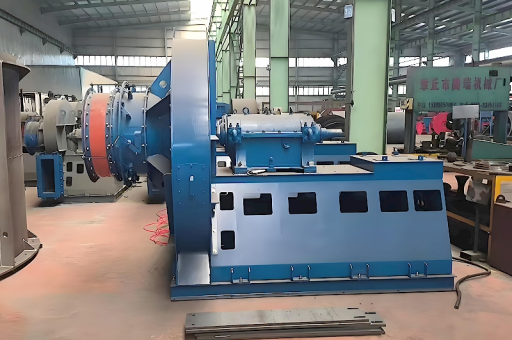
For large centrifugal fans in industrial ventilation applications, the rolling bearing type is almost always a Spherical Roller Bearing.
Here is the detailed breakdown of why this is the standard, the specific types used, and the alternatives.
The Gold Standard: Spherical Roller Bearings (SRB)
Why SRBs are dominant:
- Misalignment Tolerance: This is the most critical feature. Large fans often experience shaft deflection, thermal expansion, and slight misalignment between the fan housing and the bearing pedestal. Spherical roller bearings can accommodate angular misalignment (typically up to 1-2 degrees) without binding.
- High Load Capacity: They are designed for extremely high radial loads (from the weight of the impeller and belt tension) as well as significant axial (thrust) loads.
- Durability: The double-row design with barrel-shaped rollers provides a robust surface area for load distribution, leading to long service life under heavy, continuous operation.
Specific Bearing Arrangements (How they are used)
For large centrifugal fans, bearings are almost always used in pairs (a drive-end and a non-drive-end bearing). There are two standard configurations:
The "Fixed" and "Float" Arrangement (Most Common)
- Fixed End (Non-Drive End - NDE usually): Uses a non-locating spherical roller bearing with a tight fit on the shaft and in the housing. This bearing locates the shaft axially and handles all thrust loads.
- Float End (Drive End - DE): Uses a locating (or floating) spherical roller bearing. The outer ring has a loose fit in the housing or the housing is designed to allow the outer ring to slide axially. This allows the shaft to expand due to heat without putting excessive axial load on the fixed bearing.
Matched Pair with Rigid Housing
- Sometimes, two spherical roller bearings (usually a back-to-back arrangement) are mounted rigidly in a split pillow block housing. This is common in smaller or more rigidly constructed fans where thermal expansion is less of a concern.
A Note on "Specialty" Types (Used in Extreme or Specific Conditions)
While SRBs are standard, you will occasionally see these, especially on very large, heavy-duty, or high-temperature fans.
| Bearing Type | Where/Why it is used | Key Difference |
|---|---|---|
| Cylindrical Roller Bearings (NU/NJ type) | High-speed fans where thrust loads are minimal. They handle very high radial loads and allow axial movement (for thermal expansion) with very low friction. | Excellent for speed; poor for misalignment and thrust loads. Often paired with an Angular Contact Ball Bearing for thrust. |
| Angular Contact Ball Bearings | Smaller, high-speed fans (e.g., for clean air applications) or as a dedicated thrust bearing on large fans with a separate radial bearing. | Good for thrust; limited radial load capacity. |
| CARB (Toroidal) Roller Bearings | A modern alternative to the "float" bearing. It combines the misalignment capability of an SRB with the axial displacement capability of a cylindrical roller bearing. | Used in the non-locating position to allow very high axial movement. |
Critical Factors for Selection & Maintenance
Regardless of the type, the chosen bearing for a large industrial fan must be designed for:
- Sealing: Labyrinth seals are standard. Contact seals (like rubber lip seals) generate too much heat at high fan speeds. In dirty environments (dust, fumes), triple-labyrinth or V-ring seals are used.
- Lubrication: Grease is the most common lubricant for standard temperatures. Oil bath or circulating oil systems are used for very high speeds, high temperatures, or extreme loads. Mobil Polyrex EM or Shell Gadus S2 V220 are common greases.
- Housing: Almost always a split pillow block (e.g., SAF or SNL series) for ease of inspection and replacement without removing the fan shaft.
- Temperature: Standard clearance (C3) is typical. For temperatures >150°F (65°C), a special internal clearance (C4 or higher) is required to prevent the shaft from clamping the bearing as it heats up.
Summary Recommendation
For a typical industrial ventilation large centrifugal fan:
Specify: Spherical Roller Bearings in a fixed/float arrangement, installed in split pillow block housings with labyrinth seals, and lubricated with high-temperature lithium-complex EP grease (e.g., Mobil Polyrex EM).
If you have a specific fan model (Cincinnati Fan, New York Blower, Greenheck, etc.) or specific operating conditions (e.g., 800°F gas, high moisture, corrosive fume), the bearing type might have a specialized coating or cage material (e.g., brass cage for heavy vibration, steel cage for high temp).





