
This article's table of contents introduction:
- The System Architecture
- Component Roles & Material Compatibility
- Key Engineering Challenges
- Recommended System Sequence (Drying Cement Product)
- Summary Table
It seems you are listing key components or requirements for an industrial drying system that uses a foundry furnace as a heat source, an exhaust blower for airflow, and cement as either the material being dried or the construction material for the drying chamber.
Here is a breakdown of how these elements work together in an industrial context, along with critical considerations for material compatibility and safety.
The System Architecture
A typical setup using these components looks like this:
- Heat Source: Foundry Furnace (gas, electric, or induction).
- Heat Exchange: A plenum or duct directs hot exhaust gasses or heated air from the furnace.
- Material Handling: The target material (e.g., sand, aggregates, cement powder) is placed in a drying chamber or rotary drum.
- Air Movement: The Industrial Exhaust Blower pulls the hot, moist air through the material bed and vents it outside.
Component Roles & Material Compatibility
Foundry Furnace (Heat Source)
- Role: Provides high-temperature air (typically 200°F - 600°F+ / 93°C - 315°C+).
- Cement Context:
- If drying wet cement powder: You must be extremely careful. Exposing raw cement to high direct heat can cause pre-hydration or chemical changes that ruin its binding properties. Indirect heat is safer.
- If drying cement molds/refractory: Foundry furnaces are excellent for curing refractory cement used to line the furnace itself or for drying cement-bonded sand molds.
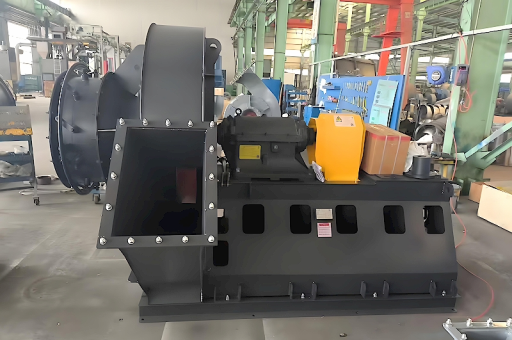
Industrial Exhaust Blower
- Type: Typically a Centrifugal Fan (Squirrel cage or Radial blade).
- Critical Specs: Must handle high temperatures (use a high-temp motor or belt-driven shaft to isolate the motor from heat). Must handle abrasive dust (cement dust is highly abrasive; you need a blower with an abrasion-resistant wheel or wear plates).
- Role: Creates negative pressure (draft) across the drying chamber. This lowers the boiling point of moisture and rapidly evacuates steam.
Materials (Cement & Drying)
- Cement (The product): If drying cement powder, you need a flash dryer or fluidized bed dryer, not a static oven. The blower velocity is critical to fluidize the powder without blowing it out.
- Cement (The structure): If using Refractory Cement or Furnace Cement to build the drying chamber or furnace lining:
- Hydraulic Setting: Most furnace cements require a controlled heat-up schedule (ramp-up) to drive off chemical water without spalling (cracking). The exhaust blower must be run at low speed initially to keep the temperature rise slow.
Key Engineering Challenges
A. Thermal Shock & Spalling
- Problem: If you put wet cement or a cold structure directly into the path of a foundry furnace exhaust without a blower managing the airflow, the rapid heat buildup causes steam explosion and cracking.
- Solution: The exhaust blower must be modulated (Variable Frequency Drive - VFD) to control the temperature rise rate.
B. Abrasion & Dust Control
- Problem: Cement dust is extremely fine and abrasive. It will erode standard blower fan blades in weeks.
- Solution:
- Use a Radial Tip or Paddle Wheel fan (less efficient but more resistant to wear).
- Install a cyclone separator or baghouse filter before the blower to strip out the cement dust. The blower only moves clean-ish air.
C. Material Halting (The "Plug" Risk)
- Problem: If the exhaust blower has too much suction, it can pull fine cement powder out of the dryer (dusting loss). If too little, the material doesn't dry. If the cement gets sticky (due to moisture), it can plug the ductwork.
- Solution: The system needs draft control (dampers or VFD) and sight glasses for visual monitoring.
Recommended System Sequence (Drying Cement Product)
- Pre-heat: Start the foundry furnace to a safe idle temperature (e.g., 250°F).
- Initiate Blower: Start the exhaust blower at low speed to create a gentle draft.
- Feed Material: Slowly introduce the wet cement material into the drying chamber (e.g., a rotary drum).
- Ramp Up: Increase furnace heat and blower speed in tandem. You want the outlet air temperature to be just above the boiling point of water (220°F - 250°F) until the "free" moisture is gone.
- Finish: Increase temperature to ~300°F - 400°F to drive off bound moisture if required (e.g., for curing refractory cement).
Summary Table
| Component | Function | Key Risk | Mitigation |
|---|---|---|---|
| Foundry Furnace | Heat Source | Overheating/Material Ruin | Use indirect heat or controlled ramp-up. |
| Exhaust Blower | Airflow & Moisture Removal | Abrasion (dust), Heat damage | Radial blade fan + VFD + Pre-filter. |
| Cement (Product) | Target for drying | Dust loss, Pre-hydration | Fluidized bed design + Lower temp ramp. |
| Cement (Structure) | Furnace lining | Cracking from steam | Controlled heat-up schedule (50°F/hour). |
Safety Note: Never allow a direct flame (from a foundry furnace burner) to impinge on cement powder if it contains organic binders or is finely dispersed. This creates a risk of explosion. The exhaust blower must be spark-resistant if there is any combustible dust.





