
This article's table of contents introduction:
- The Application: Why for a Fluidized Bed Boiler?
- Key Features of a Single Suction Centrifugal Fan for FBB
- Critical Specifications for Selection
- Common Challenges & Solutions
- Typical Manufacturers / Brands
- Summary Recommendation
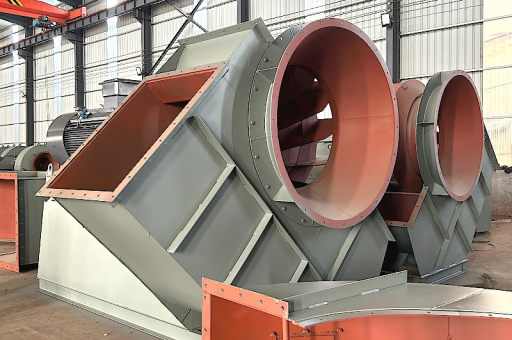
Based on your request, you are looking for a Centrifugal Cement Fan (Single Suction) specifically designed for a Fluidized Bed Boiler (FBB) . These are commonly referred to in the industry as Induced Draft (ID) Fans, Forced Draft (FD) Fans, or Primary Air (PA) Fans depending on their specific role in the boiler system.
Here is a technical breakdown of what that fan is, its specific application in a fluidized bed boiler, and key selection criteria.
The Application: Why for a Fluidized Bed Boiler?
In a Fluidized Bed Boiler (Circulating or Bubbling), the fan is critical for maintaining the "fluidized" state of the fuel (coal, biomass, or waste) and inert material (sand/ash).
- Primary Air Fan (PA Fan): Provides the high-pressure air required at the bottom of the furnace (through the air distributor plate/nozzles) to lift and suspend the fuel bed. This requires high static pressure but lower volume.
- Secondary Air Fan: Supplies air above the bed to ensure complete combustion of volatile gases. Requires medium pressure and volume.
- Induced Draft Fan (ID Fan): Sucks the flue gases out of the boiler furnace, through the heat exchangers, baghouse/ESP, and out the chimney. This fan handles hot, abrasive, and dusty gas. It must overcome the entire system's pressure drop.
The "Cement" aspect refers to the fan's construction material and design. Fluidized bed boiler flue gases contain high levels of fly ash and sand particles. "Cement" fans are engineered for high wear resistance, similar to fans used in cement plants handling raw meal or clinker dust.
Key Features of a Single Suction Centrifugal Fan for FBB
- Type: Usually Backward-Inclined (BI) or Backward-Curved (BC) blades.
- Why? These are non-overloading, highly efficient (for energy savings on continuous operation), and have good dust-handling characteristics.
- Alternative: Radial Blade or Paddle Wheel fans are used for extremely abrasive ash (high wear resistance) but are less efficient.
- Single Suction: Air enters from one side only. This is standard for most FBB fans because the air volumes, while large, do not require the complexity of a double-suction design (which is typically for very high volume, low-pressure applications).
- Housing: Heavy-duty steel plate. For high-temperature ID fans, the housing is often water-cooled or lined with refractory/ceramic coating.
- Impeller: Made of abrasion-resistant materials (e.g., HARDOX steel or NM400/NM500). Often fitted with replaceable wear plates or hard facing (chrome carbide) on the leading edges of blades.
Critical Specifications for Selection
When ordering or designing this fan for a fluidized bed boiler, you must provide:
| Parameter | Value / Description | Why it matters |
|---|---|---|
| Flow Rate (Q) | m³/h or CFM (at operating temperature) | Determines the fan size. |
| Total Pressure (Pt) | Pa or mmWG | Must overcome bed resistance, ductwork, and equipment. (FBBs have high pressure drop: ~7000-15000 Pa). |
| Temperature (T) | °C (e.g., 140°C for ID, 30°C for FD) | Determines the material expansion, bearing cooling, and motor power. (ID fans often handle 150°C - 200°C peaks). |
| Gas Composition | Air vs. Flue gas (SOx, NOx, dust load g/Nm³) | Determines corrosion resistance (SS304/316L) or abrasion protection. |
| Dust Load | g/Nm³ | Determines the need for wear liners and cleaning ports. |
Common Challenges & Solutions
- Abrasion: The ash in FBB flue gas is very hard (quartz/silica).
- Solution: Use of ceramic tiles or tungsten carbide coating on the impeller and volute tongue.
- Erosion: Uneven wear on the blade root.
- Solution: Inlet guide vanes (IGV) to control flow and reduce turbulence, or a wear-back plate.
- Vibration: Due to uneven ash buildup (fouling) on the rotor.
- Solution: Shaft-seal air purging to prevent dust ingress into the hubs and bearings.
- High Temperature: Flue gases can expand, causing the shaft to sag or bearings to overheat.
- Solution: Oversized bearings with forced lubrication, Labyrinth seals, and cooling fans on the shaft between the fan and bearing housing.
Typical Manufacturers / Brands
If you are sourcing this:
- Western Brands: Howden, Greenheck, New York Blower, TLT-Babcock.
- Asian/Chinese Suppliers: Sugico (Shanghai), Dongguan City Li Jie Fan Co., Shandong Tianrui Heavy Industry, Changzhou Hongxin Air Equipment (often listed on sites like Made-in-China for "Fluidized Bed Boiler Centrifugal Fan").
Summary Recommendation
For a Fluidized Bed Boiler, do not use a standard HVAC fan. You need a heavy-duty, abrasion-resistant, backward-inclined, single-suction centrifugal fan with a high-pressure rating.
Ask your supplier for: "Abrasion resistant ID fan for CFB boiler, single suction, temperature 160°C, with replaceable wear liners."
Would you like me to calculate an approximate power requirement (kW) or discuss the selection between an ID vs PA fan for your specific boiler size?





