
This article's table of contents introduction:
- What is its primary function?
- The System Connection
- Critical Design Challenges
- Common Types of Fans Used
- Key Components & Maintenance
- Failure Modes & Solutions
- Summary for an Operator or Engineer
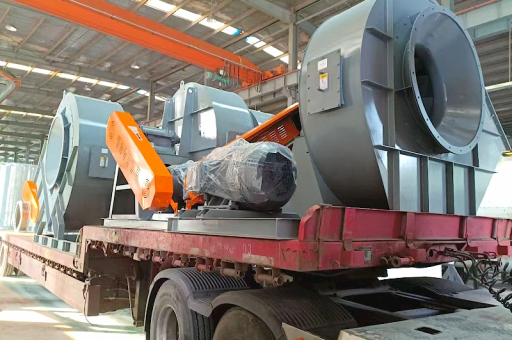
This is a great technical question. A Coal Fired Boiler Dust Collector Fan (often called the Induced Draft (ID) Fan or Baghouse Fan) is a critical component of a power plant or industrial boiler system.
Here is a comprehensive breakdown of what it is, how it works, its challenges, and its types.
What is its primary function?
The fan's job is not to blow air into the boiler (that's the Forced Draft/Forced Draft (FD) Fan's job). Its primary function is:
- To pull flue gas (the smoke and exhaust) out of the boiler.
- To force this gas through the dust collector (either an Electrostatic Precipitator (ESP) or a Baghouse/Fabric Filter).
- To overcome the pressure drop caused by the dust collector (which is very high due to the filters or plates).
- To discharge the cleaned gas into the atmosphere via the smokestack.
By doing this, it creates a negative pressure (vacuum) inside the boiler furnace, ensuring no dangerous, hot gas leaks out into the plant building.
The System Connection
The flow path is typically:
- Boiler Furnace (Combustion happens here)
- Air Preheater (Recovers heat)
- Dust Collector (ESP or Baghouse) ← The fan pulls gas through this
- Induced Draft (ID) Fan ← The Dust Collector Fan
- Stack/Chimney
Critical Design Challenges
This fan operates in a very hostile environment. Engineers must design for:
- Abrasive Dust: Unburned carbon, fly ash, and silica particles act like sandpaper. The fan blades (especially the leading edges) erode over time.
- Corrosive Gases: Sulfur dioxide ($SO_2$) and sulfur trioxide ($SO_3$) from the coal, when mixed with moisture, create sulfuric acid. This causes severe corrosion, especially at "acid dew point" temperatures.
- High Temperature: Flue gas is typically 120°C to 180°C (250°F to 360°F). In upset conditions (like a boiler bypass), temperatures can spike to 400°C+ (750°F+).
- High Pressure Drop: A modern Baghouse can have a resistance of 1500-2500 Pa (6-10 inches of water gauge). The fan must be powerful enough to overcome this.
- Large Volume: A single fan for a 500 MW coal plant must handle millions of cubic feet per minute of gas.
Common Types of Fans Used
| Type | Description | Best For |
|---|---|---|
| Radial (Radial Blade or Paddle Wheel) | Simple, rugged design. Blades are straight and radial. | Extremely abrasive dust (high erosion resistance). Low efficiency but very durable. |
| Backward-Curved / Backward-Inclined | Blades curve away from the direction of rotation. High efficiency. | Relatively clean gas after a well-performing ESP. Less tolerant of erosion. |
| Airfoil | Blades are shaped like airplane wings. Highest efficiency. | Clean gas applications (downstream of a very efficient precipitator). Very sensitive to erosion and dust buildup. |
Most common choice for dirty coal: Radial blade fans or Modified Radial fans with wear plates and hard-facing (ceramic coating or welding).
Key Components & Maintenance
- Rotors & Blades: Made of high-strength steel (e.g., Corten or HARDOX). Often have replaceable wear liners on the leading edges.
- Shaft & Bearings: Must be robustly sealed to prevent dust ingress. Sometimes use purged seals (clean air or nitrogen).
- Housing (Volute): The spiral casing that directs the gas flow. Also lined with wear-resistant material.
- Inlet Dampers (Guide Vanes): Used to control the fan's air flow (capacity control). These are often adjustable from 0-100% open.
- Drive System: Usually a large electric motor (thousands of HP/kW) connected to the fan via a coupling. Variable Frequency Drives (VFDs) are now common to save energy compared to dampers.
Failure Modes & Solutions
- Erosion of Blades:
- Cause: Fly ash impact.
- Solution: Ceramic tile lining, tungsten carbide coating, or using thicker "sacrificial" wear plates.
- Imbalance and Vibration:
- Cause: Uneven dust buildup on blades ("ash fouling").
- Solution: In-situ cleaning systems (water washing or compressed air lances). Online balancing.
- Bearing Failure:
- Cause: Heat, dust ingress, poor lubrication.
- Solution: Remote vibration monitoring, sealed/cooled bearings.
- Stalling (Surge):
- Cause: Operating the fan at too low an air flow for its design.
- Solution: Operating within a safe margin of the fan curve. Automatic anti-surge controls.
Summary for an Operator or Engineer
If you are troubleshooting a Coal Fired Boiler Dust Collector Fan:
- Check the pressure drop across the dust collector. If it's too high, the fan cannot move enough air.
- Check fan vibration. Sudden increase usually means blade erosion or heavy ash buildup.
- Check motor current (amps). A drop in amps with a drop in boiler load is normal. A drop in amps with high draft pressure means a failure (damper stuck, inlet blocked, or fan damage).
- Look for leaks. Air ingress between the dust collector and the fan reduces efficiency and causes condensation (acid).
In short: It is the workhorse of the emission control system. Without it, the boiler cannot operate safely, and pollution control is impossible.





