
This article's table of contents introduction:
- Deconstructing the Term
- Where is this exact combination used?
- Key Specifications to Look For (or request from a manufacturer)
- Common Configurations
- Summary
This is a request for a highly specific industrial equipment specification. It combines several critical performance and safety features into one unit. Let's break down what this description means, where it is used, and the key design considerations.
Deconstructing the Term
High Pressure
- What it means: This refers to the static pressure the blower can generate, typically measured in inches of water gauge (in. wg.), Pascals (Pa), or mmH₂O. For a "high pressure" centrifugal blower, this generally means pressures above 20 in. wg. (approx. 5,000 Pa), often ranging up to 40-80 in. wg. or more.
- Why it's needed: To overcome resistance in long duct runs, dense dust collection systems, pneumatic conveying lines, or processes with restrictive filters.
Forced Ventilation
- What it means: The blower is used in an active ventilation system, drawing fresh air into or exhausting stale/contaminated air out of a confined space (tank, vault, ship compartment, industrial room).
- Application Focus: It is not just for moving air; it is for safety by ensuring a controlled atmosphere, preventing the buildup of explosive gases, or providing breathable air.
Single Inlet
- What it means: Air enters the blower from one side only. This is the standard design for most forward-curved and backward-inclined centrifugal fans.
- Contrast: A "double inlet" (or double-width) fan draws air from both sides and is used for higher volume (CFM) applications at lower pressures. A single inlet is more common for high-pressure, lower-volume applications.
Centrifugal Blower
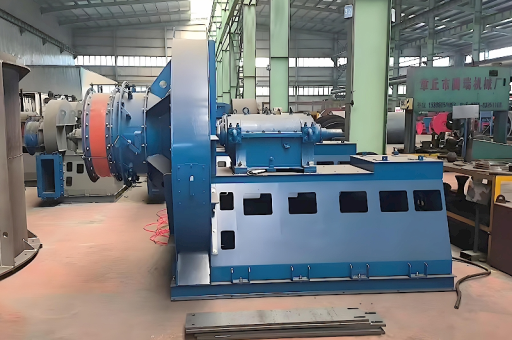
- What it means: The core technology. Air enters the center (eye) of a rotating wheel (impeller) and is flung outward by centrifugal force. The air then exits through a spiral-shaped housing (volute) which converts kinetic energy into pressure.
- Types for High Pressure:
- Backward-Curved/Inclined (BC/BI): Most efficient for high pressure. Impeller blades lean away from the direction of rotation. Non-overloading (motor won't burn out if duct is blocked). Most common for this spec.
- Airfoil (AF): Highest efficiency option. Blades are hollow and shaped like an airplane wing. Complex and expensive.
- Radial/Radial Tip (R/RT): Very robust, handles dust and particulate well. Moderate efficiency. Often used in pneumatic conveying.
Explosion Proofing
- What it means: This is the critical safety feature. It means the blower is designed and constructed to operate in hazardous (classified) locations without becoming a source of ignition.
- Key Design Elements:
- Non-Sparking Materials: Impeller and housing (or at least the impeller) are made of non-ferrous metals (aluminum, bronze) or special plastics. Steel-on-steel contact could create a spark.
- Spark-Restricting Gap: The clearance between the impeller and the inlet cone is designed to be close enough to prevent a particle from being trapped and heated, but wide enough to prevent a spark if the wheel rubs.
- Motor Certification: The motor must be a certified explosion-proof motor (e.g., UL, ATEX, IECEx). This motor is sealed to prevent internal sparks or hot surfaces from contacting the air stream.
- Grounding: Shaft grounding rings or conductive belts are used to bleed off static electricity buildup.
- Construction: The entire unit is typically built to prevent flame propagation. The housing is strong enough to contain an internal explosion.
Where is this exact combination used?
This specific configuration is a niche but essential product for the most demanding environments:
- Chemical & Petrochemical: Exhausting flammable vapors (solvents, hydrogen, methane) from reactors, storage tanks, and processing areas.
- Pharmaceutical: Handling volatile powders and solvents in fume hoods or for dust collection in hazardous zones.
- Oil & Gas: Ventilation of confined spaces on offshore platforms, refineries, and drilling sites.
- Mining: Forced ventilation of mine shafts where explosive methane gas (firedamp) or coal dust is present.
- Wastewater Treatment: Ventilating areas with methane, hydrogen sulfide, and other explosive/flammable gases.
- Paint Booths & Spray Finishing: The solvent-laden air is highly explosive.
- Shipbuilding & Marine: Ventilation of fuel tanks, engine rooms, and cargo holds.
- Bulk Material Handling (Combustible Dust): Moving grain, wood, sugar, metal powders (aluminum, magnesium) that can cause dust explosions.
Key Specifications to Look For (or request from a manufacturer)
If you are sourcing one, here are the critical parameters:
| Parameter | Description | Typical Value for "High P, X-Proof" |
|---|---|---|
| Pressure (SP) | Static Pressure | 20 - 80 in. wg. (5,000 - 20,000 Pa) |
| Flow (CFM) | Cubic Feet per Minute | 500 - 20,000+ CFM |
| Temperature | Max air temp allowed | -20°F to +200°F (or higher if special seals) |
| Hazard Class | Class, Division, Group (per NEC/CEC) | Class I, Div 1, Group C/D (for gases) or Class II, Div 1, Group F/G (for dust) |
| Material | Housing & Impeller | 304/316 SS, non-sparking aluminum bronze impeller in a steel housing (or all aluminum) |
| Motor | Explosion Proof | TEFC (Totally Enclosed Fan Cooled) or TENV, UL/ATEX listed for the specific zone |
| Surface Finish | Corrosion resistance | Epoxy paint, PTFE coating, or stainless steel |
Common Configurations
- Direct Drive: The motor is directly coupled to the impeller. Higher RPM for higher pressure. Less maintenance (no belts). More common for explosion-proof designs as it eliminates belt-static issues.
- Belt Drive: Allows for speed adjustment (change sheaves). Motor can be mounted outside the hazardous air stream (with a sealed shaft penetration). More flexible but requires belt tension monitoring.
Summary
You are describing a heavy-duty, safety-critical air mover. It is not a standard HVAC fan. It is an engineered piece of equipment for use where failure is not an option. The "explosion proof" aspect dramatically increases cost, complexity, and lead time, but is mandatory for compliance with regulations like NFPA 70 (NEC) , ATEX (in Europe) , or IECEx.
If you are writing a purchase order or spec sheet, you would likely phrase it as:
"High Pressure, Single Inlet, Centrifugal Blower, Arrangement 1 or 4, constructed with a non-sparking aluminum impeller inside a welded steel housing. Motor shall be ETL/UL listed for Class I, Division 1, Groups C & D. Complete unit shall be rated for 50 in. wg. at 5,000 CFM."





